Partner sessions at TC Sessions: Climate offer knowledge and insight

We’re just about two weeks away from our first foray into climate tech at TC Sessions: Climate & The Extreme Tech Challenge 2022 Global Finals on June 14 in Berkeley, California — with an online day to follow on June 16. It’s going to be an epic day all around for many reasons — did you know that Bill Gates is one of the featured speakers?

Don’t miss this opportunity to hear from and engage with the new wave of climate-tech entrepreneurs, early-stage founders, CEOs, scientists, researchers, engineers and the VCs who fund them.

You know what else you can’t afford to miss? Our 2-for-1 pass Memorial Day sale — it ends tonight at 11:59 pm (PT). Buy your pass now and save!

Pro Tip: Yes, TechCrunch editors will interview the leading voices in the fight against climate-change (check out the event agenda), but we’d be doing you a disservice if we didn’t remind you about our partner breakout sessions.

These expert-led, topic-specific partner sessions give you time to lean in, get more answers, discover new opportunities and connect with companies that support early-stage climate-tech startups. 

Take a look at this impressive group of partners and what they’ll discuss. They’re ready with knowledge and resources to help you build a successful startup.

Powering the Future Through Transformative Tech

This panel jumps into the breakthrough tech innovations that are transforming industries to build a radically better world. How can business, government, philanthropy, and the startup community come together to create a better tomorrow? Hear from these seasoned investors and industry veterans about how technology can not only shape the future, but also where the biggest opportunities lie. Sponsored by XTC.

Speakers:
Jamey Butcher (CEO & President, Chemonics International), Philipp Gruener (Global Head of Due Diligence, Decisive Capital Management SA), Victoria Slivkoff (Executive Managing Director, Extreme Tech Challenge), & Bill Tai (Angel Investor; Partner Emeritus CRV; Co-Founder, Extreme Tech Challenge)

Reducing your cloud computing climate impact

Making the choice to deploy to the cloud is clearly the better choice for the climate, but you can further reduce your emissions by taking a couple of key steps. You are invited to attend this session to learn more about how the tech community is helping to mitigate climate change and a simple strategy to reduce your carbon footprint in the cloud. Sponsored by Platform.sh

Speakers:
Fred Plais (Co-Founder & CEO, Platform.sh)

TC Sessions: Climate 2022 takes place on June 14 in Berkeley, California (with an online day June 16). Be sure to soak up the knowledge waiting for you in our partner breakout sessions. And don’t wait another second to buy your pass — the Memorial Day 2-for-1 sale ends tonight at 11:59 pm (PT). Go forth and save!

Is your company interested in sponsoring or exhibiting at TC Sessions Climate 2022? Contact our sponsorship sales team by filling out this form.


from https://ift.tt/7YAlhbW
via Technews
Share:

Perceptron: Risky teleoperation, Rocket League simulation, and zoologist multiplication

Research in the field of machine learning and AI, now a key technology in practically every industry and company, is far too voluminous for anyone to read it all. This column, Perceptron (previously Deep Science), aims to collect some of the most relevant recent discoveries and papers — particularly in, but not limited to, artificial intelligence — and explain why they matter.

This week in AI, researchers discovered a method that could allow adversaries to track the movements of remotely-controlled robots even when the robots’ communications are encrypted end-to-end. The coauthors, who hail from the University of Strathclyde in Glasgow, said that their study shows adopting the best cybersecurity practices isn’t enough to stop attacks on autonomous systems.

Remote control, or teleoperation, promises to enable operators to guide one or several robots from afar in a range of environments. Startups including Pollen Robotics, Beam, and Tortoise have demonstrated the usefulness of teleoperated robots in grocery stores, hospitals, and offices. Other companies develop remotely-controlled robots for tasks like bomb disposal or surveying sites with heavy radiation.

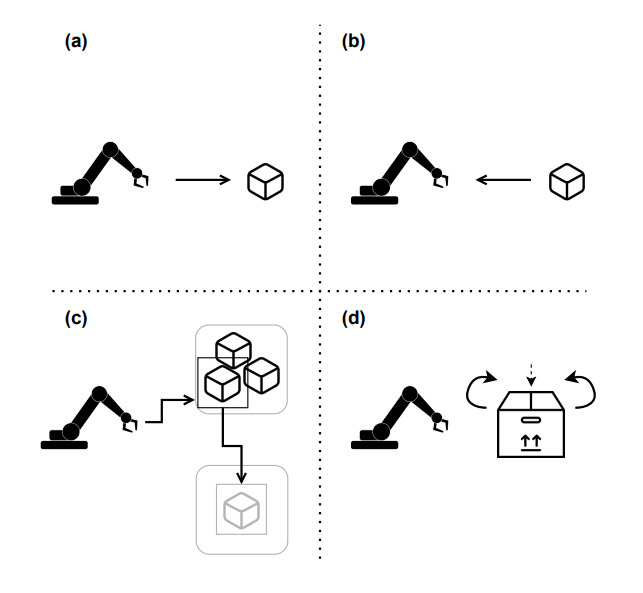
But the new research shows that teleoperation, even when supposedly “secure,” is risky in its susceptibility to surveillance. The Strathclyde coauthors describe in a paper using a neural network to infer information about what operations a remotely-controlled robot is carrying out. After collecting samples of TLS-protected traffic between the robot and controller and conducting an analysis, they found that the neural network could identify movements about 60% of the time and also reconstruct “warehousing workflows” (e.g., picking up packages) with “high accuracy.”
Teleoperations

Image Credits: Shah et al.

Alarming in a less immediate way is a new study from researchers at Google and the University of Michigan that explored peoples’ relationships with AI-powered systems in countries with weak legislation and “nationwide optimism” for AI. The work surveyed India-based, “financially stressed” users of instant loan platforms that target borrowers with credit determined by risk-modeling AI. According to the coauthors, the users experienced feelings of indebtedness for the “boon” of instant loans and an obligation to accept harsh terms, overshare sensitive data, and pay high fees.

The researchers argue that the findings illustrate the need for greater “algorithmic accountability,” particularly where it concerns AI in financial services. “We argue that accountability is shaped by platform-user power relations, and urge caution to policymakers in adopting a purely technical approach to fostering algorithmic accountability,” they wrote. “Instead, we call for situated interventions that enhance agency of users, enable meaningful transparency, reconfigure designer-user relations, and prompt a critical reflection in practitioners towards wider accountability.”

In less dour research, a team of scientists at TU Dortmund University, Rhine-Waal University, and LIACS Universiteit Leiden in the Netherlands developed an algorithm that they claim can “solve” the game Rocket League. Motivated to find a less computationally-intensive way to create game-playing AI, the team leveraged what they call a “sim-to-sim” transfer technique, which trained the AI system to perform in-game tasks like goalkeeping and striking within a stripped-down, simplified version of Rocket League. (Rocket League basically resembles indoor soccer, except with cars instead of human players in teams of three.)

Rocket League AI

Image Credits: Pleines et al.

It wasn’t perfect, but the researchers’ Rocket League-playing system, managed to save nearly all shots fired its way when goalkeeping. When on the offensive, the system successfully scored 75% of shots — a respectable record.

Simulators for human movements are also advancing at pace. Meta’s work on tracking and simulating human limbs has obvious applications in its AR and VR products, but it could also be used more broadly in robotics and embodied AI. Research that came out this week got a tip of the cap from none other than Mark Zuckerberg.

Simulated skeleton and muscle groups in Myosuite.

Simulated skeleton and muscle groups in Myosuite.

MyoSuite simulates muscles and skeletons in 3D as they interact with objects and themselves — this is important for agents to learn how to properly hold and manipulate things without crushing or dropping them, and also in a virtual world provides realistic grips and interactions. It supposedly runs thousands of times faster on certain tasks, which lets simulated learning processes happen much quicker. “We’re going to open source these models so researchers can use them to advance the field further,” Zuck says. And they did!

Lots of these simulations are agent- or object-based, but this project from MIT looks at simulating an overall system of independent agents: self-driving cars. The idea is that if you have a good amount of cars on the road, you can have them work together not just to avoid collisions, but to prevent idling and unnecessary stops at lights.

Animation of cars slowing down at a 4-way intersection with a stoplight.

If you look closely, only the front cars ever really stop.

As you can see in the animation above, a set of autonomous vehicles communicating using v2v protocols can basically prevent all but the very front cars from stopping at all by progressively slowing down behind one another, but not so much that they actually come to a halt. This sort of hypermiling behavior may seem like it doesn’t save much gas or battery, but when you scale it up to thousands or millions of cars it does make a difference — and it might be a more comfortable ride, too. Good luck getting everyone to approach the intersection perfectly spaced like that, though.

Switzerland is taking a good, long look at itself — using 3D scanning tech. The country is making a huge map using UAVs equipped with lidar and other tools, but there’s a catch: the movement of the drone (deliberate and accidental) introduces error into the point map that needs to be manually corrected. Not a problem if you’re just scanning a single building, but an entire country?

Fortunately, a team out of EPFL is integrating an ML model directly into the lidar capture stack that can determine when an object has been scanned multiple times from different angles and use that info to line up the point map into a single cohesive mesh. This news article isn’t particularly illuminating, but the paper accompanying it goes into more detail. An example of the resulting map is visible in the video above.

Lastly, in unexpected but highly pleasant AI news, a team from the University of Zurich has designed an algorithm for tracking animal behavior so zoologists don’t have to scrub through weeks of footage to find the two examples of courting dances. It’s a collaboration with the Zurich Zoo, which makes sense when you consider the following: “Our method can recognize even subtle or rare behavioral changes in research animals, such as signs of stress, anxiety or discomfort,” said lab head Mehmet Fatih Yanik.

So the tool could be used both for learning and tracking behaviors in captivity, for the well-being of captive animals in zoos, and for other forms of animal studies as well. They could use fewer subject animals and get more information in a shorter time, with less work by grad students poring over video files late into the night. Sounds like a win-win-win-win situation to me.

Illustration of monkeys in a tree being analyzed by an AI.

Image Credits: Ella Marushenko / ETH Zurich

Also, love the illustration.


from https://ift.tt/LwsfAgd
via Technews
Share:

One AI raises $8M to curate business-specific NLP models

Whether to power translation to document summarization, enterprises are increasing their investments in natural language processing (NLP) technologies. According to a 2021 survey from John Snow Labs and Gradient Flow, 60% of tech leaders indicated that their NLP budgets grew by at least 10% compared to 2020, while a third said that spending climbed by more than 30%.

It’s a fiercely competitive market. Beyond well-resourced startups like OpenAI, Cohere, AI21 Labs, and Hugging Face and tech giants including Google, Microsoft, and Amazon, there’s a new crop of vendors building NLP services on top of open source AI models. But Yochai Levi isn’t discouraged. He’s one of the co-founders of One AI, an NLP platform that today emerged from stealth with $8 million led by Ariel Maislos, Tech Aviv, Sentinel One CEO Tomer Wiengarten, and other unnamed venture firms and angel investors. 

“While the market is growing fast, advanced NLP is still used mainly by expert researchers, big tech, and governments,” Levi told TechCrunch via email. “We believe that the technology is nearing its maturity point, and after building NLP from scratch several times in the past, we decided it was time to productize it and make it available for every developer.”

One AI

Image Credits: One AI

Levi lays out what he believes are the major challenges plaguing NLP development. It’s often difficult to curate open source models, he argues, because they have to be matched both to the right domain and task. For example, a text-generating model trained to classify medical records would be a poor fit for an app designed to create advertisements. Moreover, models need to be constantly retrained with new data — lest they become “stale.” Case in point, OpenAI’s GPT-3 responds to the question “Who’s the president of the U.S.?” with the answer “Donald Trump” because it was trained on data from before the 2020 election.

Levi believes the solution is a package of NLP models trained for particular business use cases — in other words, One AI’s product. He teamed up with CEO Amit Ben, CPO Aviv Dror, and CSO Asi Sheffer in 2021 to pursue the idea. Ben previously was the head of AI at LogMeIn after the company acquired his second startup, Nanorep, an AI and chatbot vendor. Dror helped to co-found Nanorep and served as a platform product manager at Wix. Sheffer, a former data scientist at Nanorep, was the principal data scientist at LogMeIn. As for Levi, he was the VP of online marketing at LivePerson and the head of marketing at WeWork.

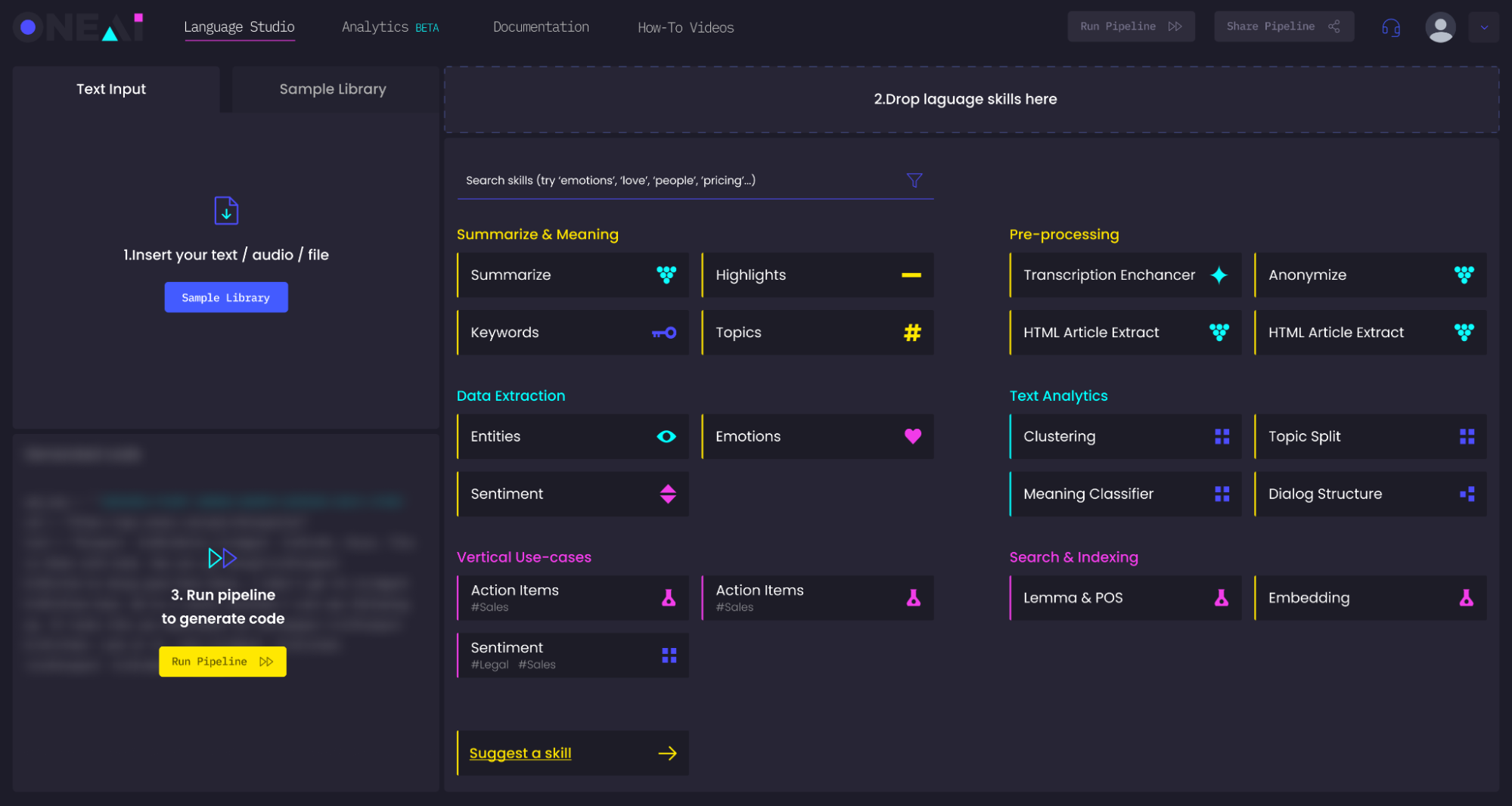
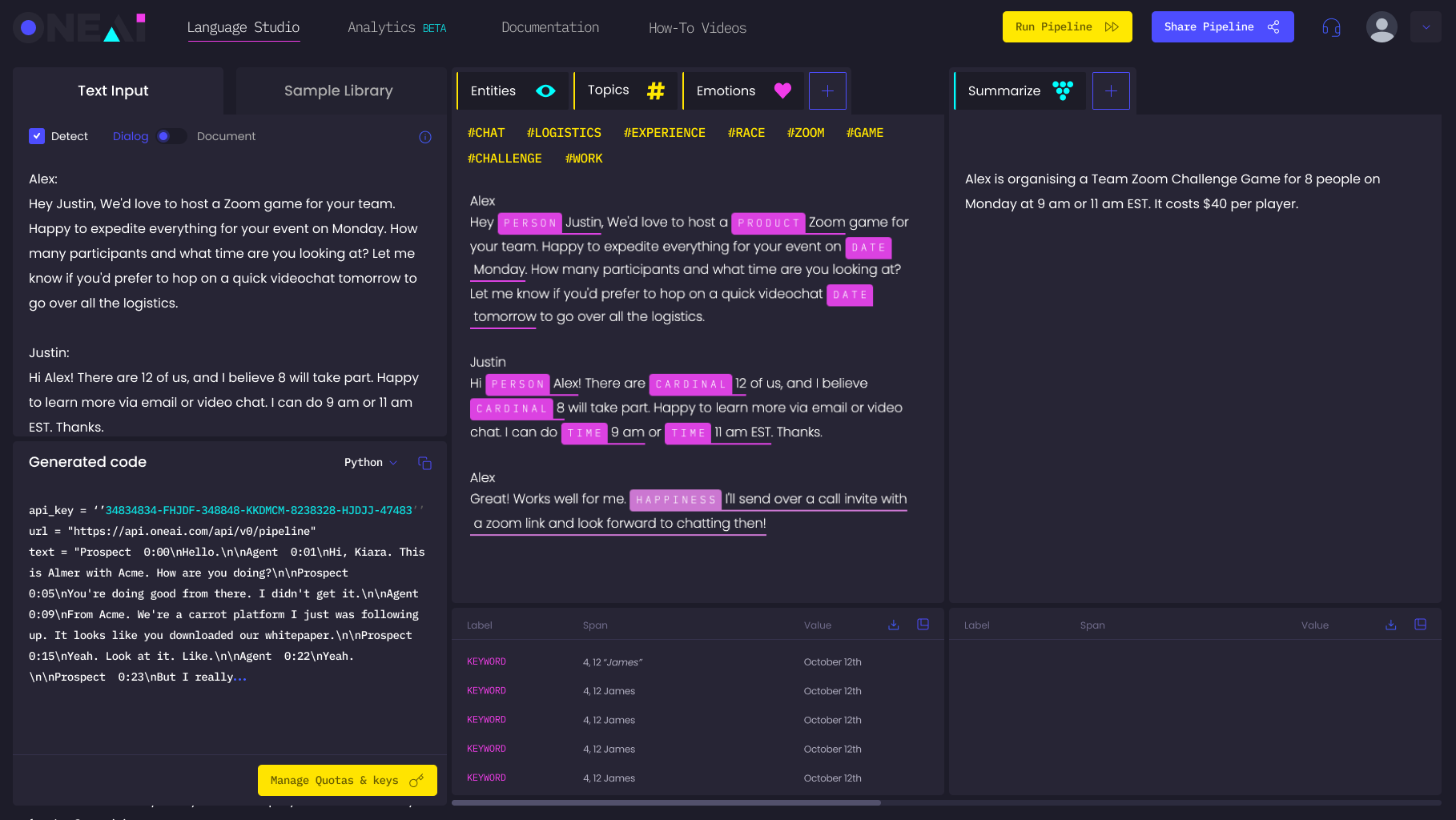
One AI offers a set of models that can be mixed and matched in a pipeline to process text via a single API call. Each model is selected and trained for its applicability to the enterprise, Levi said, and automatically matched by the platform to a customer’s task and domain (e.g., conversation summarization, sales insights, topic detection, and proofreading). One AI’s models can also be combined with open source and proprietary models to extend One AI’s capabilities.

The platform’s API accepts text, voice, and video inputs of various formats. With One AI’s language studio, users can experiment with the APIs and generate calls to use in code.

“With the maturation of Language AI technologies, it is finally time for machines to start adapting to us,” Ben told TechCrunch via email. “The adoption of language comprehension tools by the broader developer community is the way to get there.”

One AI

Image Credits: One AI

One AI prices its NLP service across several tiers, including a free tier that includes processing for up to one million words a month. The stackable “growth tier” adds 100,000 words for $1.

The hurdle One AI will have to overcome is convincing customers that its services are more attractive than what’s already out there. In April, OpenAI said that tens of thousands of developers were using GPT-3 via its API to generate words for over 300 apps. But, with Fortune Business Insights pegging the NLP market at $16.53 billion in 2020, it could be argued that there’s a large enough slice of the pie for newcomers.

Added TehAviv founder and managing partner Yaron Samid: “Language is the most valuable untapped resource, beyond the reach of most products and companies. This is true to most industries and domains and results in negative outcomes that include everything from lost sales, to lower levels of user engagement and loyalty, to reputation damage. Unleashing Language AI allows us to harness the power of this unstructured data and turn it into useful information and insights.”

One AI says that a portion of the seed round proceeds will be put toward expanding its 22-person team, which includes 10 NLP data scientists.


from https://ift.tt/rIXnLgK
via Technews
Share:

Ayoken raises $1.4M to grow its NFT marketplace for creatives

Ayoken, an NFT marketplace for creatives, has raised $1.4 million pre-seed funding to enable users grow their revenue streams through digital collectibles.

The startup’s marketplace, Ayokenlabs, will feature digital collectibles from musicians, sports brands and influencers from all-over the world.

Ayoken founder and CEO, Joshua King, told TechCrunch that the marketplace is a bridge between fans and artists, and gives supporters a sense of ownership in the success of their idols.

Through the NFT marketplace, he said, fans will have access to tokens such as behind-the-scenes videos and album art. NFT holders will also get other perks like access to unreleased music and exclusive live events by the creatives.

“Through VIP passes, fans will get the ability to actually livestream music by these artists before it arrives on Spotify, YouTube or Apple Music. Fans will get discounts for future events too,” said King, who has 14 years’ experience in strategy, growth and innovation consultancy, and entrepreneurship. His career includes helping scale AZA (Bitpesa), a Nairobi-based platform that leverages bitcoin to facilitate cross-border remittances, and where he first got introduced to crypto and blockchain technology.

King said Ayoken will over the next few months release NFTs of some major African artists, and others across the world.

The London-headquartered startup has already partnered with Ghanaian afrobeats artist KiDi (Dennis Nana Dwamena) for his first NFT drop on the first day of June. King said the cross-chain marketplace (although currently built on Avalanche blockchain) allows crypto and card payments, but plans to add mobile money – as the startup makes it easier for people in emerging markets like Africa to trade with ease. King said they are negotiating partnerships with a number of telcos in the continent to make this a reality.

“We are reducing friction points for the users by letting people use their cards instead of having to use crypto to buy, we are working on partnerships with telcos that will allow people to use mobile money to make the payment in future too. Nothing comes close to what we are doing and that is why we are able to sign some of the biggest names in the creative industry,” he said.

Users will get token (Ayo) rewards when they buy the NFTs or refer people, which they can redeem later for an NFT.

King said, unlike other NFT marketplaces, they have distribution partners including YouTubers, influencers, newsletters, crypto exchanges, and telecoms to promote NFT drops – allowing the creatives to tap a wider audience, and not just their fanbase.

“What this means is that celebrities do not have to rely on their social media following to drive transactions. They get instant access to millions of people all around the world at the touch of a button. And our approach is so different to any other NFC marketplace on the planet. we also have a marketing agency to help these creatives succeed in their first NFT drops,” said King.

“They (distribution partners) will get a revenue share based on any transactions generated on their social media promotions”.

Using the funds raised from the investors, among them Founders Factory Africa, Texas-based Kon Ventures, Europe-based venture capital collective Crypto League, Ghana-based R9C Ventures and Maximus Ventures, Ayoken plans to sign a number of exclusive deals with artists and partnerships with telcos, besides growing its team and secondary marketplaces.

“A majority of the funding will go into buying exclusive licenses and into building our tech team, that is the developers and engineers by fourfold,” he said.


from https://ift.tt/43oAmLJ
via Technews
Share:

Betastore gets $2.5M to solve stock-outs, financing challenges for informal retailers in West and Central Africa

About 80% of household retail in sub-Saharan Africa is delivered through informal channels, which perennially face several challenges like stockouts, leading to an instability in earnings, and a lack of attractiveness to financiers. These challenges befall millions of micro-retailers across the continent, and Betastore, a B2B retail marketplace for informal retailers, is working to resolve in Nigeria, Ivory Coast and Senegal.

The Betastore marketplace enables informal traders to source fast moving consumer goods (FMCGs) directly from manufacturers or distributors – which keeps the prices of the products competitive by eliminating interactions with sales agents. It also works with logistics partners to ensure the delivery of goods within 24 hours.

The Nigeria-based startup plans to provide these services beyond its current three markets by expanding to Ghana, the Democratic Republic of Congo and Cameroon by the end of this year, after closing $2.5 million in pre-series A funding from 500 Global, VestedWorld, and Loyal VC. Betastore has to date raised $3 million in funding.

“What is really important for us is to be able to continue to scale by leveraging our asset-light model. We plan to enter new markets before the end of the year and to expand to 100 cities across Nigeria, Ivory Coast and Senegal. We are also planning to reinforce our technology and leadership teams, and to bring in new products and to improve existing ones,” said Betastore CEO, Steve Dakayi-Kamga, who co-founded the startup with Leo-Armel Tchoudjang mid 2020.

The asset-light model means Betastore does not have any capital and labor intensive assets like warehouses or its own fleet of vehicles for delivery. Dakayi-Kamga said that this has helped the startup to optimize its technology to ensure that retailers source goods from the closest distributors. On average, a retailer using Betastore makes 4.4 orders per month.

“Our technology enables retailers to order on demand, access a variety of products and solves logistics headaches for them too. With Betastore, they don’t have to close their shops to go get goods from distributors stores or the market, and do not have to lose close to half of the margins in in the logistics,” said Dakayi-Kamga, who previously worked for Jumia, where he led the e-commerce platform’s logistics, warehousing and marketplace fulfillment department.

The B2B ecommerce platform is set to introduce financing in July, a launch that follows a pilot program involving 200 retailers that the startup carried out last year.

The BNPL financing strategy, Tchoudjang says, will be based on retailers’ sales and will go a long way in helping them to grow the value of their shopping baskets, and ultimately their businesses. The startup plans to charge an interest based on product margins.

Betastore is currently integrating its technology into a network of financing partners including fintechs and banks.

“The mandate of some of the partners we have on board is to support the economy by financing small businesses, but are not able to lend to them because they do not have the data to inform decisions. We have the visibility of what is happening in this sector, and have data they can use to extend financing,” said Tchoudjang, who previously held executive and leadership roles within the IFC-backed AccessHolding AG network in Africa. He has also helped multinationals rollout fintech and microfinance products for emerging markets in the past.

Retailers use the Betastore wallet to repay loans, deposit money for their operations, and to send, receive and save money.

“The wallet helps them separate their business money from their own money, and it is directly connected to the whole banking system, meaning that retailers can receive and send money to any bank, and load cash with any agency banking platform,” said Tchoudjang.

Since launch, the startup claims to have grown its customer base and revenues by 10 and 12 times, respectively. The startup anticipates greater growth especially after entering more countries and rolling out its buy now pay later (BNPL) product, as it taps the retail market in sub-Saharan, which was valued at $380 billion in 2021, contributing 20-50% of the region’s GDP on average.

“We want to simplify access to goods and services for the retailers and for the end consumer because we see the merchant as an agent able to make access to goods and services easier. We started out in Nigeria, and we are expanding within Francophone Africa on our way to being a pan African player,” said Dakayi-Kamga.

Amit Bhatti, the principal at 500 Global while commenting on the latest funding round said, “We believe Betastore’s talented team is creating market efficiencies that have the potential to boost the growth of Africa’s retailers. With Betastore, merchants can get greater transparency into wholesaler inventories and price points.”


from https://ift.tt/ax8v4VM
via Technews
Share:

Berlin-based B2B BNPL platform Mondu raises $43M Series A led by Valar in the US

Given the likely global recession, small businesses are reaching for new kinds of financing. Thus, the Buy Now Pay Later business model is now expanding into this B2B world at a rate of knots. Playter has raised backing to do this, as has Hokodo, Billie and Tranch, to name a few other players. But in Germany, B2B Payments company Mondu has emerged as a significant entrant to the market.

Mondu has now raised a $43M Series A round led by US-based venture capital fund Valar Ventures, and will use the funding to expand into more European countries later this year.

Previous investors Cherry Ventures, FinTech Collective, and tech entrepreneurs and senior executives from Klarna, Zalando, and SumUp, also participated. The company has now raised $57M to date.

Mondu’s BNPL for B2B solutions for merchants and marketplaces offers the main payment B2B payment options and flexible payment terms.

Malte Huffmann, Co-Founder and Co-CEO of Mondu, said in a statement: “The concept of BNPL isn’t new in the B2B world; offline business trade has enjoyed it for decades. But as more companies increasingly move to digital, the need for BNPL for B2B online will grow immensely. We are on the verge of a “digitalization boom”, and Mondu wants to be part of that revolution and drive innovation within the B2B payments space.”

Philipp Povel, Co-Founder and Co-CEO of Mondu, said there is a “$200Bn opportunity just in Europe and the US, which is bigger than the global consumer BNPL market.”

Since October 2021, Mondu has signed merchant customers across industries such as beauty, cleaning and manufacturing. One example is Ionto Comed, a manufacturer in the beauty sector that supplies salons.

Andrew McCormack, Founding Partner of Valar Ventures, commented: “BNPL for B2B sits at the intersection of three huge markets that are all in transition. The B2B payments market is immense, and its transition to digital has been accelerated over the past couple of years. The B2B eCommerce market is larger than B2C but is underserved by current offerings, and supply chain financing is a growing need, particularly for SMBs.”

Mondu will have to expand quickly. Berlin-based Billie has raised €138.2M so far, and Tranch in the UK has raised $5.6M.


from https://ift.tt/eufqKaR
via Technews
Share:

Indonesia’s Astro raises $60M to work on 15-minute grocery delivery

Indonesia’s sprawling archipelago has long been a headache for logistics companies, but there’s no lack of brave challengers. Jarkata-based Astro, which provides 15-minute grocery delivery, has recently closed a $60 million Series B financing round, lifting its total funding to $90 million since the business launched just nine months ago.

The Series B round was led by Accel, Citius and Tiger Global, with participation from existing investors AC Ventures, Global Founders Capital, Lightspeed and Sequoia Capital India. The company declined to disclose its post-money valuation.

The speed at which Astro is attracting investment goes to show the need for hefty upfront investment in the grocery delivery race, which is about establishing a logistics infrastructure quickly and locking in loyal customers ahead of rivals. Founded by Tokopedia veteran Vincent Tjendra, Astro plans to spend its funding proceeds on user acquisition, product development, and hiring more staff to add to its current team of 200.

As in many countries around the world, on-demand delivery got a boost during the COVID-19 pandemic in Indonesia. But e-grocery penetration in the country remains low and is estimated to be just 0.5% by 2022, compared to China’s 6% and South Korea’s 34% in 2020.

That means there’s a huge opportunity for companies like Astro that are trying to prove the convenience of online grocery ordering over brick-and-mortar visits. The e-grocery delivery market in Indonesia is projected to reach $6 billion by 2025.

Astro offers 15-minute delivery within a range of 2-3km through its network of rented “dark stores,” which are distribution hubs set up for online shopping only. The company has opted for a cash-intensive model, as it owns the entire user journey going from inventory sourcing, supply chain, mid-mile, to last-mile delivery. The benefit of this heavyweight approach is that it gets to monitor the quality of customer experience.

Astro currently operates in around 50 locations across Greater Jakarta, an area with 30 million residents, through a fleet of about 1,000 delivery drivers. Revenues grew more than 10x over the past few months and downloads hit 1 million, the company said.

The startup is competing with incumbents like Sayurbox, HappyFresh, and TaniHub to win over users. Its customers range from working professionals to young parents at home “who seek convenience,” said Tjendra.

Grocery delivery is notoriously cash-burning, but Tjendra reckoned margins will improve as the business scales. The company’s main source of revenue is the gross margin it earned from the goods sold and delivery fees customers pay. A large chunk of the business’s costs comes from delivery, which the founder believed “will come down over time as we deploy for hubs and subsequently reduce the delivery distance areas.”


from https://ift.tt/01y6zWX
via Technews
Share:

Popular Post

Search This Blog

Powered by Blogger.

Labels

Labels

Most view post

Facebook Page

Recent Posts

Blog Archive