


Who’s liable for AI-generated lies?

Who will be liable for harmful speech generated by large language models? As advanced AIs such as OpenAI’s GPT-3 are being cheered for impressive breakthroughs in natural language processing and generation — and all sorts of (productive) applications for the tech are envisaged from slicker copywriting to more capable customer service chatbots — the risks of such powerful text-generating tools inadvertently automating abuse and spreading smears can’t be ignored. Nor can the risk of bad actors intentionally weaponizing the tech to spread chaos, scale harm and watch the world burn.

Indeed, OpenAI is concerned enough about the risks of its models going “totally off the rails,” as its documentation puts it at one point (in reference to a response example in which an abusive customer input is met with a very troll-esque AI reply), to offer a free content filter that “aims to detect generated text that could be sensitive or unsafe coming from the API” — and to recommend that users don’t return any generated text that the filter deems “unsafe.” (To be clear, its documentation defines “unsafe” to mean “the text contains profane language, prejudiced or hateful language, something that could be NSFW or text that portrays certain groups/people in a harmful manner.”).

But, given the novel nature of the technology, there are no clear legal requirements that content filters must be applied. So OpenAI is either acting out of concern to avoid its models causing generative harms to people — and/or reputational concern — because if the technology gets associated with instant toxicity that could derail development.

Just recall Microsoft’s ill-fated Tay AI Twitter chatbot — which launched back in March 2016 to plenty of fanfare, with the company’s research team calling it an experiment in “conversational understanding.” Yet it took less than a day to have its plug yanked by Microsoft after web users ‘taught’ the bot to spout racist, antisemitic and misogynistic hate tropes. So it ended up a different kind of experiment: In how online culture can conduct and amplify the worst impulses humans can have.

The same sorts of bottom-feeding internet content has been sucked into today’s large language models — because AI model builders have crawled all over the internet to obtain the massive corpuses of free text they need to train and dial up their language generating capabilities. (For example, per Wikipedia, 60% of the weighted pre-training dataset for OpenAI’s GPT-3 came from a filtered version of Common Crawl — aka a free dataset comprised of scraped web data.) Which means these far more powerful large language models can, nonetheless, slip into sarcastic trolling and worse.

European policymakers are barely grappling with how to regulate online harms in current contexts like algorithmically sorted social media platforms, where most of the speech can at least be traced back to a human — let alone considering how AI-powered text generation could supercharge the problem of online toxicity while creating novel quandaries around liability.

And without clear liability it’s likely to be harder to prevent AI systems from being used to scale linguistic harms.

Take defamation. The law is already facing challenges with responding to automatically generated content that’s simply wrong.

Security research Marcus Hutchins took to TikTok a few months back to show his follows how he’s being “bullied by Google’s AI,” as he put it. In a remarkably chipper clip, considering he’s explaining a Kafka-esque nightmare in which one of the world’s most valuable companies continually publishes a defamatory suggestion about him, Hutchins explains that if you google his name the search engine results page (SERP) it returns includes an automatically generated Q&A — in which Google erroneously states that Hutchins made the WannaCry virus.

Hutchins is actually famous for stopping WannaCry. Yet Google’s AI has grasped the wrong end of the stick on this not-at-all-tricky to distinguish essential difference — and, seemingly, keeps getting it wrong. Repeatedly. (Presumably because so many online articles cite Hutchins’ name in the same span of text as referencing ‘WannaCry’ — but that’s because he’s the guy who stopped the global ransomeware attack from being even worse than it was. So this is some real artificial stupidity in action by Google.)

To the point where Hutchins says he’s all but given up trying to get the company to stop defaming him by fixing its misfiring AI.

“The main problem that’s made this so hard is while raising enough noise on Twitter got a couple of the issues fixed, since the whole system is automated it just adds more later and it’s like playing whack-a-mole,” Hutchins told TechCrunch. “It’s got to the point where I can’t justify raising the issue anymore because I just sound like a broken record and people get annoyed.”

In the months since we asked Google about this erroneous SERP the Q&A it associates with Hutchins has shifted — so instead of asking “What virus did Marcus Hutchins make?” — and surfacing a one word (incorrect) answer directly below: “WannaCry,” before offering the (correct) context in a longer snippet of text sourced from a news article, as it was in April, a search for Hutchins’ name now results in Google displaying the question “Who created WannaCry” (see screengrab below). But it now just fails to answer its own question — as the snippet of text it displays below only talks about Hutchins stopping the spread of the virus.
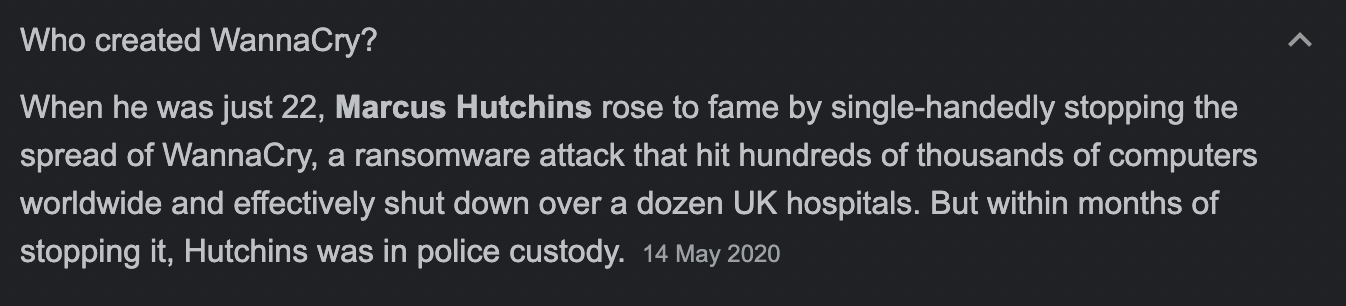
Image Credits: Natasha Lomas/TechCrunch (screengrab)

So Google has — we must assume — tweaked how the AI displays the Q&A format for this SERP. But in doing that it’s broken the format (because the question it poses is never answered).

Moreover, the misleading presentation which pairs the question “Who created WannaCry?” with a search for Hutchins’ name, could still lead a web user who quickly skims the text Google displays after the question to wrongly believe he is being named as the author of the virus. So it’s not clear it’s much/any improvement on what was being automatically generated before.

In earlier remarks to TechCrunch, Hutchins also made the point that the context of the question itself, as well as the way the result gets featured by Google, can create the misleading impression he made the virus — adding: “It’s unlikely someone googling for say a school project is going to read the whole article when they feel like the answer is right there.”

He also connects Google’s automatically generated text to direct, personal harm, telling us: “Ever since google started featuring these SERPs, I’ve gotten a huge spike in hate comments and even threats based on me creating WannaCry. The timing of my legal case gives the impression that the FBI suspected me but a quick [Google search] would confirm that’s not the case. Now there’s all kinds of SERP results which imply I did, confirming the searcher’s suspicious and it’s caused rather a lot of damage to me.”

Asked for a response to his complaint, Google sent us this statement attributed to a spokesperson:

The queries in this feature are generated automatically and are meant to highlight other common related searches. We have systems in place to prevent incorrect or unhelpful content from appearing in this feature. Generally, our systems work well, but they do not have a perfect understanding of human language. When we become aware of content in Search features that violates our policies, we take swift action, as we did in this case.

The tech giant did not respond to follow-up questions pointing out that its “action” keeps failing to address Hutchins’ complaint.

This is of course just one example — but it looks instructive that an individual, with a relatively large online presence and platform to amplify his complaints about Google’s ‘bullying AI,’ literally cannot stop the company from applying automation technology that keeps surfacing and repeating defamatory suggestions about him.

In his TikTok video, Hutchins suggests there’s no recourse for suing Google over the issue in the US — saying that’s “essentially because the AI is not legally a person no one is legally liable; it can’t be considered libel or slander.”

Libel law varies depending on the country where you file a complaint. And it’s possible Hutchins would have a better chance of getting a court-ordered fix for this SERP if he filed a complaint in certain European markets such as Germany — where Google has previously been sued for defamation over autocomplete search suggestions (albeit the outcome of that legal action, by Bettina Wulff, is less clear but it appears that the claimed false autocomplete suggestions she had complained were being linked to her name by Google’s tech did get fixed) — rather than in the U.S., where Section 230 of the Communications Decency Act provides general immunity for platforms from liability for third-party content.

Although, in the Hutchins SERP case, the question of whose content this is, exactly, is one key consideration. Google would probably argue its AI is just reflecting what others have previously published — ergo, the Q&A should be wrapped in Section 230 immunity. But it might be possible to (counter) argue that the AI’s selection and presentation of text amounts to a substantial remixing which means that speech — or, at least, context — is actually being generated by Google. So should the tech giant really enjoy protection from liability for its AI-generated textual arrangement?

For large language models, it will surely get harder for model makers to dispute that their AIs are generating speech. But individual complaints and lawsuits don’t look like a scalable fix for what could, potentially, become massively scaled automated defamation (and abuse) — thanks to the increased power of these large language models and expanding access as APIs are opened up.

Regulators are going to need to grapple with this issue — and with where liability lies for communications that are generated by AIs. Which means grappling with the complexity of apportioning liability, given how many entities may be involved in applying and iterating large language models, and shaping and distributing the outputs of these AI systems.

In the European Union, regional lawmakers are ahead of the regulatory curve as they are currently working to hash out the details of a risk-based framework the Commission proposed last year to set rules for certain applications of artificial intelligence to try to ensure that highly scalable automation technologies are applied in a way that’s safe and non-discriminatory.

But it’s not clear that the EU’s AI Act — as drafted — would offer adequate checks and balances on malicious and/or reckless applications of large language models as they are classed as general purpose AI systems that were excluded from the original Commission draft.

The Act itself sets out a framework that defines a limited set of “high risk” categories of AI application, such as employment, law enforcement, biometric ID etc, where providers have the highest level of compliance requirements. But a downstream applier of a large language model’s output — who’s likely relying on an API to pipe the capability into their particular domain use case — is unlikely to have the necessary access (to training data, etc.) to be able to understand the model’s robustness or risks it might pose; or to make changes to mitigate any problems they encounter, such as by retraining the model with different datasets.  

Legal experts and civil society groups in Europe have raised concerns over this carve out for general purpose AIs. And over a more recent partial compromise text that’s emerged during co-legislator discussions has proposed including an article on general purpose AI systems. But, writing in Euroactiv last month, two civil society groups warned the suggested compromise would create a continued carve-out for the makers of general purpose AIs — by putting all the responsibility on deployers who make use of systems whose workings they’re not, by default, privy to.

“Many data governance requirements, particularly bias monitoring, detection and correction, require access to the datasets on which AI systems are trained. These datasets, however, are in the possession of the developers and not of the user, who puts the general purpose AI system ‘into service for an intended purpose.’ For users of these systems, therefore, it simply will not be possible to fulfil these data governance requirements,” they warned.

One legal expert we spoke to about this, the internet law academic Lilian Edwards — who has previously critiqued a number of limitations of the EU framework — said the proposals to introduce some requirements on providers of large, upstream general-purpose AI systems are a step forward. But she suggested enforcement looks difficult. And while she welcomed the proposal to add a requirement that providers of AI systems such as large language models must “cooperate with and provide the necessary information” to downstream deployers, per the latest compromise text, she pointed out that an exemption has also been suggested for IP rights or confidential business information/trade secrets — which risks fatally undermining the entire duty.

So, TL;DR: Even Europe’s flagship framework for regulating applications of artificial intelligence still has a way to go to latch onto the cutting edge of AI — which it must do if it’s to live up to the hype as a claimed blueprint for trustworthy, respectful, human-centric AI. Otherwise a pipeline of tech-accelerated harms looks all but inevitable — providing limitless fuel for the online culture wars (spam levels of push-button trolling, abuse, hate speech, disinformation!) — and setting up a bleak future where targeted individuals and groups are left firefighting a never-ending flow of hate and lies. Which would be the opposite of fair.

The EU had made much of the speed of its digital lawmaking in recent years but the bloc’s legislators must think outside the box of existing product rules when it comes to AI systems if they’re to put meaningful guardrails on rapidly evolving automation technologies and avoid loopholes that let major players keep sidestepping their societal responsibilities. No one should get a pass for automating harm — no matter where in the chain a ‘black box’ learning system sits, nor how large or small the user — else it’ll be us humans left holding a dark mirror.


from https://ift.tt/BxPNgJi
via Technews

Share:

Former OpenSea exec arrested and charged with insider trading of NFTs

A top former executive at the highly valued NFT startup OpenSea was arrested Wednesday and charged “with wire fraud and money laundering in connection with a scheme to commit insider trading,” according to a press release from the U.S. Attorney’s Office in the Southern District of New York (SDNY).

TechCrunch previously covered the firing of former OpenSea Head of Product Nate Chastain. Chastain was accused of front-running purchases of NFT collections that he knew were about to be featured prominently on the homepage of OpenSea. His actions were discovered by other NFT buyers who analyzed his transactions on the Ethereum blockchain.

OpenSea soon fired Chastain after they determined the allegations were legitimate, though Chastain has continued to be active in the NFT community, especially on Twitter. The startup has noted that it didn’t have specific policies in place prohibiting this type of behavior beforehand but has since enacted new employee rules.

OpenSea was most recently valued at $13.3 billion by investors including Andreessen Horowitz, Paradigm and Coatue.

The Justice Department and SDNY U.S. Attorney’s Office have begun getting more active in prosecuting crypto crimes, but the NFT space has largely evaded much action, which made the announcement a bit of a shock to those in the crypto space.

“NFTs might be new, but this type of criminal scheme is not. As alleged, Nathaniel Chastain betrayed OpenSea by using its confidential business information to make money for himself. Today’s charges demonstrate the commitment of this Office to stamping out insider trading — whether it occurs on the stock market or the blockchain,” said U.S. Attorney Damian Williams in the press release.

We’ve reached out to OpenSea for comment.


from https://ift.tt/Ht3N6Bz
via Technews
Share:

Last April, Google launched Grow with Google Career Readiness for Reentry, a program created in partnership with nonprofits to offer job readiness and digital skills training for formerly incarcerated individuals. As a part of an expansion, Google today announced that it’ll invest just over $8 million in organizations helping “justice-impacted” individuals, including the formerly incarcerated, enter the workforce.

Continuing its work with nonprofits including The Last Mile, Center for Employment Opportunities (CEO), Defy Ventures, Fortune Society, and The Ladies of Hope Ministries, Google says that $4 million of the new roughly $8 million it’s investing will go toward Grow with Google Career Skills, aiming to help people impacted by the justice system develop career specializations. Nonprofits with which Google hasn’t previously collaborated will be able to apply for up to $100,000 in grants to “offer Google’s reentry skills training to their community.”

Meanwhile, Google.org, Google’s charitable arm, will provide $4.25 million in grants to assist state governments in reducing barriers to employment with Code for America’s Clear My Record tool, which uses an open source algorithm to review records and produce clearance motions. Other grants from Google.org will focus on connecting “justice-impacted” people with jobs through the National Urban League’s Urban Tech Jobs Program and Columbia University’s Justice through Code.

In an email interview with TechCrunch, Maal Ibrahim, racial and criminal justice lead at Google.org, said that it was always Google’s intention to bring the Career Readiness for Reentry program to scale. “There’s a real urgency to this work — more than 640,000 people are released from prison each year in this country, and nearly all of them could benefit from the digital skills and job readiness training we’re offering through our partners,” he added. “We co-created the program with five nonprofits who have a track record of successfully developing and delivering high-quality job training to returning citizens. After implementing the program in 2021 and getting partner feedback, we saw what works really well and how we can have more impact.”

The formerly incarcerated community faces many challenges, including a lack of digital skills. Inmates can go well over a decade without access to technologies like smartphones and only limited familiarity with the internet. For example, U.S. Department of Education data from 2014 showed that 62% of correctional educational programs in the country didn’t allow prisoners access to the internet.

Searching for jobs or making a resume using web tools is beyond the knowledge of some former inmates. According to a recent University of Kansas study, many women coming out of prison struggle with basic skills like protecting their online privacy. This lack of literacy, too, hinders ex-prisoners’ ability to take advantage of government services, which often require online applications.

Ibrahim asserts that programs like Career Readiness for Reentry can make a difference with a curriculum that’s designed to be integrated into the programming of nonprofit partners. “Given Google’s technological expertise, one of our focus areas is helping people learn digital skills,” he said. “[W]e believe that companies, nonprofits, and government working together can be a powerful force for good. That’s what we’re trying to facilitate here.”

Studies have shown that digital literacy can reduce recidivism, or relapse into crime. But there’s some reason for skepticism. When asked how many of the 10,000 formerly incarcerated people reached by Career Readiness for Reentry programming last year found a job, Ibrahim demurred.

Stymying efforts was the pandemic, which forced several of Google’s partner organizations including The Last Mile and Defy Ventures to shift from in-person to remote instruction. A Google spokesperson later told TechCrunch that, out of a survey of 400 Career Readiness for Reentry participants, 75% reported they had a job or were enrolled as a student somewhere by the end of the program.

Ibrahim argues the expanded program has the potential to make a lasting impact via a new embedded team of Google.org fellows who will work with nonprofits or civic organizations to build “tech solutions.” One of their first projects is an “end-to-end” automatic record clearance service built on top of the existing Clear My Record that they’ll work with Code for America to design, pilot, and implement.

Google’s lofty goal is to help 100,000 formerly incarcerated people build career skills by 2025. To achieve this, the tech giant will have to facilitate a massive expansion of access to digital literacy programs across federal and state penitentiaries. Underlining the challenge, New York State offered three programs with some degree of digital literacy training that capped out at 1,400 seats combined as of March 2020. There are over 77,000 people incarcerated in New York across the state and New York City correctional systems.

“Criminal records for many can be a life sentence to poverty, creating barriers to jobs, housing, education, and more,” Ibrahim said. “There are so many great organizations out there doing work in this space, but we know that no one organization will reach everyone in need … As we continue to refine and evaluate this work, we hope that we will be able to scale it further in the coming years.”


from https://ift.tt/U2ozBiY
via Technews
Share:

Boundary Layer wants to steal air freight’s lunch and transport it by water instead

If you’ve ever spent time writing beat poetry about container ships chugging their way into and out of harbors, “nimble” or “fast” will be unlikely to make it into your finely crafted written words. And if your (admittedly increasingly esoteric) poetic bent is more of an air freight persuasion, it’s likely that “affordable” was not in your lexicon. Boundary Layer is working on a series of electrically propulsed hydrofoiling vessels and wants to rewrite the book of transportation-focused verse, one stanza at a time, with nimble, fast-to-load, container-ship standard high-speed shipping vessels, with the goal of halving the cost of traditional air freight, at comparable speeds.

The company raised $4.8 million from Lower Carbon Capital, Fifty Years and Soma Capital, and already has $90 million in pre-orders from ferry operators for their 220-seat electric passenger vessels. The passenger ships are but a launchpad before the company goes after its real goal: the freight market. I spoke with Boundary Layer’s CEO and founder, Ed Kearney, who told me that these early vessels are a launchpad to enter the $100 billion air freight market with a high-speed hydrogen-powered container ship.

“We applied to Y Combinator and were accepted. We told the partners in the interview that if we were accepted into Y Combinator, we would come to the Bay Area, and we’d build a hydrofoil container ship that carries one container,” says Kearney. The Y Combinator team called bullshit, he tells me. The team rolled up their sleeves and got to work. “We turned up with some hand tools in our luggage, no workshop, nowhere to live, and started building. Ten weeks later, we managed to build this hydrofoil. We spent $150,000 on it, which happened to be exactly the amount of money that YC gives you. We parked out in front of the demo day facility and it made a bit of an impact.”

It’s easy to see how; the company’s prototype ship — and the video it produced to show it off — looks pretty slick:

The challenge with hydrofoiling, of course, is that you need a fair bit of energy to get the ship’s hull out of the water — and that’s harder the heavier the ship gets. The world’s largest cargo ships can transport some 24,000 containers in one go. Needless to say, those behemoths aren’t going to casually lift their hulls out of the water — but that’s also not what the company is competing with.

“The physics [of hydrofoiling] is very similar to that of an aircraft. The amount of the lift-to-drag ratio that you get with modern materials on a hydrofoil wing these days are about the same as what you can get from a traditional airplane. So the amount of power you need to make a vehicle have the same amount of mass takeoff is also kind of comparable. Also the amount of thrust you need scales with speed,” Kearney explains. “An aircraft travels at 500 knots — we travel 40 — but they still need 12 times more power. In a nutshell, the way we solved it was by taking a smaller vessel, you get very weight-conscious, and you need a large amount of power. That means we need big fuel cells and batteries.”

The company’s vision is not to replace conventional ocean freight, the freight rates — that would be madness; the price of ocean freight is incredibly low, which is why around 90% of all goods consumed in the world are shipped this way. The company tells me that the local trucking — which takes the container the last few hundred miles of its journey — can be more expensive than the 6,000-mile ocean journey.

“We will be making container ships, but we’re not competing with container ships. We are replacing air freight. Think of components and other goods they are shipping by air freight. They are already paying very high freight rates of $2-3 per kilogram,” Kearney explains. “Inter Asia is the most exciting market for us, because it’s the biggest market in terms of air freight. Those customers already have very high-value goods that need to move quickly and we’re able to offer them an alternative to air freight that’s half the price and comparable transit times.”

The battery pack on Boundary Layer’s prototype clocks in at 95 KWh and 415 Volts — very similar to what you might find in a high-end performance electric car (the Tesla Model 3 Performance packs an 82 kWh 350 V lithium-ion pack, for example). Image Credits: Boundary Layer

Of course, a plane is going to out-fly a ship cruising at sea every day of the week, but Boundary Layer believes that high speed and the use of standard containers makes it competitive. The crux of the matter is that containerized transportation can make shipping an order of magnitude more efficient. A manufacturer in Taiwan can fill a 20- or 40-foot container with whatever they need to ship, put it on a truck, move it to one of Boundary Layer’s high-speed container ships, then put it on a truck in North Korea and have it delivered to the assembly plant. All of this can happen without unloading and re-loading the container — which can be locked and sealed for the whole journey. When shipping by air, even if the goods are on pallets, the company claims there are significant inefficiencies.

If you really want to nerd out about why containerized commerce is such a benefit, there’s an incredible eight-part podcast series that’ll have you transfixed for a few hours. One for the transportation nerds. Anyway — back to Boundary Layer…

“We’ve got three Fortune 500 companies as launch partners — one is in the electronics space, one in the automotive supply and one is in the electronic equipment space,” claims Kearney, who declined to name the companies for now, but claims those three partners have $26 million worth of letters of intent (LOI), and an additional $60 million in pre-orders for the passenger ferries, spanning the world: “The passenger ferry customers will be announced soon, but they’re all over the world, including the Mediterranean, the US, as well as the Caribbean”

Boundary Layer created a video to show off its passenger ferry:

The company makes a big deal out of its vehicles being zero-emission.

“All our vessels will be zero-emissions, and propulsion ultimately comes from electric motors. The passenger ferry will just have lithium-ion batteries powering the electric system,” says Kearney. “For the container ship, we need to have a range of 1,500 nautical miles. Batteries only really get you to about 100 nautical miles, so for cargo, we are doing liquid hydrogen. That will even get us to 10,000 nautical miles if you wanted to have very large tanks. The electric system between the passenger ferry and the cargo ship will be identical. What differs is where the electrical power comes from.”


from https://ift.tt/BdUKf5i
via Technews
Share:

The US is about to get serious about EVs

For most of the last decade, Americans largely ignored electric vehicles. Some brands sold decent numbers, like the Chevy Bolt or Nissan Leaf, but they were largely targeted at thrifty commuters or EV diehards. Others, like the Ford Focus Electric, were intended only to comply with laws that mandated a small number of EV sales. Still others, like the early Tesla models, were desirable but out of reach for most people.

In the last couple of years, though, automakers have dropped their resistance and consumers have likewise let go of their indifference. New technology adoption often follows an S-curve, where people are slow to embrace it at first but then rush in once a tipping point is reached. EVs appear to be at that inflection point today: Car buyers snapped up nearly twice as many plug-in vehicles last year as they did the year before.

The sudden surge has observers wondering whether the pace can be maintained, especially in the U.S. Their concern isn’t misplaced: Apart from Tesla’s factories, the U.S. doesn’t have significant EV or battery manufacturing infrastructure, at least not yet. And in terms of publicly available chargers, we have fewer per road-going EV than any country but Norway, where the public’s sudden embrace of EVs has led to a wave of new registrations, according to a recent International Energy Agency report.

Innovation may help position U.S. battery makers to be more independent of Chinese supply chains, an agenda that’s been top-of-mind for many manufacturers.

The U.S. may seem behind, but is it hopelessly so? Can the country pull a rabbit out of the hat? It’s happened before, of course. The U.S. didn’t invent the automobile — that honor goes to Germany’s Karl Benz — but it did produce the Model T, which helped the country take the lead in the adoption of the automobile.

Neither was the Interstate Highway System the first controlled-access highway network, but today it’s far more extensive than the Autobahn, and until a decade ago, was the most extensive in the world. The trend holds outside transportation, too — Americans didn’t embrace mobile phones at first, but subscription rates continue to grow domestically while they’ve plateaued or dropped in more zealous countries.

It’s not guaranteed, but there are plenty of reasons why the U.S. has a good chance of catching up in the race. And if it does, it’ll mean plenty of opportunities for investors, especially on the infrastructure side.


from https://ift.tt/tzErFsn
via Technews
Share:

Plenty of opportunities for students at TC Sessions: Climate

Calling all climate-change warriors! If you’re determined to join the new wave of entrepreneurs fighting the climate crisis, don’t miss TC Sessions: Climate on June 14 in Berkeley, California with an online day on June 16. Hear from and engage with some of the climate world’s leading scientists, researchers, founders, CEOs, investors and iconic leaders — including Bill Gates.

This one-day deep dive offers plenty of benefits for students.

  • First off, affordability. Discounted student passes cost $45 each.
  • Network your way to post-college employment at the conference and at the SOSV Climate Tech Meetup. Note: This networking event takes place the day before TC Sessions: Climate.
  • Learn from thought leaders, founders and operators in climate tech, CSR, ESG and sustainability. Have you seen this list of heavy hitters? While you’re at it, take a look at the agenda.
  • Understand how America plans to achieve net-zero carbon emissions by 2050. U.S. Energy Secretary Jennifer Granholm will speak at the online event on June 16. 
  • Apply to compete in the TC Sessions: Student Pitch Competition (Powered by Blackstone LaunchPad). Read all about it here. The prize? A free pass to Disrupt 2022 and hotel accommodations in San Francisco.

Basically, we’re saying that for $45, you can set your climate career aspirations on a faster, sustainable track — and help humanity in the process. Everybody wins.

TC Sessions: Climate takes place on June 14 in Berkeley, California with an online day on June 16. Buy your student pass today. Who knows? You might score a terrific internship or even win a ticket to Disrupt 2022, plus a hotel for three nights.

What are you waiting for?

Is your company interested in sponsoring or exhibiting at TC Sessions Climate 2022? Contact our sponsorship sales team by filling out this form.


from https://ift.tt/MjPfVdR
via Technews
Share:

Dear Sophie: How do we qualify for each of the O-1A criteria?

Here’s another edition of “Dear Sophie,” the advice column that answers immigration-related questions about working at technology companies.

“Your questions are vital to the spread of knowledge that allows people all over the world to rise above borders and pursue their dreams,” says Sophie Alcorn, a Silicon Valley immigration attorney. “Whether you’re in people ops, a founder or seeking a job in Silicon Valley, I would love to answer your questions in my next column.”

TechCrunch+ members receive access to weekly “Dear Sophie” columns; use promo code ALCORN to purchase a one- or two-year subscription for 50% off.


Dear Sophie,

Our startup will be sponsoring my co-founders and me for O-1A visas.

How do we qualify for each of the O-1A criteria?

— Extraordinary Entrepreneur

Dear Extraordinary,

What an exciting journey for you and your co-founders — the O-1A is a great option to enable you to grow your startup and take control of your geographical destiny.

Earlier this year, immigration officials clarified and expanded the types of evidence that meet the requirements for the O-1A extraordinary ability visa, making it more accessible for individuals to qualify. As always, I recommend that you consult with an immigration attorney who can help you and your co-founders devise an immigration strategy and backup plans, if needed.

To qualify for an O-1A, an individual must either have received a major international award, such as a Nobel Prize, or meet at least three of the following eight criteria. Strong cases typically meet four or more of these criteria, backed by extensive letters of recommendation as well as other documentary evidence:

Taking the prize

Nationally or internationally recognized awards

You must demonstrate that you’ve received nationally or internationally recognized awards — typically two or more — for excellence in your field.

In January 2022, the Biden administration announced new efforts to attract and retain STEM talent in the United States. That prompted immigration officials to expand the achievements that qualify as nationally or internationally recognized awards for the O-1A.

Here are a few examples of what can now qualify as an award for excellence:

  • Receiving a Ph.D. scholarship or doctoral dissertation award.
  • Securing venture capital funding.
  • Winning a national or international startup pitch competition or hackathon.
  • Professional association awards.
  • Awards for presenting at internationally or nationally recognized conferences.

Exclusive membership

Invitation to join a group or association that demands outstanding achievements

This criterion requires you to show you’ve been invited to join a group or association that demands outstanding achievements of its members and is judged by recognized experts. This cannot be a membership that is only based on the payment of a fee or subscription to join, or one based on the level of education or the years of experience in a field or is a requirement for employment, such as union membership.

A composite image of immigration law attorney Sophie Alcorn in front of a background with a TechCrunch logo.

Image Credits: Joanna Buniak / Sophie Alcorn (opens in a new window)

Some examples that will serve to strengthen your O-1A application include:

  • Fellow-level membership in an association or organization in your field, such as the Institute of Electrical and Electronics Engineers (IEEE) or the Association for the Advancement of Artificial Intelligence (AAAI).
  • Invitation to join a scientific committee or entrepreneurship club.
  • Acceptance into accelerators or incubators, such as Y Combinator (although probably not YC Startup School), Founders Network or Techstars.
  • Membership in, or a fellowship with, organizations such as Forbes Councils or On Deck.
  • Invitation to be an adviser or mentor to an individual startup or through an accelerator or incubator.

It is important to note that the group, organization or association you join or work with must relate to your field of expertise.


from https://ift.tt/uyTm0Ls
via Technews
Share:

Popular Post

Search This Blog

Powered by Blogger.

Labels

Labels

Most view post

Facebook Page

Recent Posts

Blog Archive