



TechCrunch Podcasts this week: Layoffs, the crypto downturn, investor offense, and Columbus, Ohio

TechCrunch is more than just a site with words. We’re also building a growing stable of podcasts focused on the most critical topics relating to the startup and venture capital worlds. To help you find the right show for your interests, we’ve compiled our audio output from the week.

Embedded below is the latest from Chain Reaction, our new and stellar crypto-focused podcast hosted by Lucas and Anita. You will also find Found, a long-form bit of work that goes deep on the real saga of company formation, from Jordan and Darrell. There’s an audio-only version of TechCrunch Live hosted by Matt that features founders and investors discussing successful pitch decks. Finally, there’s Equity, TechCrunch’s long-running, Webby-award-winning podcast focused on venture capital and the latest startup news, hosted by Natasha, Mary Ann and Alex.

And if you are more into the written over the spoken word, well we have newsletters on the above topics as well.

TechCrunch Podcast

Episode 3: Why do people keep giving Adam Neumann money? And other TechCrunch news

Welcome back to The TechCrunch Podcast where you’ll hear everything you need to know about the week’s top stories in tech from the people who wrote them. This week our host, Managing Editor Darrell Etherington, talks with Natasha Mascarenhas about the ongoing tech layoffs, Anita Ramaswamy about WeWork founder Adam Neumann moving into the crypto space with backing from a16z, And Devin Caldewey about AI-generated images.  Plus a rundown of the week’s top news on TechCrunch.

Articles from the episode:

Other news from the week:

Extras:


The TechCrunch Live Podcast

Episode 6: How Olive pivoted 27 times on its way to be worth $4 billion

Olive is a homegrown Columbus, Ohio unicorn; hear from the CEO and lead investor how the company was founded and grew into an industry leader.

Sean Lane co-founded Olive in 2012, and signed on Chris Olsen from Drive Capital as the company’s first investors. Now, nearly 10 years later, Olive has raised $856.3 million on its way to being a driving force in using artificial intelligence in the healthcare industry. But the company’s path to success wasn’t a straight line. As CEO Sean Lane explains on this special TechCrunch Live event, the company pivoted 27 times before finding its current product market fit.

Lane explains the strategy behind changing a company’s direction and the emotional toil it takes on everyone involved — from employees to executives to the investors.

Want to watch the panel: Here’s the YouTube video.


Chain Reaction

Episode 8: Outdoor Voices’ founder on scaling a new crypto startup in a downturn (with Ty Haney)

Welcome back, this week Lucas and Anita argue about Coinbase’s latest management strategies, whether Do Kwon being called the new Bernie Madoff is a fair comparison, and why the OnlyFans founder is the latest web2 entrepreneur pivoting to crypto.

In their interview this week, Anita and Lucas chat with Ty Haney. Haney is the founder of athleisure empire Outdoor Voices, though she’s recently departed the company to start a new effort around getting brands to embrace NFTs. We chatted with her about founding a crypto startup in a downturn, keeping her company well-capitalized and how she pivoted from yoga pants to non-fungible tokens.

Subscribe to the Chain Reaction newsletter to dive deeper: https://techcrunch.com/newsletters

Helpful links:


Found

Episode 60: Claire Coder, Aunt Flow

Claire Coder, founder and CEO of Aunt Flow joined us on Found Live. Darrell, Jordan, and Claire got into how she landed on a B2B model for Aunt Flow and the importance of free, accessible period products– which is something she often has to educate prospective investors or customers on. Claire also opened up about how she has grown as a leader, learned to listen to feedback from her team, and improve the culture at Aunt Flow.  And don’t forget to hear from more founders from Columbus, Ohio tun into the TC City Spotlight on June 1 at 12pm PT/ 3pm ET. RSVP here.

Connect with us:

  • On Twitter
  • On Instagram
  • Via email: found@techcrunch.com
  • Call us and leave a voicemail at (510) 936-1618

Equity

Episode 524: Sheryl Sandberg, Substack and the art of still raising money for groceries

This was another live week from the Equity crew, meaning that the towering Mary Ann, the inimitable Natasha, and the somewhat fungible Alex were all chatting in real time, thanks to Grace and Julio having the script and tech in place to allow for it. And as we were live, we also wound up taking a little bit more time per story than usual, which was good fun.

What did we get into? A lot:

  • The end of an era: Sandberg steps down from Meta COO role.
  • Deals of the Week: Affirm ties up with Stripe, Felt raises $15 million for maps, and Astro proves that quick grocery delivery is still a thing.
  • A new fund is coming from an alum of Precursor Ventures, a firm that we have covered extensively on the podcast.
  • The latest from Substack, a startup that we nearly all use, but wonder about from a valuations perspective.
  • And we wrapped with notes from our recent spotlight on Columbus, Ohio!

Equity is mostly off next week, meaning no Monday show, and some pre-taped stuff the rest of the week. We’re going to breathe, and come back recharged. Hugs, and chat soon!

Episode 523: How investors are playing offense right now (their words, our two cents)

Hello and welcome back to Equity, a podcast about the business of startups, where we unpack the numbers and nuance behind the headlines.

This is our Wednesday show, where we niche down to a single topic, think about a question and unpack the rest. This week, we’re trying something new. Natasha spent a good chunk of last week at the All Raise VC summit, an annual off-the-record event that brings together some of the best and brightest in the investment community. After the summit, she sat down with Mandela SH Dixon — All Raise’s new CEO — to unpack what happened, and discuss how today’s changing venture capital market will impact diverse founders.

The first half of this episode is a conversation between Natasha and Mandela, and then we’ll bring on Alex and turn to some on-the-ground clips from the summit. Sound bytes from Freestyle’s Jenny Lefcourt, January Ventures’ Jennifer Neundorfer, Rethink Impact’s Heidi Patel and Union Square Ventures’ Rebecca Kaden will get the classic Equity treatment. Or, put differently, Alex and Natasha will react to top investors talking about their game plans for the next market cycle. It’s fun!

Episode 522: Faster ML models, crypto M&A, and what’s ahead for on-demand pricing

It’s Monday, which means that Alex and Grace were back as a team to cover the biggest, boldest and baddest technology news. We are once again back with your weekly kickoff! Here’s what we got into:

  • More on the potential M&A boom this week, in light of this recent CNBC piece that got my mind turning. Sure, this is kinda like the CVC story we’ve been tracking but a bit more focused.
  • China’s venture capital market is taking body-blows, albeit from recent highs. Still, it is more than easy to track the country’s regulatory crackdown to falling venture capital activity.
  • Strong Compute raised money, highlighting the fact that early-stage companies can still raise, and that there could be huge unlocks coming in ML model training. Which would be good for all of us.
  • And is on-demand pricing on the way out? Things aren’t looking good for the model that once challenged the incumbency of SaaS.

Woo! Equity is live this Thursday, so come hang with us on Twitter Spaces or Hopin, yeah? Chat then!


from https://ift.tt/k8fNIwY
via Technews
Share:

Biden admin policy change could tip solar and wind projects into profitability

There’s an idea floating in the ether (or at least in my ether) that there’s enough sunny federal land in Nevada to power the entire United States with solar.

Some very rough back-of-the-envelope math suggests it’s possible, requiring just over 11% of Nevada’s federal land. None of that includes room for batteries for storage or the massive transmission wires needed to export it all — both of which would expand the footprint significantly — and a concentrated installation like that wouldn’t be very resilient or ecologically sound. 

The point is, there’s room to spare! The federal government owns plenty of land in other sunny and windy places, not just Nevada.

So why don’t we have more solar and wind on public lands?

The Biden administration is hoping to remove at least one roadblock. This week, the Department of the Interior announced 50% cuts in rent and capacity fees (a fee assessed based on how much power is produced) in an effort to spur more solar and wind development on federal land. (Geothermal doesn’t get any love in this policy change for whatever reason.) Utility-scale wind and solar projects can incur lease fees of millions of dollars per year, so the boost could be significant.


from https://ift.tt/yudoUQr
via Technews
Share:

Carbon Health lays off 8% of staff

Adding to the myriad unicorn layoffs we have seen recently is now Carbon Health, a healthcare company offering virtual care, which said in a letter Thursday that it laid off 250 people, or 8% of its workforce.

CEO Eren Bali also tweeted out the news, noting that “We hired some of the most talented and mission-driven people on Earth. Any company would be lucky to have them. Please reach out to us at alumni@carbonhealth.com if you’re hiring, and we will connect you.”

Bali started Carbon Health six years ago after leading education marketplace Udemy. In subsequent years, Carbon Health went on to raise over $500 million in venture-backed investments, according to Crunchbase data.

The most recent was a $350 million Series D round in July 2021, led by Blackstone Group, that reportedly put the company at a $3.3 billion valuation. We covered its $100 million Series C round in November 2020.

In his letter to employees, Bali outlined two reasons for the decision to let go of staff — despite its continued and fast growth over the years. The first was winding down some of its business lines related to COVID. In 2020, Carbon Health developed both pop-up clinics and at-home test kits.

According to growth metrics reported when it raised capital last year, Carbon Health’s patient volume increased 129% between its Series D and its Series C raise in November 2020.

Since the pandemic started in early 2020, the company kept up the pace by doubling its full-time staff to 1,600 employees as it opened over 80 clinics in 12 states and expanded its virtual clinics to 23 states. One of its goals with the Series D had been to grow to 1,500 clinics by 2025.

The other reason Bali gave for the decision to lay off staff was a shift to focus on profitability, writing, “we have been more focused on top-line revenue growth, patient acquisition, patient retention and service expansion, and we have been less focused on profitability. While that was the right decision in 2020 and 2021, the macro environment with more volatile capital markets means it is vital that we become less focused on growth and more focused on profitability.”

Impacted employees were told via 1:1 conversations and offered separation packages that included extended healthcare coverage, removed equity cliffs for options and outplacement support.

As noted, Carbon Health joins a list of unicorns that had to scale back their workforces, some as a result of growth during the pandemic, including Loom, Hopin and Picsart. Health tech companies having layoffs this year included Halycon Health, Mfine, Kry, Thirty Madison, divvyDOSE, Noom, Ahead and Truepill, according to Layoffs.fyi, which keeps a database of reported layoffs.


from https://ift.tt/mND0KTL
via Technews
Share:

Pitch Deck Teardown: Encore’s $3M seed deck

For this week’s Pitch Deck Teardown, I’m (virtually) traveling to Sweden to take a look at the $3 million seed round raised by developer tool startup Encore.

The company is creating what it calls a software development platform for the cloud. It reportedly raised from Crane Venture Partners with Acequia Capital, Essence Venture Capital and Third Kind Venture Capital joining the round.

I wanted to take a look at this deck in more detail, in particular, because it tells a really elegant story in a market where it’s extraordinarily hard to differentiate yourself — both to your customers and to investors!

Pitching a dev tool in a way that tells the story well enough to understand but without dropping deep into a rabbit hole is a particularly hard challenge, and that’s the needle Encore threads ever so efficiently in this 24-slide pitch deck.


We’re looking for more unique pitch decks to tear down, so if you want to submit your own, here’s how you can do that. 

Slides in this deck

  • 1 — Cover slide
  • 2 — “We spent 8 years scaling Spotify Premium” – team slide
  • 3 — “Modern software is richer and more advanced than ever” – problem slide
  • 4 — “Building modern software is slow” – problem slide
  • 5 — “Building backends seems simple” – problem slide
  • 6 — “But there’s lots more to it” – problem slide
  • 7 — “Encore lets you focus on your product” – solution slide
  • 8 — “Unlike all other tools, Encore understands your application” – solution slide
  • 9 — “Unique end-to-end insights to radically improve the dev experience” – value prop slide
  • 10 — “Encore: The Software Development Platform for the Cloud” – product slide
  • 11 — Diagram showing how current solutions perform – product slide
  • 12 — “Order of magnitude improvement” – product slide
  • 13 — “Flexible abstraction level” – product slide
  • 14 — “Always work at your ideal abstraction level” – product slide
  • 15 — “What’s in the box” – product feature set slide
  • 16 — “Road map” – product road map slide
  • 17 — “Strong traction” – traction slide
  • 18 — Diagram slide
  • 19 — “User feedback incredibly positive” – market validation slide
  • 20 — Early user personas – target audience slide
  • 21 — “Grow through word of mouth by nurturing a community of builders” – go-to-market slide
  • 22 — “Start by charging for productivity, add incredible tools for whole orgs” – business model slide
  • 23 — “Sales through organic adoption and meeting bottom-up with direct sales” – sales strategy slide
  • 24 — Company vision slide

Three things to love

This is a relatively small round, and Encore is still very early in its journey, and I can 100% understand how it could totally “get away with” some of the things I’ll bring up in this teardown. It also tells a really good story in an engaging manner — so let’s start with the good!

Easy-to-understand problem space

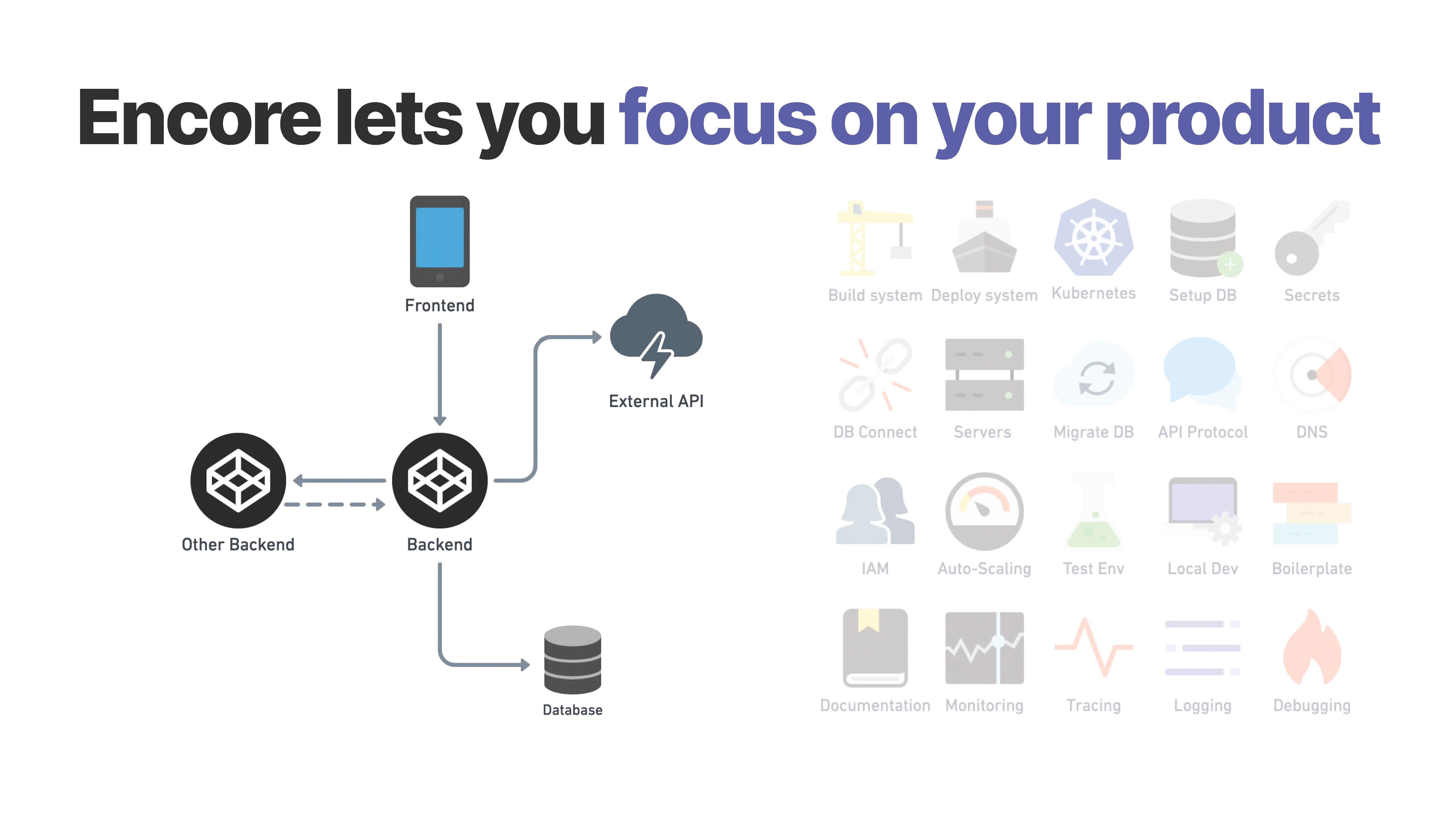
Engore's product slide

[Slide 7] Encore’s product space slide is particularly elegant. Image Credits: Encore

Over a number of evolving slides (5, 6, 7), the founders do a really smooth job of carving out a space within a market that has spectacular competition right now. By spending a few slides telling the story of how the company is positioning itself in the space, it starts alluding to what the product challenge is. The message of letting the technical team focus on building its product, rather than worrying about what’s happening under the hood, is a compelling proposition for anyone who’s ever had DevOps ruin the product party.

One quibble here that isn’t really serious enough to warrant its own item in the “things that could be improved” section: These slides are formulated as if the company is talking to its customers. “Lets you focus” makes sense if you’re talking to a prospective sale. Remember, though, that you aren’t selling the product to the investors — you’re selling shares in your company. “Lets developers focus” would work better and is an opportunity to name who your target audience is as well.

Clear value proposition

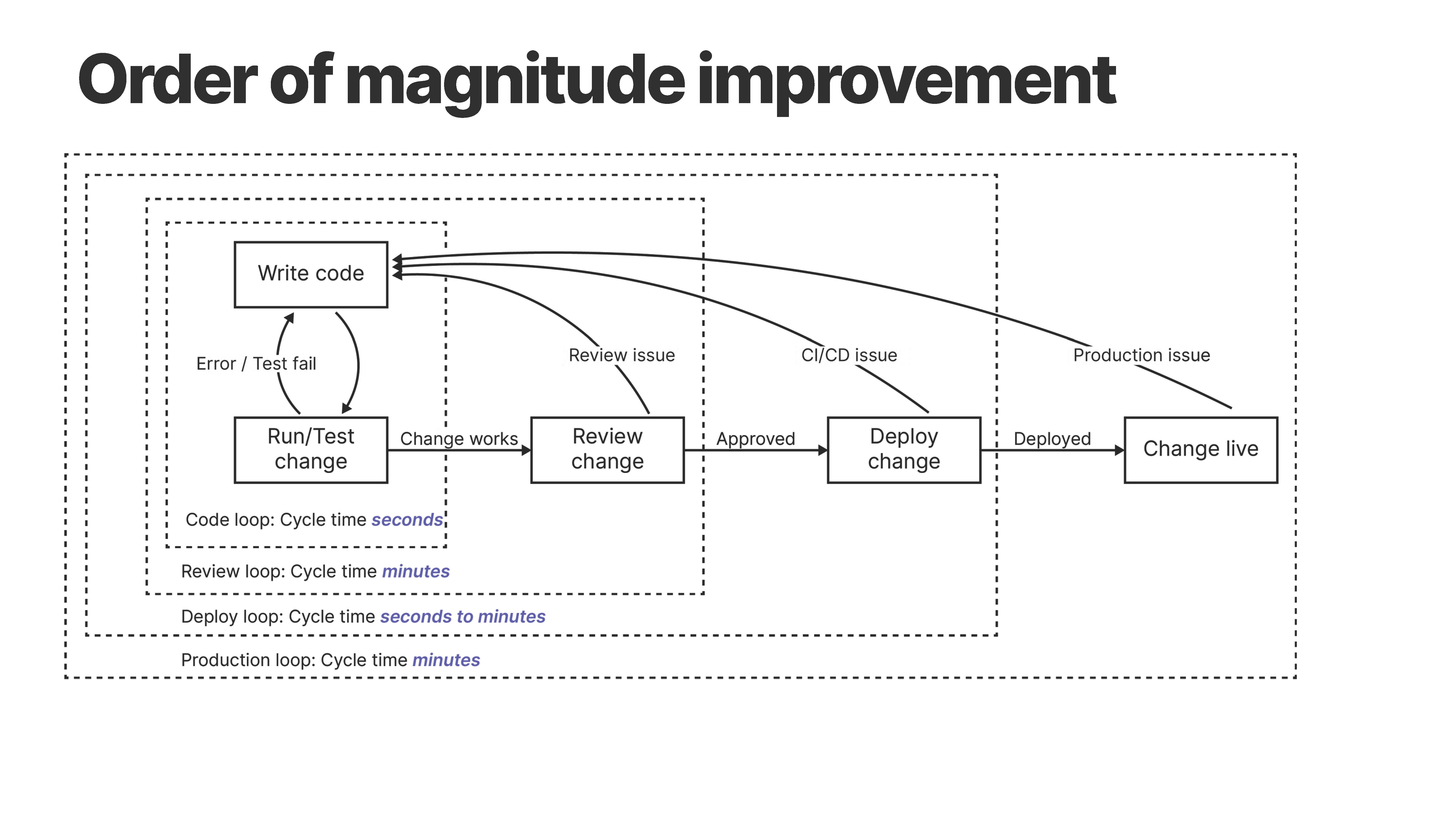
[Slide 12] Encore’s value proposition is extremely clear. Image Credits: Encore

Time is money, and if most startups’ P&Ls are anything to go by, developer time is right up there with some of the most expensive time there is.

In slides 11 and 12, Encore nails down why its product has such a powerful value proposition: Flicking to this slide, it tells the story of how getting a product feature or a bug fix to a production app suffers hours of avoidable delays. The subtext is clear: This is avoidable by using Encore’s tools.

If the company can put the money where its mouth is — i.e., if it really does reduce time to deployment from hours to minutes — and if it can prove a direct link to development efficiency, the value to software companies is immense. That’s it; that’s the story — it doesn’t really matter what Encore even does, exactly, if it can show that developers save significant amounts of time and it can find a route to market, this is a company that could get huge.

Telling the same story in a different way

[Slide 14]  Image Credits: Encore

This slide says, essentially, the same thing as slides 12 and 13 — but it says it in a way that is really easy to visualize.

As a company, one way to gain efficiency is to ensure that you focus your developers’ attention on the things that really matter, which is worth reiterating on multiple slides.

In the rest of this teardown, we’ll take a look at three things Encore could have improved or done differently. In particular, I’m curious about why it focuses so heavily on its product, when — in my experience — investors generally don’t care as much as you might think. A more curious part is how the business is working now (in the form of traction and finding a repeatable business model) and what it is hoping to accomplish with the money raised in this round. We’ll also share Encore’s full pitch deck so you can see the whole thing in context.

Three things that could be improved

There is a lot to love about Encore’s deck: It simplifies a complex product story into a few easy-to-digest slides and shows why there’s an opportunity in the market. But if I were to invest in this company, I would have a few questions right off the bat. Let’s take a closer look at what raises the red flags:


from https://ift.tt/M3I4Spz
via Technews
Share:

‘Social good’ cloud provider Blackbaud takes millions from the NRA

Blackbaud, which bills itself as the “leading cloud software company powering social good,” counts the National Rifle Association as a customer receiving its highest level of care and engagement, raking in more than $1 million yearly from the infamous firearms industry lobbyist.

The two have been in business since 1997, according to internal documents viewed by TechCrunch, just recently hitting 25 years together. It is classified under “Cause & Cure” and “Civil Liberties” internally. Blackbaud provides the NRA with fundraising, grant making and other organizational support services.

With records showing recurring annual payments to Blackbaud of at least $1 million, the NRA is one of very few customers (under 0.1%) the company designates “Enterprise Strategic” and gives the white-glove treatment:

Bespoke individually crafted approach for each highest-ARR, highest-impact customer: Strategic Onboarding and Implementation, and then regular Executive Partnership Meetings and other proactive engagement with direct GM involvement, underpinned by a highly-strategic Individual Success Plan.

This level of service naturally encompasses items included on other levels, such as “managing sentiment,” direct engagement with customers, targeting of cohorts for fundraising and outreach campaigns, and so on. In other words, the NRA isn’t just using Blackbaud as a payment processor or bookkeeping solution — this is a deep and collaborative partnership.

Neither Blackbaud nor the NRA responded to requests for comment.

It must be said that objectively speaking, Second Amendment rights lobbyists can be and are considered by many to be supporting civil liberties. But the NRA is better known for its ghoulish, cynical obsession with putting handguns and assault weapons in the hands of as many as possible with as few restrictions as possible as to the gun or the person. Its influence is directly tied to the reduction or obstruction of even the lightest gun control laws.

Whether and how it is ethical as an organization supportive of civil liberties to do business with the NRA is a complicated question — and one that need not be answered here, because the level of involvement between it and Blackbaud is plainly contrary to the latter’s own stated priorities.

Blackbaud speaks loudly of its commitment to social good and ESG, or environmental, social and governance issues. And indeed it does promote and involve itself with numerous laudable institutions and efforts.

Blackbaud’s giving goals — gun rights not listed. Image Credits: Blackbaud

It is careful, like many organizations, not to make any statements easily identifiable as political in nature, instead focusing on the principles involved. And nowhere does the company state that fighting gun proliferation is among their priorities. Yet it is hard not to feel deep hypocrisy in statements like this one.

“Our Hearts are with the Victims of the Horrific Acts of Violence in our Nation” — and simultaneously with the NRA, which it helps fight for the right to commit those acts as efficiently as possible and without any pesky paperwork.

But you won’t find the NRA in the list of organizations Blackbaud suggests visiting or supporting nor that the company takes millions from the firearms advocate. In fact you won’t find the NRA listed anywhere on the site as a client, donation recipient, recommended charity or in any form that I could see — searches for it also come up empty. Though internally, Blackbaud matches donations to the NRA Foundation as well as charities and support groups.

In an email to employees, Blackbaud’s CEO wrote after the mass shooting in Uvalde that “I share in your shock, anger, and grief over the string of horrific, violent acts in the U.S.,” and under the heading “What Blackbaud is doing” listed a victims fund it donated to. No mention of the NRA being more lucrative than 99.9% of its other customers and whether that presents any kind of moral or professional conundrum.

Again, to narrowly define civil rights and exclude firearms from the category entirely is not the idea — it just seems unethical to publicly support the victims of gun violence while privately supporting and being supported by the NRA. In fact, the Uvalde School District is also a customer of Blackbaud, a source within the company said, following its acquisition of Everfi.

In internal discussion threads viewed by TechCrunch, employees express dismay at that last fact and that Blackbaud matches support to the NRA. While an executive explains this is considered a matter of allowing free choice, they fail to mention that the NRA is one of the company’s biggest customers, something the employees do not appear to be aware of.

In 2020 TechCrunch reported that Blackbaud also counted far-right organizations the Heritage Foundation and the Center for Security Policy as customers. Both are still active users of the service, with Heritage producing some $169,000 ARR — putting it in the second-highest service tier, with a “highly personalized approach.”

As I wrote then, Heritage “has been behind lobbying efforts against climate change action, equal rights for LGBTQ Americans and immigration modernization efforts. It has worked on behalf of the oil and tobacco industries, opposed health care reform and recommended the likes of Betsy DeVos and Scott Pruitt to the administration.” CSR is focused on anti-Muslim propaganda, promoting ideas like “Sharia-supremacists” infiltrating Hollywood.

Such customers have prompted employees at the cloud services company to ask that Blackbaud drop these and other companies whose actions contradict the idea of supporting social good, according to a source within the company. But unlike the recent conflict at Salesforce, where employees referred to co-founder Marc Benioff’s prominent progressive stances on many issues to justify ceasing business with the NRA, Blackbaud’s leadership reportedly harbors no such relevant political leanings.


from https://ift.tt/YdRpnHr
via Technews
Share:

Fresh tickets available to TC’s Annual Summer Party — get one while you can!

Heads-up, party people. We’ve just released another round of tickets to the most fun, relaxed and opportunity-filled networking event of the year. We’re talking about TechCrunch’s Annual Summer Party, of course.

Tradition holds that we join forces with a top Silicon Valley company to host this fabulous fete, and this year, we’ve partnered with Mayfield — a global venture capital firm with a people-first philosophy. It has a 50-plus-year history of investing at the inception stage in iconic enterprise, consumer and human and planetary health companies. 

Join us under the stars for a casual evening of cocktails, canapés and conversation with people who hail from every part of the startup spectrum. The daily grind makes it easy to forget that a simple conversation over a drink and nibbles can be an even more effective way to connect and explore meaningful ways to collaborate. Or just get to know and appreciate your colleagues. 

Here’s the when-where-and-how-much details you need to know:

  • When: June 23 from 6 p.m. to 8:30 p.m. PDT
  • Where: Mayfield: 2484 Sand Hill Road, Menlo Park, California
  • How much: $75

If you’re looking to stand out from the crowd and garner maximum exposure to the VCs who will be attending the event, then book an Early-Stage Startup Exhibitor Package for just $995.

Pro tip: The Exhibitor Package includes four tickets to the party. Bring your crew or invite a client. But don’t wait — there are only five spots left.

This is our fourth ticket release, and if the last three rounds are any indication, these babies won’t be around for long. Buy your ticket now, because you can’t buy them at the door. Speaking of doors, we’ll have great door prizes — like TechCrunch swag and tickets to TechCrunch Disrupt. Are you feeling lucky? 

Leave the daily grind behind, join the Summer Party and enjoy an evening of community and opportunity. Cheers!

Did you try to buy a ticket and came up empty? We release tickets to the Summer Party on a rolling basis. Sign up on the website, and we’ll let you know when the next batch goes on sale.

Is your company interested in sponsoring TechCrunch’s Summer Party? Contact our sponsorship sales team by filling out this form.


from https://ift.tt/bzRdDfB
via Technews
Share:

Gemini lays off 10% of workforce as the ‘crypto revolution’ enters its ‘contraction phase’

Crypto platform Gemini has cut approximately 10% of its workforce, per co-founders and twin brothers Cameron and Tyler Winklevoss. In a post announcing the news, the duo attributed the layoffs to “turbulent market conditions that are likely to persist for some time.”

All employees will be provided a separation package and healthcare benefits. The company closed its physical offices, the co-founders wrote, “so that these conversations will be held remotely to protect the privacy of each impacted individual. Our highest priority throughout will be to treat everyone affected with compassion and respect.”

The drawback comes as the crypto market at large feels in flux. Other major crypto companies have also been slowing hiring in response to a downturn in prices — Coinbase, Gemini’s close competitor, announced plans last month to reverse its prior headcount growth projections, and Latin American crypto exchange Bitso let go 80 employees last week.

Exchanges may be hit the hardest by a recent slowdown in crypto trading volumes from retail investors, but not all crypto companies are as concerned. Fidelity’s digital asset arm said earlier this week that it will double headcount this year to meet growing demand for crypto trading from institutional investors. Meanwhile, FTX, the second-largest crypto exchange, is giving the impression of playing offense, as it expands into equities trading to diversify its business amid risk in the crypto market and eyes the acquisition of an Indian gaming startup. FTX was last valued at $32 billion in January. 

Despite reacting to the market changes, Gemini’s co-founders also addressed that there’s a somewhat expected volatility in what they called the “crypto revolution.”

“Its path can best be described as punctuated equilibrium — periods of equilibrium or stasis that are punctuated by dramatic moments of hypergrowth, followed by sharp contractions that settle down to a new equilibrium that is higher than the one before,” the co-founders wrote in the post. They go on to say that crypto has entered its contraction phase, otherwise known as the contraction phase, further “compounded by the current macroeconomic and geopolitical turmoil.”

The company did take advantage of the venture capital boom, last year raising $400 million in a growth equity round led by $7.1 billion. In January, the startup acquired Blockrize for an undisclosed amount and teased plans to launch a credit card with bitcoin rewards. It’s unclear if layoffs impact the Blockrize team, and if so, how it impacts Gemini’s product roadmap.


from https://ift.tt/wjxJQzp
via Technews
Share:

Popular Post

Search This Blog

Powered by Blogger.

Labels

Labels

Most view post

Facebook Page

Recent Posts

Blog Archive