The success of any piece of visual communication depends on colour. Research into the impact of colour in marketing tells us that it takes the average person just 90 seconds
If you've been hard at work in your spare time creating stunning paper art or impressive poster designs, selling your merchandise online can be a quick way to...
Originally designed in 1974 and launched internationally in 1980, Rubik's Cube is a design classic that's sold by the hundreds of millions. Over the years, it...
Your design portfolio is one of your most useful tools. It can win you commissions, help you snag a new design job, attract collaborators, and get your work in...
Editorial design can be a daunting task for someone who isn’t used to formatting large amounts of text. The skills you'll need are different to those of...
Hello all! Welcome back to Week in Review, the newsletter where we recap some of the top stories to cross TechCrunch over the last 7 days. If you want it in your inbox every Saturday, sign up here.
The most read story this week was about, get this: a DeLorean. As in the Back to the Future car. Yep. The short version: the recently revived brand released images of the Alpha 5, an electric vehicle built in homage to the DeLorean of yesteryear, complete with those signature gull-winged doors. Details like price/availability are still under wraps, but for the curious: the company says it’ll do zero to 60 in 2.99 seconds — and, perhaps more importantly, zero to 88 in 4.35 seconds.
other stuff
What else happened this week? Here’s some of the stuff people were reading about most:
Sheryl Sandberg steps down at Meta: After 14 years in the role, Sheryl Sandberg will no longer be the COO of the company formerly known as Facebook. Meta chief growth officer Javier Olivan will shift into the COO role; Sandberg will remain on Meta’s board of directors.
Amazon kills the Cloud Cam: Back in 2017, Amazon launched a little smart home camera called the Cloud Cam. Then it pretty much immediately bought two smart camera makers — Blink and Ring. Half a decade later, Amazon is ditching Cloud Cam in favor of the latter two. Cloud Cams will stop working at the end of this year; existing Cloud Cam users will get a free Blink Mini camera as a replacement, along with a free year of the Blink Plus plan. If you’re using a Cloud Cam, make sure you back up your saved videos before they disappear in December.
Amazon experiments with “invite-based” ordering to fight scalpers: If you’re a normal person just trying to casually buy something like a PlayStation 5 or an Xbox Series X on Amazon, you’ve probably felt the disappointment of being beat to the punch by a billion bots. Amazon announced this week that it’ll roll out “invite-based” orders for select high-demand items; you’ll “request an invitation” and then Amazon will check things like purchase history/account creation date to determine who gets first dibs.
And Tesla, too: First came word that Elon Musk will require “everyone at Tesla” to be in the office (rather than remote) for a “minimum of 40 hours” per week. Then came word of a company-wide hiring freeze, and plans to cut up to 10% of Tesla’s salaried workforce.
audio stuff
You love TechCrunch for your eyes — how about TechCrunch for your ears? We’ve got a bunch of super-good podcasts, the latest of which Matt Burns summed up here.
Example A: the TechCrunch Live podcast, where this week Burnsy talked with the CEO and lead investor of Olive — a Columbus, Ohio, company that pivoted 27 times and is now worth billions.
added stuff
We have a paywalled section of our site called TechCrunch+. It only costs a few bucks a month and it’s full of very good stuff! From this week, for example:
VCs on the state of crypto: Pretty much all of the big cryptocurrencies have spent the last 6 months in a downward spiral. How are investors feeling about the space overall? Jacquelyn Melinek checked in with a handful of VCs for their thoughts.
How the Biden admin could power up solar/wind projects: “There’s an idea floating in the ether (or at least in my ether) that there’s enough sunny federal land in Nevada to power the entire United States with solar,” writes Tim De Chant. “So why don’t we have more solar and wind on public lands?”
Even Stripe isn’t immune to a changing market: Fintech companies are getting hit hard by the downturn; Alex Wilhelm takes a look at how/why “even the largest and best-known private fintech companies are suffering from embarrassing revaluations.”
Welcome back to This Week in Apps, the weekly TechCrunch series that recaps the latest in mobile OS news, mobile applications and the overall app economy.
The app industry continues to grow, with a record number of downloads and consumer spending across both the iOS and Google Play stores combined in 2021, according to the latest year-end reports. App Annie says global spending across iOS and Google Play is up to $135 billion in 2021, and that figure will likely be higher when its annual report, including third-party app stores in China, is released next year. Consumers also downloaded 10 billion more apps this year than in 2020, reaching nearly 140 billion in new installs, it found.
Apps aren’t just a way to pass idle hours — they’re also a big business. In 2019, mobile-first companies had a combined $544 billion valuation, 6.5x higher than those without a mobile focus. In 2020, investors poured $73 billion in capital into mobile companies — a figure that was up 27% year-over-year.
This Week in Apps offers a way to keep up with this fast-moving industry in one place with the latest from the world of apps, including news, updates, startup fundings, mergers and acquisitions, and much more.
It’s that time again. Google I/O has come and gone, which means it’s now WWDC season. Apple’s big developer conference is back this year as a hybrid event with invites sent to some developers (and press), and a keynote that airs Monday, June 6 at 10 a.m. PT. Amid the possibility of new Macs (or maybe even the rumored AR headset?), app developers are most interested in the coming updates to Apple’s development platforms and what’s ahead for its mobile operating systems, including the big new release of iOS 16.
Thanks to leaks largely from Bloomberg’s Mark Gurman, iOS 16 — code-named “Sydney” — could be a fairly big upgrade. Rumored changes include an updated lockscreen that features the Today View widgets, perhaps — more real estate for app developers to capture users’ attention — as well as the chance that an iPhone 14/iOS 16 combo will include an always-on display. Other updates could see first-party apps like Messages and Health getting updates, the former with enhancements to its audio features, the leaks claim.
Elsewhere, we’re expecting multitasking improvements for iPadOS, plus updates to macOS, watchOS and tvOS, including other first-party app updates (Settings, Mail, Safari, Podcasts and Notes, potentially), new watch faces and more.
If Apple wanted to surprise us, it could announce the rumored homeOS or its smartglasses, but for the time being, we’re not betting on those releases.
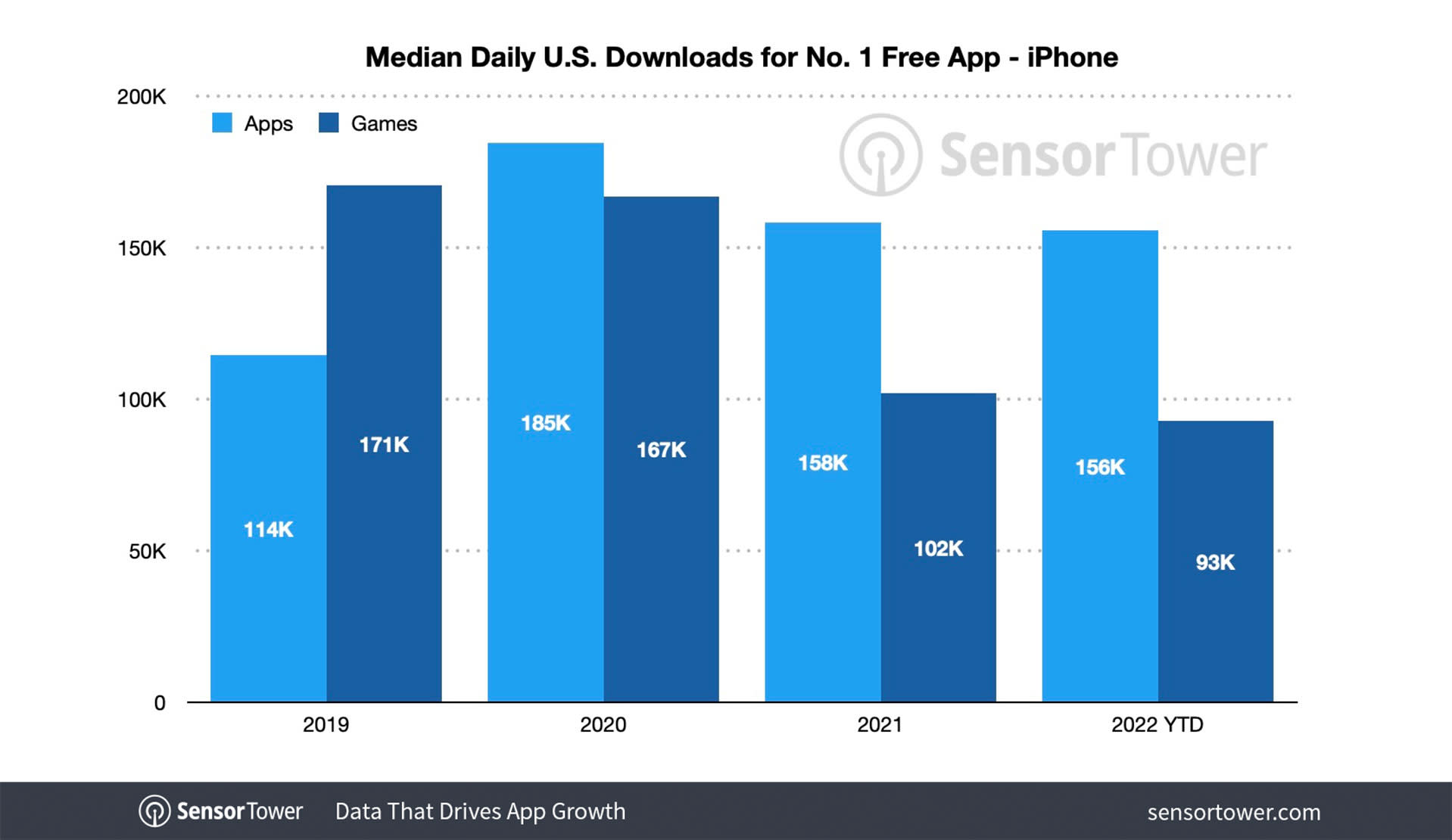
Daily downloads to reach top of the App Store have increased 37% since 2019
Image Credits: Sensor Tower
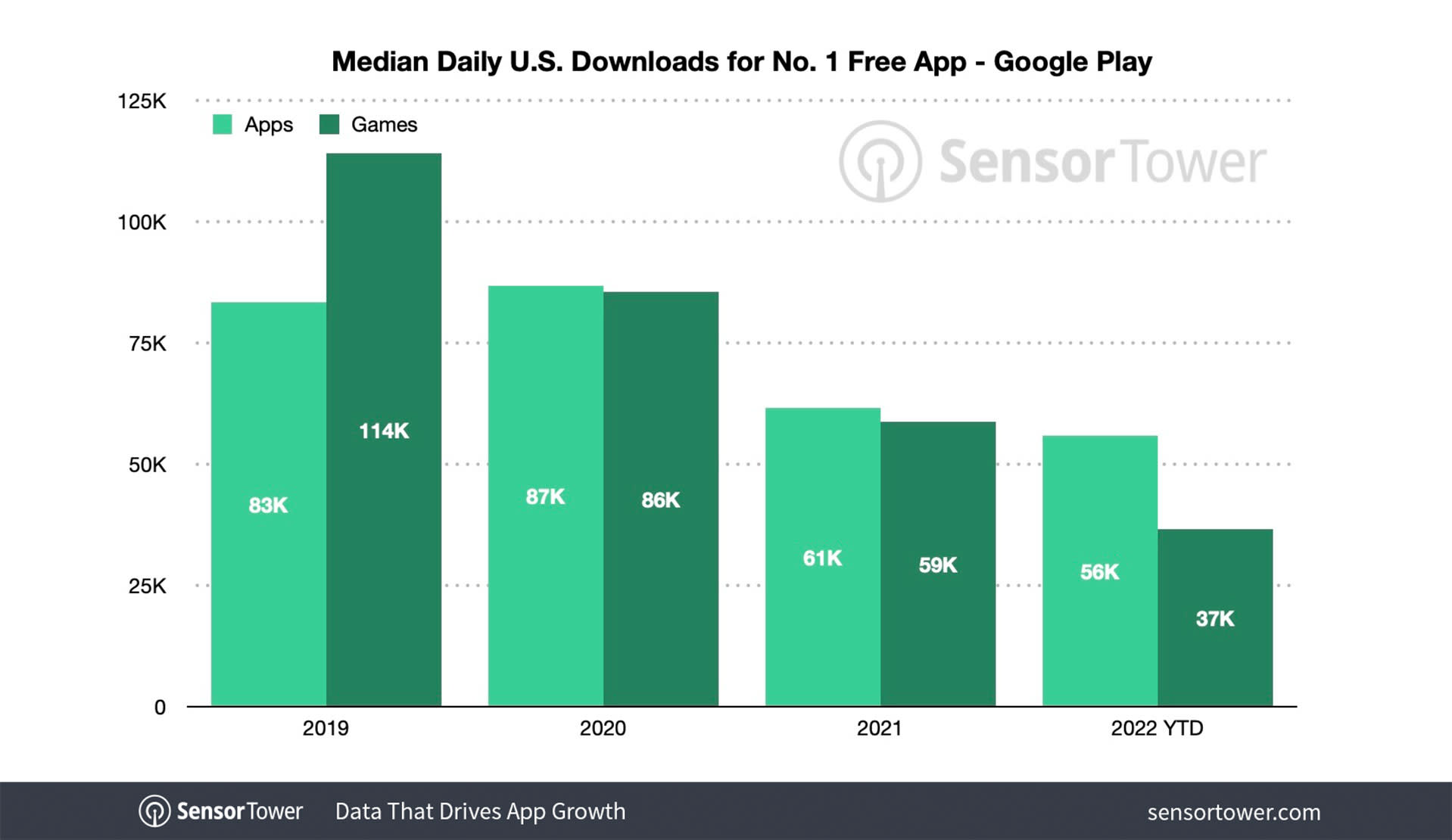
New analysis indicates it’s gotten harder to get an app to the top of the App Store, in terms of downloads, over the past several years. According to new data from app intelligence firm Sensor Tower, the number of downloads needed for an app to break into the No. 1 position on Apple’s iPhone App Store in the U.S. has climbed by 37% since 2019. Specifically, it estimates an app now requires approximately 156,000 downloads on a given day to hit the top spot on the U.S. App Store, up from 114,000 daily downloads back in 2019.
Meanwhile, Android apps only need 56,000 daily downloads, down from 83,000 in 2019.
Image Credits: Sensor Tower
Of course, developers know that downloads alone don’t move an app to the top of the charts. It’s only one of several factors that Apple’s ranking algorithm takes into account for managing its Top Charts. Still, it’s an interesting metric to track as it does matter — and Sensor Tower has done the work to analyze the median needed per marketplace, by categories, and even among select markets. You can read our write-up here.
Apple updated its Apple Developer App in advance of WWDC. The app will allow developers to browse the WWDC tab to watch the complete schedule of each day’s session videos, as well as access Digital Lounge activities and the Coding and Design Challenges. The app also now supports SharePlay so developers can watch videos together with colleagues or friends.
Apple also launched a new webpage, Beyond WWDC, devoted to listing a number of other events and gatherings related to WWDC, many of which are sponsored by or led by developer organizations.
Ahead of next week’s reveal of iOS 16, Apple released the latest iOS 15.6 beta 2, as well as the second developer betas for iPadOS 15.6, tvOS 15.6 and watchOS 8.7. Notably, the update fixed the bug that saw the Apple Music app pushing other apps out of the iPhone’s dock.
Mixpanel noted that Apple’s iOS 15 is now installed on 85% of active iPhones as we head toward the reveal of iOS 16.
Apple featured a selection of its WWDC22 Swift Student Challenge Winners, which this year total 350 students from 40 countries and regions. Among the apps that Apple highlighted were Ivy, an app for gardeners; an app that teaches CPR; and an app that lets people try out different pronouns using sample texts.
Platforms: Google
Google said Android users will soon be able to apply their Play Points to in-app purchases for apps published on Google Play. The points will be available right in the checkout flow.
Google announced the General Availability (GA) of App Actions using shortcuts.xml, part of the Android shortcuts framework. By using the Shortcuts API, developers can add a layer of voice interaction to their apps, by using the Android tooling, platform and features they already know, Google said.
Google’s latest Android update included new Gboard stickers, 1,600 Emoji Kitchen combos, new Play Points features and accessibility app improvements. Most notably, the company is bringing custom text stickers to all Android devices, after first launching them on Pixel phones in March.
A number of South Korean app developers and content providers upped their paid subscription and service fees on Google’s Play marketplace due to the 15-30% commissions now required following Google’s policy changes that force apps to use its first-party billings and payments system. While South Korean law permits app developers to use a third-party payment option, this only reduces Google’s commission by 4% — and that’s not enough, developers believe.
Amazon added an invite-only ordering option to its website and app designed to limit bots’ ability to score high-demand, low-supply products. The system launches in the U.S. with the PS 5 and Xbox Series X console preorders.
Kohl’s is the latest retailer to sign on for Apple’s Business Chat, which allows customers to talk to live chat customer service agents through Apple’s Messages app.
Fintech
SEC filings indicated banking app Varo, the first U.S. neobank to receive a bank charter, had $263 million equity, an $84 million burn rate and 98% of its income came from interchange and fees, according to an analysis by Fintech Business Weekly. The report suggested Varo could be out of money by year-end if it doesn’t cut costs and raise more capital.
Visa and East Africa’s biggest telecom, Safaricom, the operator of the M-Pesa mobile money product,launched a virtual card that will allow M-Pesa users to make digital payments globally.
Square said it would roll out support for Apple’s new Tap to Pay on iPhone feature inside its Square Point of Sale app later this year, and it launched an Early Access Program for select merchants.
Coinbase said it will extend its hiring freeze for “as long as this macro environment requires” and said it would also rescind a number of accepted offers.
Social
Image Credits: Instagram
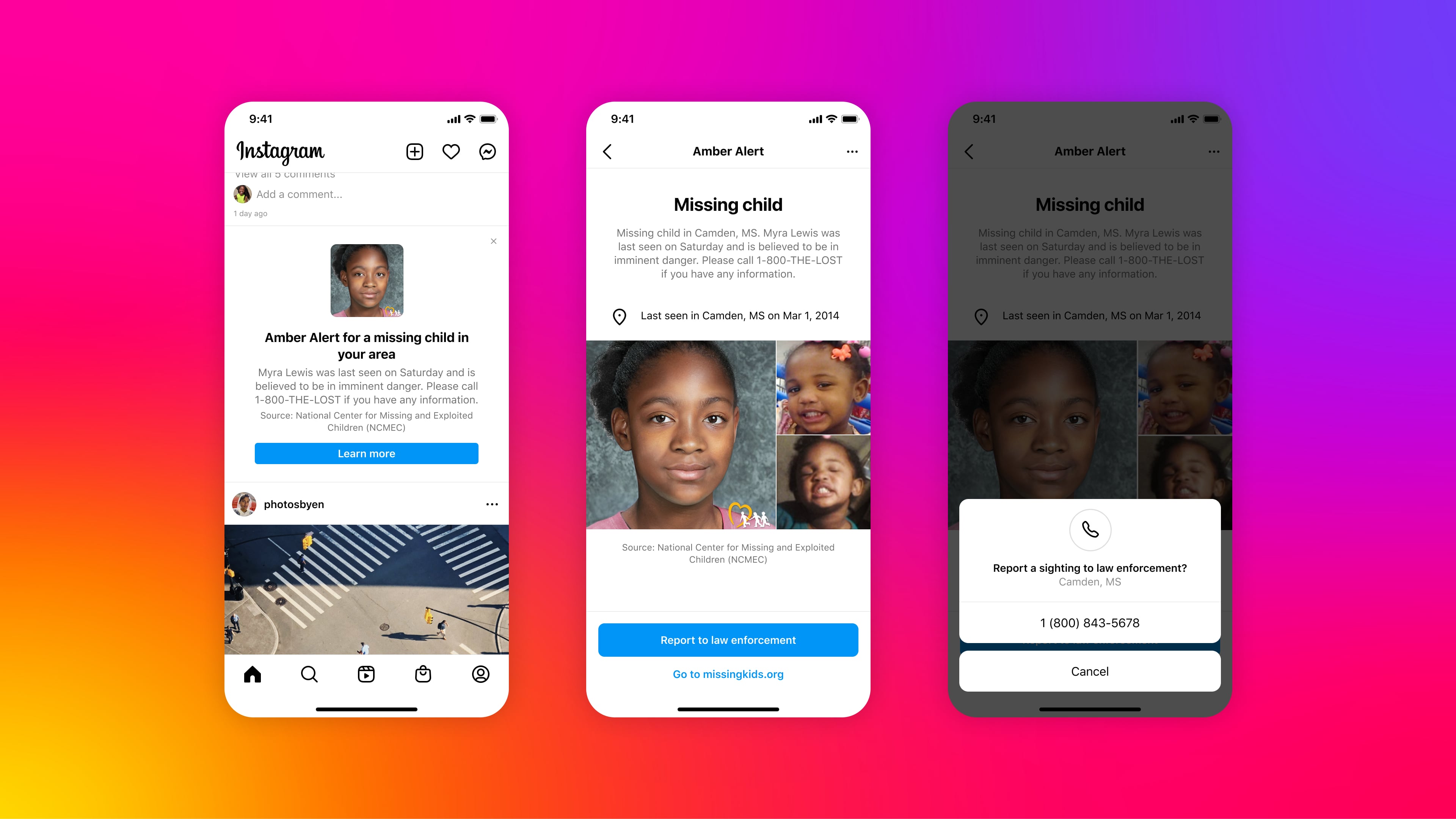
Instagram launched AMBER Alerts on its app to tap into its wide user base to help find missing children. The alert will appear if you’re in the designated search area and will include information about the missing child, including an image, description, location of the abduction and other details.
Twitter is said to be restructuring to focus on user growth and personalization, which is impacting staffing for other features like Spaces, newsletters and Communities, Bloomberg said.
After 14 years, Meta announced COO Sheryl Sandberg is leaving the company. The resignation follows reports that the exec used Meta’s resources for personal interests, like wedding planning, and used Facebook resources to pressure Daily Mail to kill a story about then-boyfriend Activision Blizzard CEO Bobby Kotick.
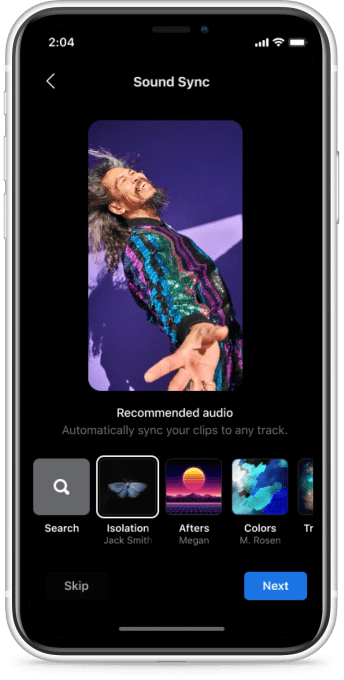
Meta announced a series of updates and new features for its Reels products across both Facebook and Instagram, including a Sound Sync feature on Facebook Reels and support for longer Instagram Reels of up to 90 seconds, instead of 60 seconds. It also rolled out more creative tools, including bringing Instagram’s Story stickers to Reels.
Image Credits: Meta
Snapchat launched a new “Shared Stories” feature that makes it easier for users to collaborate and share memories. It also partnered with restaurant review website The Infatuation to help users to find local eats on its Snap Map.
The Uvalde shooter used the Gen Z social app Yubo to meet people who he would then follow on Instagram and with whom he discussed buying a gun in private chats, The Washington Post reported. Yubo additionally announced new age estimating features to separate minors from adults on its app.
Twitter said it’s shutting down TweetDeck for Mac, the social media dashboard app aimed at power users who want to view multiple columns within a single screen. The app will sunset on July 1 after which users will be directed to the web version, which is being updated.
TikTok is testing a new feature, “clear mode,” that allows for a distraction-free scrolling experience on the app. The feature is in limited testing with select users and removes all clutter on-screen, like captions and buttons.
Tumblr rolled out a way to gift ad-free browsing to friends at a rate of $4.99/mo or $39.99/year. It also introduced a way to turn off the ability for users to limit reblogs on their posts.
Social events app IRL is laying off 25% of its team, or around 25 people, citing market dynamics. The cut comes around a year after the startup landed a $170 million SoftBank-led Series C and reached unicorn status.
Google announced plans to combine its Google Duo and Google Meet calling apps into a single app that uses Duo’s tech as the foundation but leverages the Google Meet branding. The Duo app will gain all of Meet’s features, including scheduled meetings, but users will also be able to use the new app for ad hoc calls. Google had previously sunset Duo’s chat-based sister app Allo ahead of this move.
The Jonas Brothers-backed startup Scriber forgoes a standalone app to connect fans with exclusive celeb content over SMS updates to their preferred messaging app. The Jonas Brothers charge $4.99/mo for their fan subscription but plan to donate half the earnings to charity.
Streaming & Entertainment
Image Credits: YouTube
YouTube announced its mobile app can now sync to your TV without using casting, for a “second screen’ experience.” The app will instead ask users if they want to sync to their TV, which will then allow the users to interact with the video, by liking, commenting and supporting the creator, as well as shop the products being featured.
Google launched the Google TV for iOS app after moving the Movies and TV section from the Play Store to the Google TV app. The new app replaces the Play Movies & TV app for iOS and lets TV viewers use their phone as a remote control.
Apple is now injecting first-party ads for its own radio shows within the premium Apple Music service, to the anger of some users.
Spotify faced a streaming outage on Monday and Tuesday when podcasts on Spotify-owned Megaphone were unavailable for more than eight hours from Monday night through early Tuesday morning due to an expired SSL certificate.
Singapore-based TIYA, a Clubhouse-like social audio networking platform, launched a Spotify integration that lets its users listen to music and podcasts with friends. The app is a subsidiary of Chinese app maker LIZHI.
TikTok is launching a live subscription comedy series in partnership with social media collaboration company Pearpop and creator Jericho Mencke. Episodes of the show, “Finding Jericho,” will air twice a week in June on TikTok LIVE, with eight 30-minute episodes in total. It will cost $4.99 to watch the series.
Gaming
Google announced the return of the Indie Game Accelerator program for 2022. It said selected game studios from 78 eligible countries will be invited to take part in the 10-week acceleration program starting in September 2022 as the Accelerator Class of 2022. The program includes a series of online classes, talks and game development workshops. Develoeprs also get the chance to meet and connect with others from around the world.
Epic Games is hosting its first major in-person competitive Fortnite event since the Fortnite World Cup in 2019. The upcoming FNCS Invitational 2022 will take place November 12-13 at the Raleigh Convention Center and will feature a $1 million prize pool.
Popular iOS mobile games from Ustwo, the developer behind Monument Valley, will come to the PC with a launch on Steam on July 12.
Travel & Transportation
The world’s second most frequently downloaded ride-hailing app after Uber, inDriver, was profiled by Rest of World this week. The Siberia-based app, which lets drivers haggle over prices, hit unicorn status last year with a valuation of $1.23 billion. It now serves 42 countries worldwide.
News & Reading
Amazon removed in-app purchases from its Kindle and Amazon Music apps for Android, as well as direct audiobook purchases from its Audible app for Android, following Google Play’s policy change that forces developers to use its own first-party billing and payments service.
Substack’s latest updatesincluded the ability to embed TikToks into posts, a new reactions section at the bottom of posts, a new profile section that shows your recent likes and several updates to its mobile app. For the latter, readers can now change the font, text size and background color to enhance their reading experience, as well as for better collapsing and threading of comments.
Utilities
Apple Maps began testing its more-detailed maps in more countries including France, Monaco and New Zealand. Users in these areas spotted updated maps with better renders of 3D objects, like the Eiffel Tower, Notre-Dame Cathedral and Mont Saint-Michel in France.
Security & Privacy
Canada’s privacy regulator found that coffee shop chain Tim Hortons had illegally collected customer location datathrough its mobile app without adequate user consent. An investigation found the app was tracking customers’ locations even when it was not in use.
Funding and M&A
Indian short video app ShareChat’s parent company Mohalla Tech raised nearly $300 million from Google, Times Group and Temasek Holdings at an approximately $5 billion valuation, according to Reuters sources. Google had previously backed rival short-form video app Josh.
Indonesian delivery app Astro, which offers 15-minute grocery delivery, raised $60 million in a Series B led by Accel, Citius and Tiger Global, bringing its total raise to date to $90 million. The app offers delivery within a range of 2-3 km through a network of dark stores and operates around 50 locations across Greater Jakarta.
LA-based metaverse startup TRIPP raised $11.2 million in a Series A extension led by gaming-focused investment firm BITKRAFT, and acquired world-building platform Eden. TRIPP’s vision for the metaverse includes AR smartglasses, VR headsets as well as smartphone apps, as it expects AR, VR and mobile to ultimately converge.
Latin American local on-demand delivery and transportation super app Yummy raised $47 million in new funding led by Anthos Capital. The app offers delivery of items, ridesharing and grocery delivery in less than 20 minutes, and the purchase of experiences like concerts and sporting events.
Sanlo, a San Francisco-based fintech startup that offers small to medium-sized game and app companies access to tools to manage their finances and capital to fuel their growth,raised $10 million in Series A funding led by Konvoy.
Super, an Indonesian social commerce app that focuses on small towns and rural areas, raised $70 million in Series C funding led by NEA, bringing its total funding to $106 million. The startup plans to use its funding to expand into Kalimantan, Bali, West Nusa Tenggara, East Nusa Tenggara, Maluka and Papua over the next few years.
Railway, a startup offering a dashboard for building, deploying and monitoring apps and services, raised $20 million in Series A funding led by Redpoint Ventures.
Poparazzi, the anti-Instagram social app that hit the top of the App Store last year, announced its Benchmark-led Series A round, reported last year but not confirmed by the company until now. The company said it raised $15 million in funding, a bit under the $20 million being reported.
Pinterest acquired the AI-powered shopping service for fashion known as The Yes, founded by e-commerce veteran and former Stitch Fix COO Julie Bornstein and technical co-founder, Amit Aggarwal. Deal terms were not disclosed. The service will be used to help Pinterest personalize the shopping experience on its platform.
Yet, it’s a quieter and more realistic truth that has landed my attention as of late: For diverse founders, the downturn is nothing new. Some investors, largely those who focus on backing historically overlooked founders, say that the crackdown on tech companies isn’t impacting diverse founders as harshly as their overly funded, homogeneous counterparts because of pre-existing biases.
All Raise CEO Mandela SH Dixon, who joined the Equity podcast fresh off of her annual summit, told TechCrunch that women and racially diverse investors, founders and operators don’t have the “doom-and-gloom mentality because we are so used to doing more with less.”
“We are so used to not having access to this influx of capital that we have already adjusted and built muscles and capacity to weather a lot of storms that more privileged founders who have like this never-ending flow of capital and access to advice and insider information” haven’t had to deal with, she said. “We as women, and as women of color, have a long history of weathering storms, so this isn’t new to us.”
Dixon’s belief — that minority founders may be more prepared for a pullback because they were already experiencing one — feels both spot-on and nuanced. Yes, diverse founders still receive disproportionately less venture capital financing than their homogeneous counterparts, making them smarter with their money. We have reams of studies spanning years that show that women and diverse teams can be more capital-efficient.
At the same time, if even the small dollars heading their way are at risk, won’t the industry slide further and further from a more equitable spot?
For the rest of my thoughts on this topic, check out my TechCrunch+ column: “For diverse founders, a downturn is nothing new.” In the rest of this newsletter, we’ll talk about the myth of the moniker that is the girl boss, a nuance about all these layoffs and a deal that may have flown under your radar this week. As always, you can support me by forwarding this newsletter to a friend or following me on Twitter or subscribing to my blog.
Deal of the week
On Equity this week, we spoke about a venture-backed startup that has attracted even more capital to make maps mainstream. Felt, co-founded by Sam Hashemi and Can Duruk, allows users to build a map with datasets integrated into it and to work with each other to showcase impact in a less static way than your average Google maps query.
Here’s why it’s important: The co-founders cited proven business models from Figma and Notion, both valued in the billions, as reason to believe in their work. The aforementioned companies both succeeded in rolling out to users for personal use, then pivoting to the enterprise, a playbook that Felt wants to follow (and that VCs can certainly speak the language of).
“That kind of business model and go to market is — I don’t want to say immune, but is a little bit removed from the kind of market fluctuations we’re seeing,” Hashemi said in an interview. “It’s really not about consumer spending, it’s not about an advertising business, it’s just day in day out work that businesses are relying on.”
How the myth of the “girlboss” harms emerging women in tech
If there’s one story you read this weekend, make it this one. My colleagues Anita Ramaswamy and Amanda Silberling wrote about the myth of the girlboss and how it impacts women in tech. They explore how “once a vaguely aspirational term of praise reserved only for affluent white women, the moniker now reflects the maddening contradiction of workplace feminism: We know that it’s not enough to just be a woman in power, and that what we do with that power matters far more than simply wielding it.”
Here’s why it’s important: The story puts into words a lot of the irony, emotion and impact of why this term frustrated so many people. Here are two excerpts that stand out:
There’s a disconnect between the evolution of feminism in the outside world, juxtaposed with the frustratingly slow rate at which Silicon Valley realizes that a woman CEO shouldn’t be a novelty. Outside of work, women fight for an intersectional feminism that’s trans-inclusive, uplifts people of color and advocates for disability rights. But in startup culture, just being a woman in and of itself is seen as subversive.
And, this, from Sruti Bharat, who most recently worked as interim CEO at All Raise.
“Just because a woman has been oppressed, or has been marginalized, or treated differently, doesn’t mean that she is also aware of how to fix it, or how to speak about it or is not perpetuating it herself. We’re always advocating for women to be icons … but the reality of that is it takes actual advocacy work and movement building and policy,” Bharat said.
I know, I know. There was a lot of layoff news last month and June is starting no differently. This week, we wrote about layoffs at IRL, SWVL, PolicyGenius, Loom, Gemini and Carbon Health.
Here’s why it’s important: At this point, it still feels newsworthy to report on layoffs of venture-backed startups regardless of if they’re impacting 10% or 50% of staff. I don’t want to get in the game of deciding what number of people need to lose jobs for it to be relevant, but I also realize it’s going to be hard to cover every single workforce reduction.
One nuance that I want to remind everyone, but mostly myself, of is that there’s the layoffs that happen due to market uncertainty, and there’s the layoffs that happen due to the ability to cite market uncertainty. Questions and reasoning matter a lot, and the “no comment” speaks volumes.
Welcome back to The TechCrunch Podcast where you’ll hear everything you need to know about the week’s top stories in tech from the people who wrote them. This week we talk with Mary Ann Azevedo about two fintech giants, Affirm and Stripe, partnering up and what that means for competitors and Brian Heater comes on to preview next week’s Apple Worldwide Developer Conference. As always, you’ll get a rundown of the week’s top news on TechCrunch.
Dave Wechsler leads insurtech investing for OMERS Ventures. After serving as the VP of Growth at Hippo, Dave is one of the first insurtech operators to become a full-time investor.
Just over five years ago, the insurance industry entered the crosshairs of the tech world. Despite serving as the backbone of global growth, insurance lagged the pace of technology adoption enjoyed by other industries.
Entrepreneurs saw this as an opportunity to disrupt incumbents, and soon there were lofty claims that everything about the industry was about to change. With tech’s embrace, people were about to soon “love their insurance!” Venture capitalists noticed, and startups closed large rounds of capital.
Fast-forward to today, and it’s safe to say that none of us have found an intimate connection with our insurers. That said, the industry is in a transformational moment as it races to keep pace with technology.
Many like to refute the underlying disruption by pointing to public valuations of insurtech firms, some of which are down as much as 85%-90%. But we are experiencing a typical phenomenon that occurs in industries transformed by technology: Early challengers often lack appreciation for the complexities of the market and sometimes overpromise short-term visions.
We learned that it’s hard to change a highly regulated industry with a disinterested customer base who rarely shops the competition.
Now, a new crop of challengers is learning from their predecessors’ mistakes. As we enter “insurtech 2.0,” the lessons learned are becoming the new best practices, and nowhere is this more evident than at the startups building an MGA (a managing general agent).
The MGA (R)evolution
An MGA is a hybrid between an insurance agency (policy sales) and insurance carrier (underwriting and assumption of the risk). MGAs started off during the U.S.’ frontier years. East coast carriers pursued the emerging westward market by granting remote agents unique underwriting and servicing authorities. In return for their added responsibilities, these MGAs received higher sales commissions from their carrier partners.
When they arrived on the scene, insurtech challengers revived the dormant MGA structure to monetize their more scalable solutions. Founders pitched carriers a tech-forward relationship with the customer, focusing on:
The New York Senate has passed a bill that bans crypto mining operations that use carbon-based fuel to power their facilities.
The bill specifically is targeting proof-of-work mining, which is one of the two most popular mechanisms cryptocurrencies use to verify new transactions on the blockchain and make new tokens, but it uses a lot of energy to validate blockchain transactions.
Some of the most popular proof-of-work tokens include Bitcoin, Ethereum and Dogecoin.
The alternative, proof-of-stake, is when cryptocurrencies – like ETH2.0 or Avalanche – use staking to achieve the same thing for less energy and it is thought to be more efficient for scaling than proof-of-work.
The bill is an attempt by lawmakers to impede the state’s carbon footprint and “mitigate the current and future effects of climate change,” according to the bill.
“Cryptocurrency mining operations running proof-of-work authentication methods to validate blockchain transactions are an expanding industry in the State of New York,” it stated. The continued expansion of operations will “greatly increase the amount of energy usage” in the state, it added.
If it passes, all proof-of-work mining activity in the state that relies on burning fossil fuels will face a two-year ban. However, 100% renewable energy proof-of-work mining businesses will still be allowed to operate.
“Ultimately, this bill will hurt New York more than it will help, as these miners will increasingly cluster in states such as Texas, Tennessee, Washington State, and elsewhere that provide solar, wind, hydro and other sources of clean energy,” said Steven McClurg, co-founder and CIO of Valkyrie Investments, which oversees WGMI, the largest US-based Bitcoin miners ETF.
The Senate voted 36-27 in favor of the bill after passing it through the New York State Assembly in April. It now moves to the desk of New York Governor Kathy Hochul, who could sign or veto the legislation.
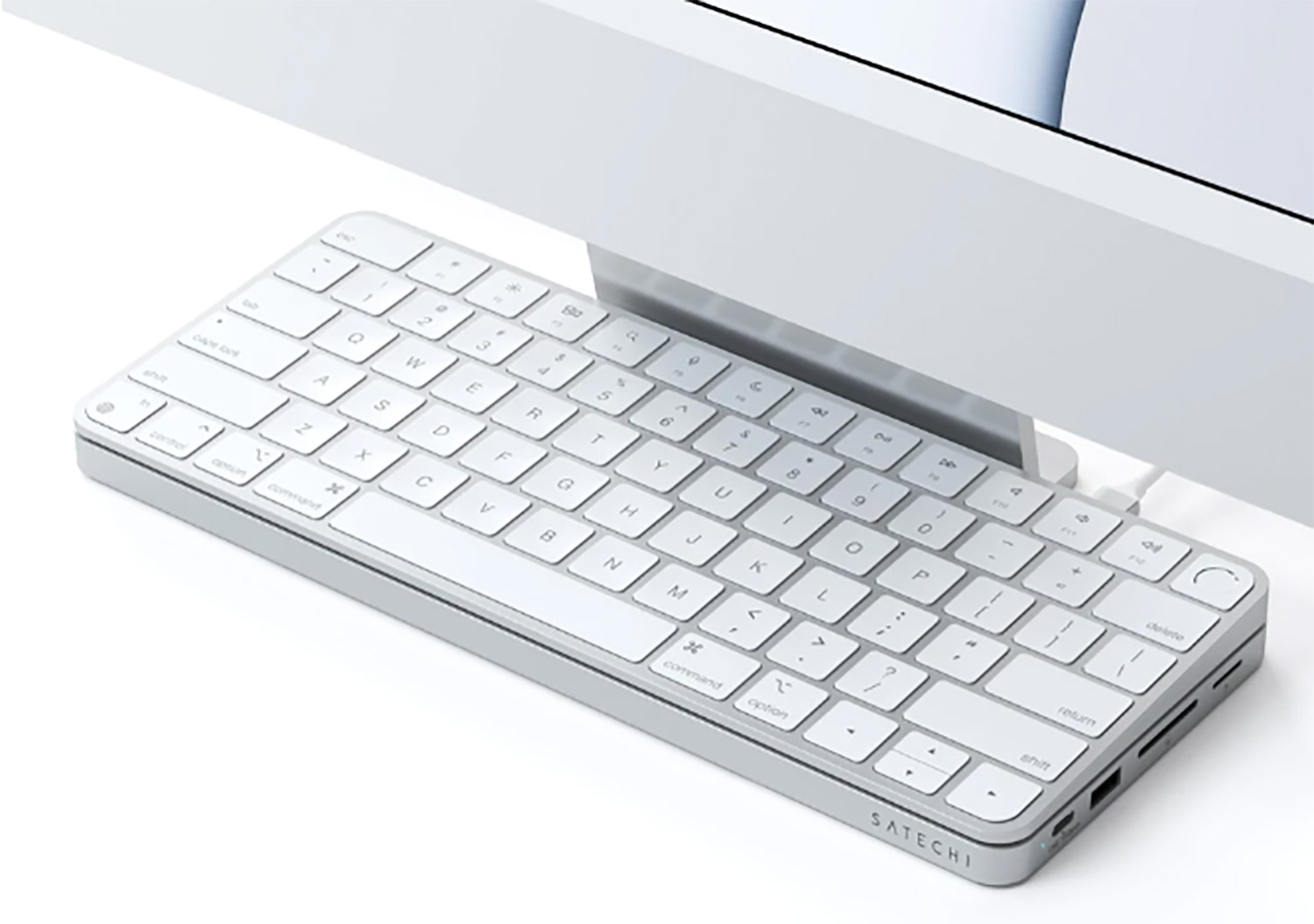
The world of Mac peripherals has a lot of complete and utter garbage in it, so it’s a breath of aluminum-scented air to see the new USB-C slim dock from Satechi. The dock is exactly the same size as Apple’s wireless keyboard, so when it’s not in use, your alphanumerics have a sleek metal hammock for some rest and recuperation. More importantly, the dock slides neatly on top of the 24-inch iMac’s foot, adding a slew of easy-to-reach features and functionality without ruining the dastardly good looks of your silver-and-glass design masterpiece.
It makes so much sense that as soon as I saw it, I sighed in a not entirely safe-for-work way. Don’t get me wrong, I applaud Apple for its shapely computers, but the company has long been leaning pretty deep into form-over-function territory. The number of times I’ve been swearing to have to crawl behind my computer to plug in a peripheral for a few minutes, then accidentally yank the wrong USB cable out of the back of it when I’m done… It’s a gorgeous design and a terrible user experience.
I’m a sucker for a tidy desk, and LOOK AT IT! Image Credits:Satechi.
Satechi, then, swoops in with a product that just… works. It’s Exclusively designed for 2021 iMac (24-inch) models, and adds extra data storage space and extends the number (and reachability) of the USB ports, all through a single USB-C cable running to the back of your trusty work-steed.
The dock packs a USB-C 3.2 Gen 2 data port (with transfer speeds up to 10 Gbps). It also has a USB-A 3.2 Gen 2 data (with up to 10 Gbps), and a couple of slower USB-A 2.0 ports. There’s also microSD and SD card reader slots; perfect for a grumpy-ass journalist or photographer trying to get some work done.
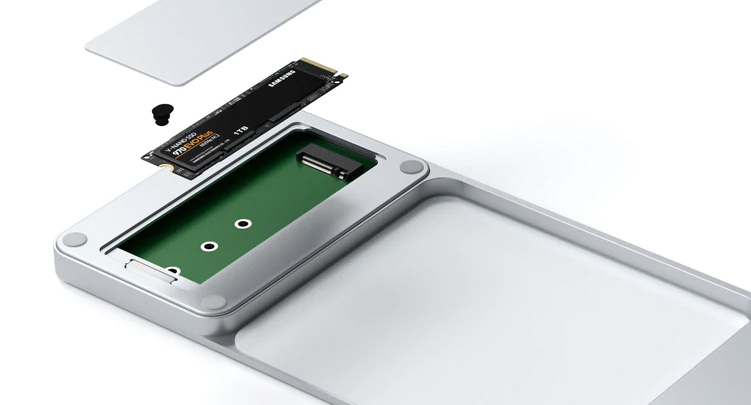
Another neat trick the USB-C dock has up its sleeve is a tool-free NVMe SATA NGFF enclosure. That’s a lot of alphabet soup, but in a nutshell, it means you can install a small solid state harddrive to extend the storage available on your computer, all at 10 Gbps speeds.
Add a harddrive in your dock? It makes so much sense it hurts. Image Credits:Satechi.
The dock costs $150, but the company is running an early-bird special that knocks $30 off the price if you order now. Deliveries start now-ish. If I didn’t have a dumb Windows box as my work computer, my finger would be twitching over the “add to cart” button right now.






 Indian short video app ShareChat’s parent company Mohalla Tech
 Pinterest