



Max Q: Capped

Hello and welcome back to Max Q. I hope all my American readers had a restful Independence Day. In this issue:

  • Rocket Lab launches NASA’s CAPSTONE mission
  • The first images from James Webb Space Telescope are almost here
  • News from AWS, SpaceX and more

Don’t forget to sign up to get the free newsletter version of Max Q delivered to your inbox. And by the way…TechCrunch+ is having an Independence Day saleSave 50% on an annual subscription here. More information here.

Relativity Space inks deal with OneWeb, reaches $1.2B in Terran R launch contracts

Relativity Space will be sending OneWeb’s second-gen broadband satellites to orbit starting in 2025 using its fully reusable 3D-printed rocket Terran R, under a new multi-launch agreement. This is the fifth customer for Terran R, and the only one that has been publicly named, bringing the total value of all binding launch agreements for that rocket to more than $1.2 billion.

I spoke to CEO Tim Ellis on the news. He was pumped, as one might expect!

“To have such large contracts signed before launching, and before even launching Terran 1, I think is really speaking to the confidence that people have in the team and in our approach,” he said.

We also chatted about the company’s latest generation of its line of 3D printers, which it calls Stargate. Ellis said this new gen can print up to 10 times faster than the previous generation. But just how fast is that? At the current rate they’re demonstrating, a Stargate can print a Terran 1 fuselage in just five days. That’s not a typo.
Relativity Space Tim Ellis Stargate

Relativity Space CEO Tim Ellis with Stargate. Image Credits: Relativity Space

Get hype for the first images from NASA’s James Webb Space Telescope

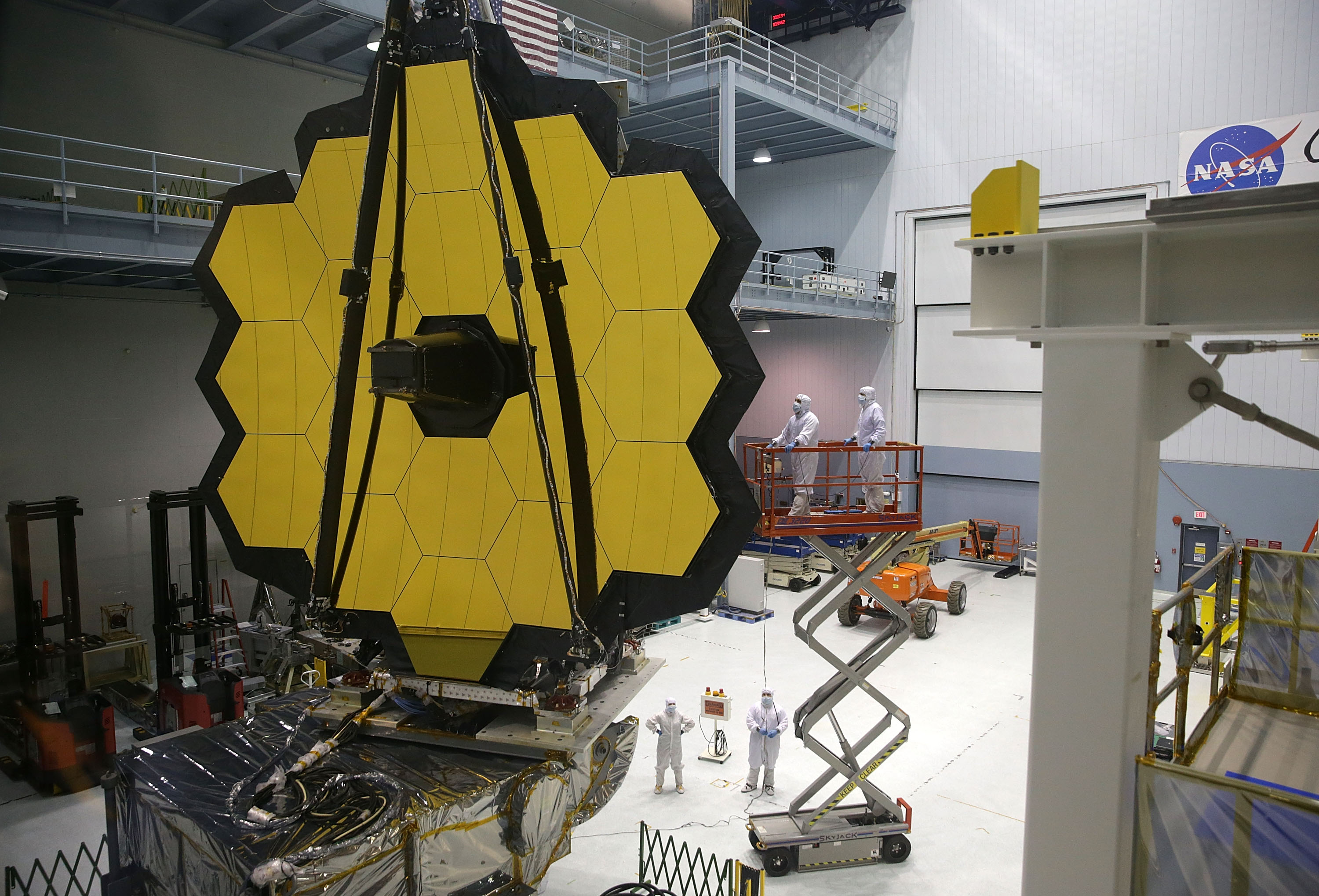
Very soon, humanity will get to view the deepest images of the universe that have ever been captured. In two weeks, the $10 billion James Webb Space Telescope (JWST) — NASA’s super expensive, super powerful deep space optical imager — will release its first full-color images, and agency officials today suggested that they could just be the beginning.

“This is farther than humanity has ever looked before,” NASA Administrator Bill Nelson said during a media briefing Wednesday (he was calling in, as he had tested positive for COVID-19 the night before). “We’re only beginning to understand what Webb can and will do.”

Check back with TechCrunch for coverage of the image release on July 12. Mark your calendars!
james webb space telescope

GREENBELT, MD – NOVEMBER 02: Engineers and technicians assemble the James Webb Space Telescope November 2, 2016 at NASA’s Goddard Space Flight Center in Greenbelt, Maryland. The telescope, designed to be a large space-based observatory optimized for infrared wavelengths, will be the successor to the Hubble Space Telescope and the Spitzer Space Telescope. It is scheduled to be launched in October 2018. Image Credits: Alex Wong/Getty Images

More news from TC…

  • Asterix Aeronautics founder Fia Jones on how she wooed Rocket Lab CEO Peter Beck to launch her startup, over at TC+.
  • China National Space Administration released a series of images of Mars taken by its Tianwen-1 spacecraft, in case anyone needed any further proof that the country’s space program is one to be taken seriously.
  • Rocket Lab launched NASA’s CAPSTONE mission to the moon from the company’s New Zealand launch complex. CAPSTONE will test a unique lunar orbit that could eventually be used by a lunar outpost/space station.

…and beyond

  • Airbus UK won a €160 million ($168 million) contract from the European Space Agency to develop a satellite capable of measuring heat emitted by Earth into space.
  • Axiom Space and Collins Aerospace, the two companies that won bids to develop the next space suits for NASA astronauts, were the only companies to place bids.
  • Boeing and NASA may conduct the first crewed flight of Boeing’s Starliner spacecraft as early as this December, according to internal schedules obtained by Eric Berger, though the agency has not yet set an official date.
  • Expace, a developer of solid rockets and a subsidiary of the state-owned defense company China Aerospace Science and Industry Corporation, closed a $237 million Series B round.
  • Leanspace, a French startup, closed a $6.35 million seed round for its space-focused cloud platform.
  • NASA’s Space Launch System rocket could see flight as early as August 23. That flight would be the uncrewed maiden voyage for the $20 billion rocket.
  • SpaceX launched SES-22, a geostationary communications satellite, bringing the total number of Falcon 9 rocket launches this year to 27.
  • SpaceX obtained permission from the U.S. Federal Communications Commission to begin operating its Starlink satellite broadband service on a range of vehicles, including boats, airplanes and RVs.
  • Velo3D made a $250,000 in-kind investment in Plasmos, a propulsion startup developing rocket engines.
  • Venture Orbital Systems closed a $10.4 million Series A to continue developing its orbital launcher, Zephyr.
  • Virgin Orbit set up a Brazilian subsidiary and received regulatory approval to conduct launches of its LauncherOne craft from Brazil as soon as 2023.

Image of the week
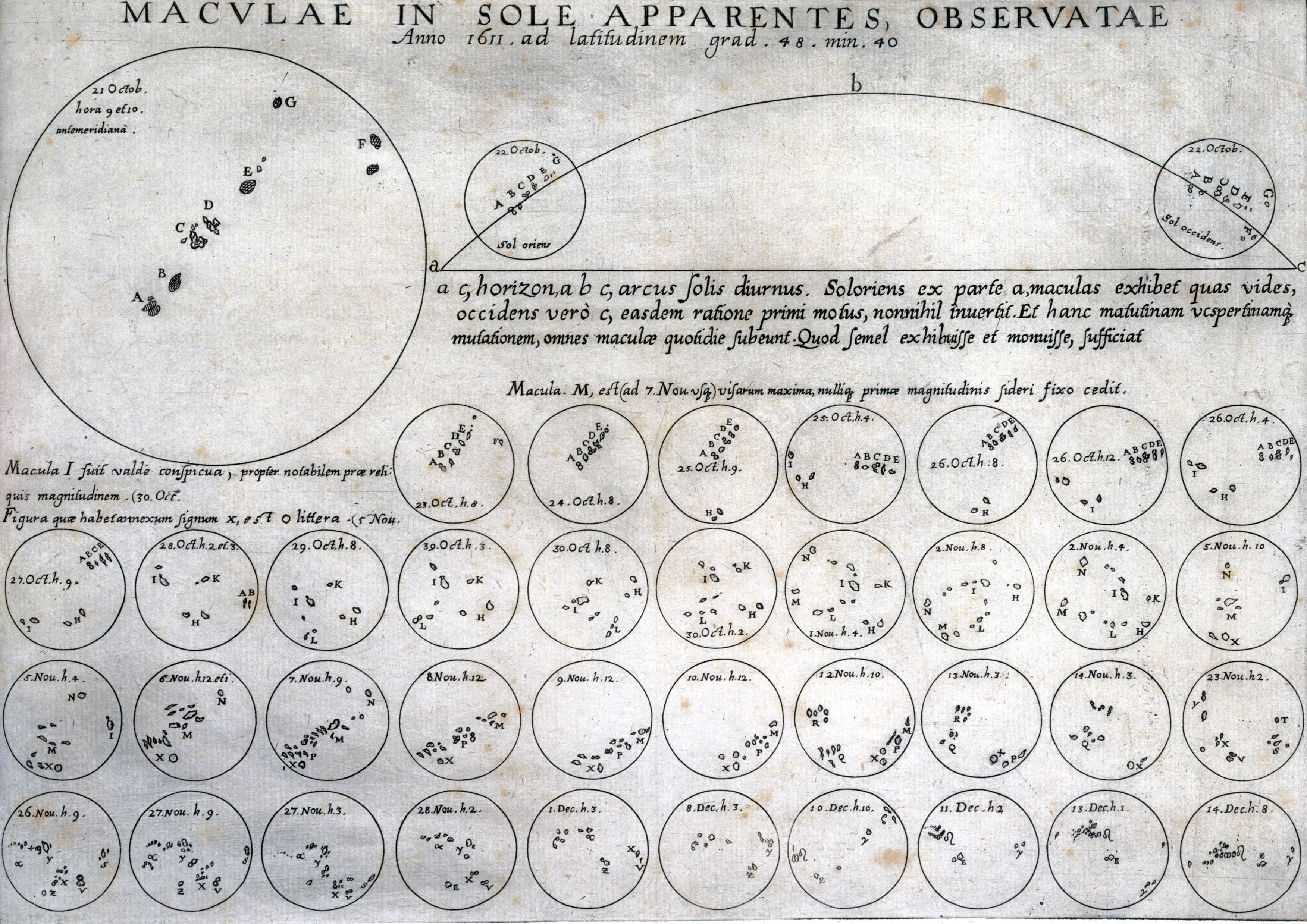
Galileo Galilei sunspots

This illustrated plate, published in 1613 by Italian astronomer Galileo Galilei, shows the movement of sunspots on the Sun’s surface. Twenty years after this image was published, he was found guilty of heresy by the Roman Inquisition, in part due to his belief that the Earth was not the center of the universe. Image Credits: SSPL/Getty Images

Max Q is brought to you by me, Aria Alamalhodaei. If you enjoy reading Max Q, consider forwarding it to a friend. 


from https://ift.tt/UEougPs
via Technews

Share:

FTX policy exec says its ‘priorities have not changed’ amid market madness

As the crypto markets continue to trend downward, the world’s second-largest crypto exchange, FTX, remains undeterred.

“Our priorities have not changed,” Mark Wetjen, head of policy and regulatory strategy at FTX, told TechCrunch. “Markets will do what they do, but the reality is that the digital asset marketplace and digital asset ecosystem, we believe, is here to stay.”

If anything, the exchange, last valued at $32 billion, has the potential to become something of a savior for a number of struggling crypto companies. At the least, it’s been in the news often enough to give that theory some credence.


TechCrunch+ is having an Independence Day sale! Save 50% on an annual subscription here. (More on TechCrunch+ here if you need it!)


For one, FTX has reportedly gathered over $2 billion for acquisitions and stakes in other companies. The company has also launched a $2 billion venture capital fund earlier this year to back teams building in web3.

“One of the challenges of operating in the space is the relative lack of clarity.” Mark Wetjen, head of policy, FTX

from https://ift.tt/R5mK3Lj
via Technews
Share:

Just how wrong were those 2021 valuations?

Happy Monday. It’s Independence Day here in the United States, which means that much of TechCrunch is on holiday. But as last week came to a close, several important pieces of data dropped that are worth our consideration. Let’s not let that opportunity pass, day off or not. (Also, this is the last day of our Fourth of July sale, so, you know, feel free to contribute to, ahem, TechCrunch’s financial independence as well!)

The bits of data that came out on Friday included Klarna’s potentially final new valuation, which is settling even lower than we anticipated, and the conclusion of the FTX-BlockFi drama, which we need to unpack because the numbers are a little harder to parse than the headline figures you might have seen over the weekend.


TechCrunch+ is having an Independence Day sale! Save 50% on an annual subscription here.
(More on TechCrunch+ here if you need it!)


Let’s compare the figures with 2021 prices, discuss the discrepancies thereof, and then chat through which other companies might be in trouble based on the somewhat shocking math we have ahead of us. Just how far from the mark did some startup pricing get last year? This far:



Klarna and BlockFi as warning shots

As always when discussing negative news items, we’re not here to crow. Instead, we want to parse new data so that we can better understand the state of the market. Covering layoffs, down rounds and the like is not nearly as much fun as covering IPOs. So, here’s to getting back to that when possible.

Regardless, the bad news summarizes as follows:


from https://ift.tt/1k9QsuI
via Technews
Share:

Meta is pulling the plug on its crypto payments wallet, Novi

Three years after Facebook announced its ill-fated push into cryptocurrency, aka the Libra project, the tech giant has signalled another scaling back of its activity — announcing Friday that Novi, the digital wallet payments pilot it launched last October, will be ending on on September 1.

In a statement provided to CoinDesk, the tech giant that’s now known as Meta suggested it has plans to repurpose the digital wallet technology (neé Calibra) for future products, including those related to its eponymous focus on “metaverse” development. Although it’s not clear exactly what Meta might have in mind for repurposing the Novi tech.

Senior Meta execs have talked up the metaverse as a major opportunity for digital commerce. Albeit, they’ve also cautioned over the lengthy timescales that will be required to develop the sought for market — suggesting it could take decades.

In recent months, the company has also been testing support for digital collectables (aka NFTs) — so Meta having its own digital wallet infrastructure could support a wider push into non-fungible token trading if it decides there’s enough money to be made on that front (but, again, NFT trading volumes are steeply down vs last year — as digital collectables catch crypto’s chill).

The Novi pilot, meanwhile, was a lot more basic: It enabled testers to make fee-free, instant personal payments via the Novi app, using a stablecoin as the transfer medium — with Meta’s marketing claiming its tech made sending money “as easy as sending a message”. The pilot was limited to users in the US and Guatemala.

A limited integration with WhatsApp was also rolled out last December for a subset of US users of the Facebook-owned messaging platform.

However the wallet project was generally hampered by Meta’s crypto ambitions never having panned out as hoped — in the face of regulatory push-back and withering support.

Following years of governance scandals, it’s fair to say that Facebook’s reputational troubles impeded its ability to ‘move fast and break things’, as crypto raised the stakes for regulatory concerns, around issues like money laundering and currency volatility.

Hence, at launch, Novi was already scaled back vs the original ambition — involving another stablecoin, USDP, rather than the coin associated with the Libra project itself (Diem), for example.

More recently, writing on the wall for the digital wallet included the departure of Meta’s top crypto exec: David Marcus, who had headed up Novi, and who announced his departure in November.

Then, in January, the Libra/Diem Association, aka the consortium Meta had originally set up to back and steer the crypto project, announced it was winding down — selling off the assets of the Diem stablecoin. Aka: Game over.

A note on Novi’s website informing users of the looming end of the payment pilot offers no color or context on Meta’s decision to pull the plug — with the tech giant merely writing:

“Novi will no longer be available for use after September 1. Before Novi goes away, we’ve made it easy for you to get your remaining balance and download your Novi information.”

There is, for example, no mention of the wider crypto market free fall that’s led to dramatic sell offs in recent months and ramped up scrutiny of stablecoins over concerns about stability. Nor rising attention internationally to crypto regulation. But changing market conditions are likely to be cooling Meta’s interest. 

Meta was contacted for comment.


from https://ift.tt/v1PBumk
via Technews
Share:

The Station: Robotaxi roadblock and Tesla layoffs hit Autopilot team

The Station is a weekly newsletter dedicated to all things transportation. Sign up here — just click The Station — to receive it every weekend in your inbox.

Welcome back to The Station, your central hub for all past, present and future means of moving people and packages from Point A to Point B.

Happy July 4th for all Americans, in the U.S. and abroad. On this independence day, I’ve been thinking a lot about freedom of movement — this is after all a newsletter dedicated to mobility. I’m talking about the privileges and immunities clause in the U.S. Constitution, Article IV, Section 2, Clause 1.

The fundamental right of movement, includes interstate travel. Consider reviewing the clause; I suspect it will get more attention in a post Roe v. Wade world.

Since this is a holiday weekend, I’ll keep this short and sweet. See you next week.

Oh, one item to flag. Our regular founder Q&A series went a bit further afield this week. Rebecca Bellan interviewed Fia Jones, who at 19 approached Rocket Lab founder and CEO Peter Beck at a party and told him she had an idea that would change the game for powering satellites. She’d be happy to tell him all about it … if he’d be willing to sign a nondisclosure agreement. Fia’s startup is Astrix Astronautics.

As always, you can email me at kirsten.korosec@techcrunch.com to share thoughts, criticisms, opinions, or tips. You also can send a direct message to @kirstenkorosec

Micromobbin’

Bird has been experiencing quite a bit of drama lately, what with the NYSE giving it a warning for trading at too low of a stock price and having to let go 23% of staff. This week, CEO Travis VanderZanden has stepped down from a role as president to be succeeded by Shane Torchiana, Bird’s COO. VanderZanden will maintain his position as CEO and chair of the board. 

Bo Mobility, a UK-based e-scooter manufacturer, recently launched a new scooter with a unibody frame that gives it a seamless, curvy appearance and a stable, smooth riding experience. The company was founded by ex-Formula One engineers, so it’s certainly got promise. 

The dawn of the electric micro-bike – like something between a scooter and a bike.

I have no idea if any of them are good, but targeted advertising has taught me that you can buy electric mototaxis wholesale off Alibaba

Gozem, a West African super app, has raised $10 million to expand its fleet of electric moto-taxis.

Global revenue from shared mobility, including car rentals, ride hailing and bike-share apps, are expected to generate an annual revenue of $660 billion in 2030, which is nearly 40% increase from revenue generated in 2020. 

Numan, a German-Indian startup, is using Audi-sourced second life batteries to bring electric rickshaws to India.

Populus was selected as the mobility management program for the new launch of Chicago’s permanent shared scooter program. The company will share vehicle and trip data with the city so it can manage vehicle caps, parking policies, equity zones, curb management solutions and more. In other Populus news, former Spin CEO Ben Bear has signed on as an advisor to the company.

Why e-bike companies need to give their vehicles USB-C charging.

The UK is extending shared scooter trials until May 2024!

Velotric, a mobility startup led by Lime’s hardware co-founder Adam Zhang, has launched its first e-bike, the Discover 1. It’s got a straight back riding posture so it’s comfortable to ride, a range of 60 miles on a single charge, a removable battery pack and it’s not too expensive – $1,399. 

 — Rebecca Bellan

Deal of the week

money the station

Every time I drive an EV on a long road trip — that is not a Tesla — I’m disappointed by the charging infrastructure in the United States. Maybe this deal will change that.

I’m talking about Volkswagen Group subsidiary Electrify America raising $450 million in a deal that includes its first external investor as it aims to accelerate its rollout of ultra-fast charging stations in the U.S. and Canada.

The deal, which values North America’s largest ultra-fast EV charging network at $2.45 billion, includes more than $100 million from German industrial company Siemens and additional capital from VW Group.

Other deals that got my attention …

Bykea, Pakistani bike ride-sharing and on-demand delivery startup, raised $10 million from existing backers Prosus Ventures, MEVP, Sarmayacar, Tharros and Ithaca Capital.

Clarios International, a low-voltage vehicle battery manufacturer based in Wisconsin, revived its IPO. The company disclosed plans to raise up to $100 million. Renaissance Capital notes this is likely a placeholder for a deal and estimates the company could raise up to $1 billion.

Mottu, a São Paulo-based motorcycle rental startup, raised $30 million in equity in a Series B round of funding. The company also secured $10 million in debt financing.

Paragon ID, a provider of identification solutions for e-ID, transport and smart cities, traceability, brand protection and payment, acquired UrbanThings. Terms of the deal were not disclosed.

Tenet, a drive now, pay later fintech startup focused on EV auto loans, raised $18 million in a seed round led by San Francisco-based Human Capital and London’s Giant Ventures.

Zipp Mobility raised a $6.1 million Series A to expand beyond Ireland into Europe.

Notable reads and other tidbits

Advanced driver assistance systems

Tesla gutted the data annotation team working on Autopilot, laying off nearly 200 employees and shutting down the San Mateo, California office where they worked.

Autonomous vehicles

Cruise robotaxis stopped operating and sat in a street in San Francisco late Tuesday night, blocking traffic for a couple of hours until employees arrived and manually moved the autonomous vehicles.

Aurora, Luminar, UPS and Waymo are among a group of 34 autonomous vehicle developers, California business organizations, and automotive and logistics companies that signed an open letter to Governor Gavin Newsom asking him to revisit the California Department of Motor Vehicles’s 2015 prohibition on the operation of autonomous trucks in the state.

Waymo’s most serious crash to date (which was not its fault) and that involved a self-driving truck might have resulted in only moderate injuries, but it exposed how unprepared local government and law enforcement are to deal with the new technology.

Waymo announced a partnership with JB Hunt to deliver goods for its customer Wayfair in a pilot program.

Electric vehicles & batteries

CATL, a battery behemoth in China, might not be a household name. But it should be. Check out this feature on CATL and the man who runs it.

Cadillac is reportedly pricing the Celestiq, the brand’s halo EV set to debut during Monterey Car Week in August, around $300,000. TechCrunch looks at Cadillac’s large-scale ambitions for this small-batch car.

Canoo might be facing more problems, this time on the factory side of things. Tulsa World reports that plans by Canoo to build a production plant at Mid-America Industrial Park may be delayed by unfavorable economic conditions.

Drako Motors, an EV startup, released details on its 2,000-horsepower Drako Dragon Super-SUV.

Hyundai previewed the IONIQ 6 sedan, the heavily-anticipated follow-up to the brand’s popular first battery-electric model, the IONIQ 5 SUV. The automaker won’t announce details such as the IONIQ 6’s price range and production run size until the vehicle’s world premiere in July.

J.D. Power released its U.S. Initial Quality Study and found that  battery-electric vehicles and plug-in hybrids have more problems than the average car.

LFP batteries: An older, cheaper and safer battery technology already dominating China’s electric vehicle industry is now poised to reshape battery manufacturing worldwide and boost EV sales in the United States, Jaclyn Trop reports in this TC+ deep dive.

Nikola adjourned its annual meeting to July 18, giving the company time to lobby shareholders to pass a money-raising measure to issue more shares of common stock.

Rivian opened its first three EV fast charging sites in California and Colorado as part of the automaker’s bid to build out an “adventure” network along interstates as well as locations near recreational activities aligned with its customer base

Tesla delivered 254,695 electric vehicles globally in the second quarter, a nearly 18% drop from the previous period as supply chain constraints, China’s extended COVID-19 lockdown and challenges around opening factories in Berlin and Austin took their toll on the company. The QoQ drop is the first in two years.

Volkswagen Group unveiled its ID. AERO concept in China, which is mean to serve as the inspiration behind the automaker’s flagship EV, and first-ever global all-electric sedan, next year.

In-car tech

BMW Group tapped Valeo to provide the advanced driver assistance system for the automaker’s new electric vehicle platform due to launch in 2025.

Updates to a right to repair law in Massachusetts prompted automakers represented by the Alliance for Automotive Innovation to file a lawsuit. The outcome has been delayed yet again. A federal judge postponed a decision this past week — the third time since March that the long-awaited ruling has been delayed.

People

Activist investors are shouting for the Securities and Exchange Commission to intervene in Tesla’s shrinking board.

Hyzon Motors appointed Shawn Yadon president of commerical. He will be responsible for the commercialization of the North American market while supporting Hyzon’s strategic position of the production and sales of its hydrogen fuel cell vehicles.

Owen Diaz, a former elevator operator at Tesla’s Fremont factory who accused the company of racial discrimination, will once again face off against the automaker in court.

Volta, the EV charging network, appointed Yifan Tang as Chief Technology Officer.

Woven Planet Holdings, a subsidiary of Toyota Motor, hired John Absmeier as chief technology officer, effective July 25, 2022. He will report to Woven Planet CEO James Kuffner.


from https://ift.tt/oSrmw2W
via Technews
Share:

Crypto platform Vauld suspends withdrawals, trading and deposits amid financial challenges

Vauld, a Singapore-headquartered crypto lending and exchange startup, has suspended withdrawals, trading and deposits on its eponymous platform with immediate effect as it navigates “financial challenges,” it said Monday.

The startup — which counts Peter Thiel-backed Valar Ventures, Coinbase Ventures and Pantera Capital among its backers and has raised about $27 million — said it is facing financial challenges amid the market downturn and has seen customer withdrawals of about $198 million since June 12.

Vauld founder and chief executive Darshan Bathija said the startup is exploring restructuring options and has engaged with Kroll for financial advice and Cyril Amarchand Mangaldas and Rajah & Tann for legal advice in India and Singapore,

“We are confident that, with the advice of our financial and legal advisors, we will be able to reach a solution that will best protect the interests of Vauld’s customers and stakeholders,” he wrote in a blog post, adding that the startup will make “specific arrangements” for customer deposits to meet their margin calls.

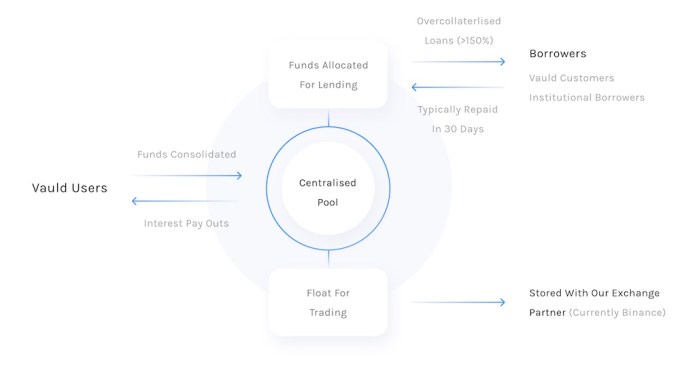
Vauld enables customers to earn what it claims to be the “industry’s highest interest rates on major cryptocurrencies.” On its website, it says it offers 12.68% annual yields on staking several so-called stablecoins including USDC and BUSD and 6.7% on Bitcoin and Ethereum tokens. The platform also facilitated several other trading services.

An illustration of how Vauld works. (Image: Vauld)

“We seek the understanding of customers of the Vauld platform that we will not be in a position to process any new or further requests or instructions in this regard. Specific arrangements will be made for customer deposits as may be necessary for certain customers to meet margin calls in connection with collateralised loans,” Bathija wrote today.

The announcement follows Vauld cutting its workforce by 30% two weeks ago.

The move comes as a surprise. On June 16, Bathija had assured Vauld customers that the platform had no exposure to Celsius, another lending startup that is facing increasing financial challenges, and Three Arrows Capital, one of the high-profile crypto hedge funds that filed for a Chapter 15 bankruptcy over the weekend.

“We remain liquid despite market conditions. Over the last few days, all withdrawals were processed as usual and this will continue to be the case in the future,” Bathija wrote earlier.


from https://ift.tt/VF5lAjO
via Technews
Share:

Juragan Material is simplifying Indonesia’s complicated construction supply chain

Indonesia’s construction industry is large and growing quickly, but a lot of supply procurement is still done the old-fashioned way, through phone calls and text messages. Juragan Material wants to make things easier with a B2B marketplace for building materials from curated suppliers.

The company announced today it has raised $4 million in seed funding led by Go-Ventures, with participation from Susquehanna International Group (SIG).

The new capital will be used for hiring, increasing Juragan Materials’ market share and technological enhancements.

Founded in 2021, the company’s marketplace currently has more than 9,000 products and over 180 brands, including structural, architectural, mechanical and electrical products. It is meant for use by contractors and project owners, and helps them source materials more quickly.

Before launching Juragan Materials, Tito Putra, CEO and co-founder, was a managing director of a building contractor firm.

All the startup’s other founders also have experience working in the construction industry. Chief operating officer Graceila Putri was a product associate at Amazon and worked on growth for a building contractor firm. Chief marketing officer Ricky Fernando previously worked in marketing and relations as Mortindo, a mortar producer, and chief procurement officer Meichael Surja was an architect and contractor on residential products for more than 15 years.

Putra said it often took days for him to source a single item, including time spent checking with multiple vendors for pricing and availability.

He also dealt with deliveries that could not be tracked and arrived late and offline payment and invoicing processes that were long and frustrating. This resulted in high working capital costs and potential losses because of overstocks and over- or under-supply.

Juragan Materials was created to simplify the last leg of the supply chain for the construction industry.

“We recognized that construction is a huge market that is still very conventional and untapped by technology, resulting in a lot of inefficiencies happening in the industry,” Putra said.

Juragan Materials new capital will be used to improve its platform and launch more features, scale-up its customer and vendor acquisitions and enhance its supporting infrastructure, particularly financing and logistics, Putra added.


from https://ift.tt/x25EOe8
via Technews
Share:

Popular Post

Search This Blog

Powered by Blogger.

Labels

Labels

Most view post

Facebook Page

Recent Posts

Blog Archive