Benitago Group exec confirms it didn’t close, but did lay off some employees

Benitago Group’s website no longer working this week set off an alarm bell for some folks, those who regularly follow the comings-and-goings of active fulfillment-by-Amazon aggregators. They believed it might spell the end for the e-commerce aggregator, which raised $380 million in equity and debt financing last year.

Co-founder Benedict Dohmen confirmed to TechCrunch via a LinkedIn message that “Benitago (or any related entity) is not shutting down its operations. We have not sold or disposed of any assets.” Though the company did make a few acquisitions this year, it shifted gears toward brand incubation and operations, or essentially developing their own brands.

And unfortunately, this decision led the company to cut staff. One former colleague, who wished to remain anonymous, told me they were with the company for only about three months before his department was let go. Dohmen confirmed the layoffs.

“We unfortunately had to reduce the size of our teams by 14%, primarily in the M&A and talent acquisition departments,” he said. “We underestimated the probability and impact of an e-commerce market downtrend. As the world has changed and market pressure for probability rose, we shifted focus towards incubation and operations.”

The company was started by Benedict Dohmen and Santiago Nestares (Benitago, get it?) back when they were at Dartmouth College seven years ago. We profiled the company in March 2021 when it raised $55 million in both equity and debt to go about funding acquisitions of brands built to sell on Amazon’s marketplace.

Benitago leaning into brand development was more of a return to its roots than anything, Dohmen said. The company began as an incubator and operator. It wasn’t until later in 2021, around the time the company raised a whopping $325 million in Series A equity and debt, that it developed “an acquisitive M&A arm,” he added.

E-commerce aggregators buy up brands from marketplaces, like Amazon and Shopify. As we’ve reported, just this week in fact, these kinds of businesses have seen their sector go from very hot two years ago to cool. Some have continued to do well, even grabbing the now random venture capital deal, while others found the funding firehose dry up.

Dohmen, too, noted that the shift in strategy to focus on brand incubation and operations was “due to the increasing cost of debt.”

The new focus seems to be paying off for the company now. The incubation effort accounts for 20% of Benitago’s business and is growing 88% quarter over quarter, Dohmen said. Consolidated revenue in the third quarter was up 308% from last year, and this quarter “was Benitago’s most profitable and cash-flowing quarter yet,” he added.

The company has since developed five international brands, operates over 10 brands and has more than 300 new products in the pipeline.

Dohmen doesn’t believe Benitago is done with M&A, but does admit that future acquisitions will be “more targeted,” and instead of casting a wide net on Amazon, it “will only seek brands that fit with our current brands’ strategic direction.”

“We regret being overly optimistic and not foreseeing the e-commerce downtrend and the rising cost of capital,” Dohmen said. “We take full responsibility and are sad about the reduction in team. But we’re excited about the brands and products we have in the pipeline, and we’re excited to come out of this recession much stronger.”

Benitago Group exec confirms it didn’t close, but did lay off some employees by Christine Hall originally published on TechCrunch


from https://ift.tt/Vsu1mDN
via Technews
Share:

Stability AI backs effort to bring machine learning to biomed

Stability AI, the venture-backed startup behind the text-to-image AI system Stable Diffusion, is funding a wide-ranging effort to apply AI to the frontiers of biotech. Called OpenBioML, the endeavor’s first projects will focus on machine learning-based approaches to DNA sequencing, protein folding and computational biochemistry.

The company’s founders describe OpenBioML as an “open research laboratory” — and aims to explore the intersection of AI and biology in a setting where students, professionals and researchers can participate and collaborate, according to Stability AI CEO Emad Mostaque.

“OpenBioML is one of the independent research communities that Stability supports,” Mostaque told TechCrunch in an email interview. “Stability looks to develop and democratize AI, and through OpenBioML, we see an opportunity to advance the state of the art in sciences, health and medicine.”

Given the controversy surrounding Stable Diffusion — Stability AI’s AI system that generates art from text descriptions, similar to OpenAI’s DALL-E 2 — one might be understandably wary of Stability AI’s first venture into healthcare. The startup has taken a laissez-faire approach to governance, allowing developers to use the system however they wish, including for celebrity deepfakes and pornography.

Stability AI’s ethically questionable decisions to date aside, machine learning in medicine is a minefield. While the tech has been successfully applied to diagnose conditions like skin and eye diseases, among others, research has shown that algorithms can develop biases leading to worse care for some patients. An April 2021 study, for example, found that statistical models used to predict suicide risk in mental health patients performed well for white and Asian patients but poorly for Black patients.

OpenBioML is starting with safer territory, wisely. Its first projects are:

  • BioLM, which seeks to apply natural language processing (NLP) techniques to the fields of computational biology and chemistry
  • DNA-Diffusion, which aims to develop AI that can generate DNA sequences from text prompts
  • LibreFold, which looks to increase access to AI protein structure prediction systems similar to DeepMind’s AlphaFold 2

Each project is led by independent researchers, but Stability AI is providing support in the form of access to its AWS-hosted cluster of over 5,000 Nvidia A100 GPUs to train the AI systems. According to Niccolò Zanichelli, a computer science undergraduate at the University of Parma and one of the lead researchers at OpenBioML, this will be enough processing power and storage to eventually train up to 10 different AlphaFold 2-like systems in parallel.

“A lot of computational biology research already leads to open-source releases. However, much of it happens at the level of a single lab and is therefore usually constrained by insufficient computational resources,” Zanichelli told TechCrunch via email. “We want to change this by encouraging large-scale collaborations and, thanks to the support of Stability AI, back those collaborations with resources that only the largest industrial laboratories have access to.”

Generating DNA sequences

Of OpenBioML’s ongoing projects, DNA-Diffusion — led by pathology professor Luca Pinello’s lab at the Massachusetts General Hospital & Harvard Medical School — is perhaps the most ambitious. The goal is to use generative AI systems to learn and apply the rules of “regulatory” sequences of DNA, or segments of nucleic acid molecules that influence the expression of specific genes within an organism. Many diseases and disorders are the result of misregulated genes, but science has yet to discover a reliable process for identifying — much less changing — these regulatory sequences.

DNA-Diffusion proposes using a type of AI system known as a diffusion model to generate cell-type-specific regulatory DNA sequences. Diffusion models — which underpin image generators like Stable Diffusion and OpenAI’s DALL-E 2 — create new data (e.g. DNA sequences) by learning how to destroy and recover many existing samples of data. As they’re fed the samples, the models get better at recovering all the data they had previously destroyed to generate new works.

Stability AI OpenBioML

Image Credits: OpenBioML

“Diffusion has seen widespread success in multimodal generative models, and it is now starting to be applied to computational biology, for example for the generation of novel protein structures,” Zanichelli said. “With DNA-Diffusion, we’re now exploring its application to genomic sequences.”

If all goes according to plan, the DNA-Diffusion project will produce a diffusion model that can generate regulatory DNA sequences from text instructions like “A sequence that will activate a gene to its maximum expression level in cell type X” and “A sequence that activates a gene in liver and heart, but not in brain.” Such a model could also help interpret the components of regulatory sequences, Zanichelli says — improving the scientific community’s understanding of the role of regulatory sequences in different diseases.

It’s worth noting that this is largely theoretical. While preliminary research on applying diffusion to protein folding seems promising, it’s very early days, Zanichelli admits — hence the push to involve the wider AI community.

Predicting protein structures

OpenBioML’s LibreFold, while smaller in scope, is more likely to bear immediate fruit. The project seeks to arrive at a better understanding of machine learning systems that predict protein structures in addition to ways to improve them.

As my colleague Devin Coldewey covered in his piece about DeepMind’s work on AlphaFold 2, AI systems that accurately predict protein shape are relatively new on the scene but transformative in terms of their potential. Proteins comprise sequences of amino acids that fold into shapes to accomplish different tasks within living organisms. The process of determining what shape an acids sequence will create was once an arduous, error-prone undertaking. AI systems like AlphaFold 2 changed that; thanks to them, over 98% of protein structures in the human body are known to science today, as well as hundreds of thousands of other structures in organisms like E. coli and yeast.

Few groups have the engineering expertise and resources necessary to develop this kind of AI, though. DeepMind spent days training AlphaFold 2 on tensor processing units (TPUs), Google’s costly AI accelerator hardware. And acid sequence training data sets are often proprietary or released under non-commercial licenses.
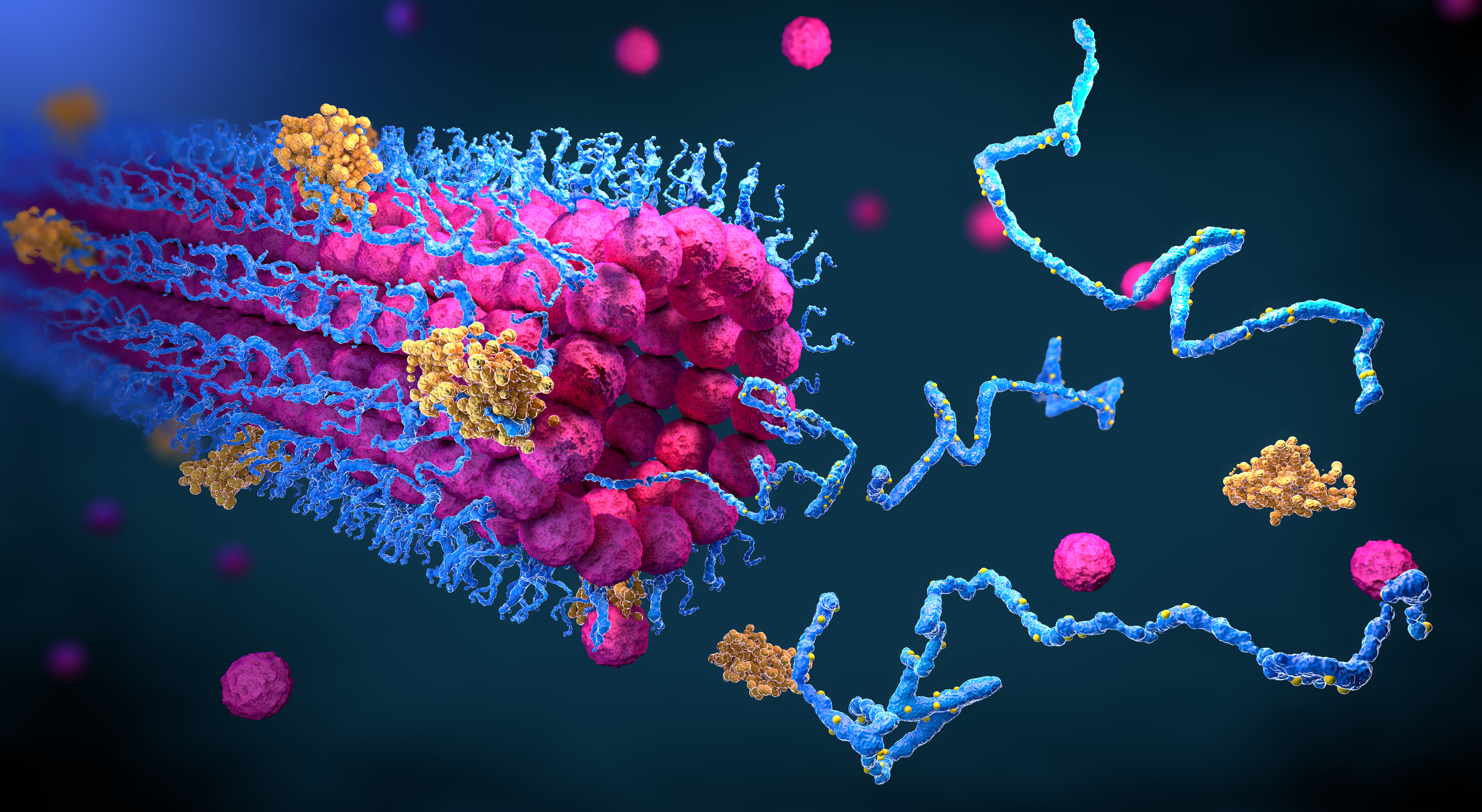
Proteins folding into their three-dimensional structure. Image Credits: Christoph Burgstedt/Science Photo Library / Getty Images

“This is a pity, because if you look at what the community has been able to build on top of the AlphaFold 2 checkpoint released by DeepMind, it’s simply incredible,” Zanichelli said, referring to the trained AlphaFold 2 model that DeepMind released last year. “For example, just days after the release, Seoul National University professor Minkyung Baek reported a trick on Twitter that allowed the model to predict quaternary structures — something which few, if anyone, expected the model to be capable of. There are many more examples of this kind, so who knows what the wider scientific community could build if it had the ability to train entirely new AlphaFold-like protein structure prediction methods?”

Building on the work of RoseTTAFold and OpenFold, two ongoing community efforts to replicate AlphaFold 2, LibreFold will facilitate “large-scale” experiments with various protein folding prediction systems. Spearheaded by researchers at University College London, Harvard and Stockholm, LibreFold’s focus will be to gain a better understanding of what the systems can accomplish and why, according to Zanichelli. 

“LibreFold is at its heart a project for the community, by the community. The same holds for the release of both model checkpoints and data sets, as it could take just one or two months for us to start releasing the first deliverables or it could take significantly longer,” he said. “That said, my intuition is that the former is more likely.”

Applying NLP to biochemistry

On a longer time horizon is OpenBioML’s BioLM project, which has the vaguer mission of “applying language modeling techniques derived from NLP to biochemical sequences.” In collaboration with EleutherAI, a research group that’s released several open source text-generating models, BioLM hopes to train and publish new “biochemical language models” for a range of tasks, including generating protein sequences.

Zanichelli points to Salesforce’s ProGen as an example of the types of work BioLM might embark on. ProGen treats amino acid sequences like words in a sentence. Trained on a dataset of more than 280 million protein sequences and associated metadata, the model predicts the next set of amino acids from the previous ones, like a language model predicting the end of a sentence from its beginning.

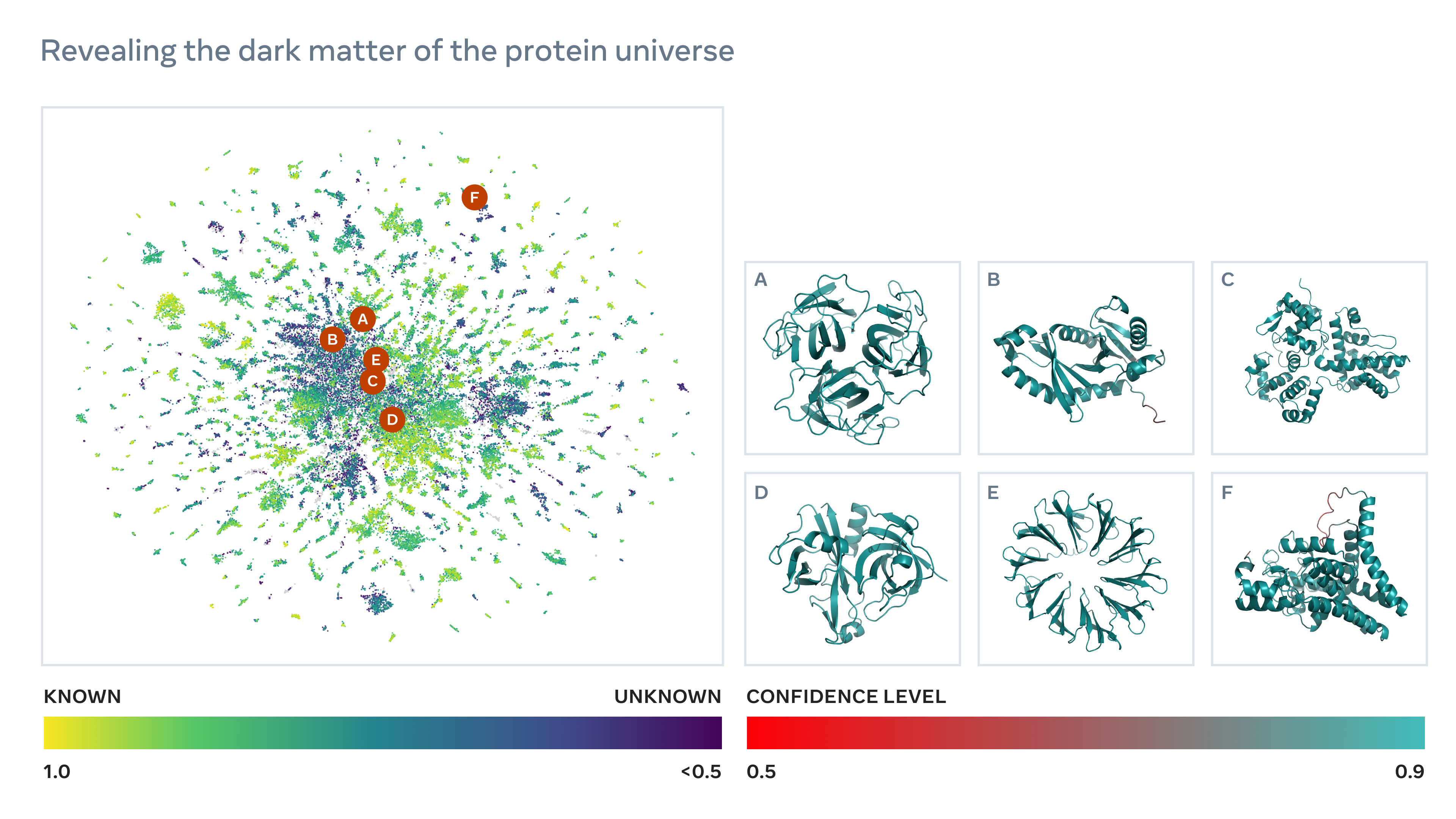
Nvidia earlier this year released a language model, MegaMolBART, that was trained on a dataset of millions of molecules to search for potential drug targets and forecast chemical reactions. Meta also recently trained an NLP called ESM-2 on sequences of proteins, an approach the company claims allowed it to predict sequences for more than 600 million proteins in just two weeks.
Meta protein folding

Protein structures predicted by Meta’s system. Image Credits: Meta

Looking ahead

While OpenBioML’s interests are broad (and expanding), Mostaque says that they’re unified by a desire to “maximize the positive potential of machine learning and AI in biology,” following in the tradition of open research in science and medicine.

“We are looking to enable researchers to gain more control over their experimental pipeline for active learning or model validation purposes,” Mostaque continued. “We’re also looking to push the state of the art with increasingly general biotech models, in contrast to the specialized architectures and learning objectives that currently characterize most of computational biology.”

But — as might be expected from a VC-backed startup that recently raised over $100 million — Stability AI doesn’t see OpenBioML as a purely philanthropic effort. Mostaque says that the company is open to exploring commercializing tech from OpenBioML “when it’s advanced enough and safe enough and when the time is right.”

Stability AI backs effort to bring machine learning to biomed by Kyle Wiggers originally published on TechCrunch


from https://ift.tt/imNzhEQ
via Technews
Share:

Hear NASA’s science and tech ambitions from Carolyn Mercer at TC Sessions: Space

TechCrunch Sessions: Space returns on December 6, and among our distinguished guests is Dr. Carolyn Mercer, chief technologist for NASA’s Science Mission Directorate, who will share the agency’s tech and science ambitions and priorities in the Artemis era.

Mercer is a NASA veteran and started as a research engineer at Glenn before ascending through the ranks to her current role. As the “focal point” for new tech and capabilities in all the forms of science and research that the agency uses and funds, she has a powerful bird’s-eye (or orbital) view of its operations.

Of course with a new focus on lunar exploration and habitation, as well as increased reliance on commercial partners, NASA is in the middle of a complex evolution. How do government projects and commercial enterprises safely and securely share knowledge? What is the role of an expert agency in the growing private space economy? And how does it all serve humankind’s knowledge of the cosmos?

With experience in scientific, engineering, and leadership roles, Mercer can speak to the power of NASA-led technological advancement in both space exploration and everyday life. Join us December 6 to hear where the agency is placing its bets and investing its considerable resources.

You won’t find a better atmosphere for networking with hundreds of engineers, founders, students, investors, executives, and military and government officials in the house. Use our event app to find people you want to connect with, schedule 1:1 meetings, and explore potential opportunities for collaboration, partnerships, investment and more.

TC Sessions: Space takes place on December 6 in Los Angeles, but your chance to buy your early-bird pass and save disappears end of day today Friday, November 4 at 11:59 p.m. (PDT). We can’t wait to see you in LA!

Is your company interested in sponsoring or exhibiting at TC Sessions: Space? Contact our sponsorship sales team by filling out this form.

Hear NASA’s science and tech ambitions from Carolyn Mercer at TC Sessions: Space by Devin Coldewey originally published on TechCrunch


from https://ift.tt/BQTDZv8
via Technews
Share:

Why Robinhood and Coinbase gained ground after reporting earnings

You’d be forgiven for expecting public fintech companies that facilitate consumer trading to be under pressure this week. And yet, after reporting earnings, the share prices of two pandemic-era highfliers gained ground. Coinbase and Robinhood up? In this economy? Yes.

Of the out-of-fashion tech sectors, consumer trading has to be among the most out of favor. And yet.

TechCrunch wanted to better understand investor response to results from both Coinbase (crypto-focused) and Robinhood (equities-focused) to figure out what drove each company’s shares higher in the wake of their reports. The answers, it turns out, are partially related.


The Exchange explores startups, markets and money.

Read it every morning on TechCrunch+ or get The Exchange newsletter every Saturday.


In an ironic twist, some of the forces that have made consumer trading less attractive are the very same impulses helping the two companies derive more revenue from a previously less-critical part of their business. The Federal Reserve taketh away, and the Fed also giveth some back.

Why Robinhood and Coinbase gained ground after reporting earnings by Anna Heim originally published on TechCrunch


from https://ift.tt/id7VtBT
via Technews
Share:

Rocket Lab will attempt to catch an Electron rocket booster with a helicopter again

Rocket Lab is gearing up for a second attempt to catch a rocket booster mid-air using a helicopter, a technique the company is hoping to perfect after a partially successful recovery earlier this year.

The mission, playfully dubbed “Catch Me If You Can,” is scheduled to take place no earlier than November 4 from the company’s launch site on New Zealand’s Mahia Peninsula. The 75-minute launch window opens at 1:15 PM EST. It will be the 32nd Electron launch to date.

The company aims to carry a single science research satellite for the Swedish National Space Agency, provided by OHB Sweden, to sun synchronous orbit. The Mesopheric Airglow/Aerosol Tomography and Spectroscopy satellite will be used to study atmospheric waves and their relationship to wind and weather patterns in different parts of the atmosphere.

Catching a rocket booster mid-air is no small feat — even with the parachute that the booster releases to slow its descent to Earth. During the first helicopter recovery attempt on May 2, the Sikorsky S-92 helicopter did manage to grab hold of the parachute line around 6,500 feet above the ocean, but released it almost immediately. The pilot offloaded the booster after noticing “different load characteristics” than had been experienced during testing, a Rocket Lab spokesperson said at the time. Like other recovery attempts, the booster was dropped into the sea and recovered via boat.

Once again, Rocket Lab will be deploying its Sikorsky S-92 helicopter shortly before launch. The S-92, built by Connecticut-based Sikorsky Aircraft, is capable of lifting 5,000 kilograms, a capacity that’s more than sufficient for the 1,000-kilogram Electron booster. Rocket Lab outfitted the helicopter with a capture hook, extended range fuel tanks and other features to ensure that the three-person crew — a pilot, co-pilot and rocket spotter — are set up for success.

“Our first helicopter catch only a few months ago proved we can do what we set out to do with Electron, and we’re eager to get the helicopter back out there and advance our rocket reusability even further by bringing back a dry stage for the first time,” Rocket Lab CEO Peter Beck said in a statement.

Rocket Lab, which was founded in 2006, has taken a relatively iterative testing approach. It conducted two missions, in November 2020 and May 2021, where the booster was equipped with a parachute (no helicopter present) and the company gathered data on its descent. The company also used booster simulators and studied boosters fished out of the ocean to better understand their condition upon returning to Earth.

Beck has said that reusability is key to increasing launch cadence and reducing vehicle manufacturing costs. The heavier-lift Neutron rocket, which is still under development, is also being designed for reusability.

Rocket Lab will attempt to catch an Electron rocket booster with a helicopter again by Aria Alamalhodaei originally published on TechCrunch


from https://ift.tt/lskGu3C
via Technews
Share:

Amazon exec confirms corporate hiring freeze through end of year

Given the on-going economic headwinds and the company’s expensive belt-tightening under CEO Andy Jassy, it ought not come as a surprise that Amazon has instituted a corporate hiring freeze. The retail giant’s Senior Vice President of People Experience and Technology, Beth Galetti, confirmed the move in a staff memo that has since been published on Amazon’s own blog.

In the letter, Galetti notes that the company had already begun pausing or slowing hiring in various corporate departments in “recent weeks.” The move has since been applied to “new incremental hires” across its corporate business for “the next few months.” The “corporate” caveat here is likely meant to differentiate the roles from positions like those in Amazon fulfillment centers across the U.S., as the company ramps up for the holidays.

There are other potential exceptions, as well, including replacements for employees who have vacated existing roles. The executive adds that the company plans to add “a meaningful number of people” next year.

“We’re facing an unusual macro-economic environment, and want to balance our hiring and investments with being thoughtful about this economy,” writes Galetti. “This is not the first time that we’ve faced uncertain and challenging economies in our past. While we have had several years where we’ve expanded our headcount broadly, there have also been several years where we’ve tightened our belt and were more streamlined in how many people we added. With fewer people to hire this moment, this should give each team an opportunity to further prioritize what matters most to customers and the business, and to be more productive.”

Jassy, the AWS head who took over Amazon founder Jeff Bezos’ CEO role in July 2021, has been looking for meaningful ways to cut costs across the company. He reportedly noted in a corporate all-hands earlier this month, “Good companies that last a long period of time, who are thinking about the long term, always have this push and pull. There are some years where they’re expanding really broadly. Some years where they’re checking in and working on profitability, tightening the belt a little bit. And sometimes when you have multiple businesses like we do at Amazon, some businesses are expanding at the same time that others are checking in.”

Amazon is certainly not alone in such decisions, either. Meta CEO Mark Zuckerberg announced plans for cost cutting measures and a hiring freeze at the social media giant back in September.


Amazon exec confirms corporate hiring freeze through end of year by Brian Heater originally published on TechCrunch


from https://ift.tt/yrtgCWH
via Technews
Share:

Bitcoin’s future could hinge on mines over matter

Image Credits: TechCrunch

Welcome back to Chain Reaction.

Last week on the podcast, we talked about Apple’s App Store tax and how it could hinder NFT adoption. This week, we dug up a few stories about bankruptcies brewing in the bitcoin mining sector and asked ourselves whether this could unfold in a similar way to the troubles faced by DeFi lenders just a few months ago. 

We’re incredibly excited to chat with some of the biggest names in web3 at our first dedicated crypto event in Miami on November 17. We’ll be hearing from experts such as FTX’s Amy Wu, OpenSea’s Devin Finzer and Binance’s Changpeng Zhao on how their companies are shaping the future of the industry. We’d love to have you join us: use the promo code REACT for 15% off a General Admission ticket.

Do you want Chain Reaction in your inbox every Thursday? Sign up here: techcrunch.com/newsletters.

this week in web3

Here are some of the biggest crypto stories TechCrunch has covered this week.

Coinbase and Polygon back new crypto advocacy group in India

Top crypto firms including Coinbase and Polygon are among the firms that have formed an industry body in India to promote dialogue between key stakeholders and drive awareness about web3, months after the largest local crypto advocacy group was disbanded. Members of the new industry body, named Bharat Web3 Association (BWA), include top local crypto exchanges, including CoinDCX, CoinSwitch Kuber and WazirX, TechCrunch’s Manish Singh reports.

Web3 infrastructure startup Tenderly takes on Infura, Alchemy with new node offering

Web3 developer tooling startup Tenderly is getting into the node game with a new product it announced today called Web3 Gateway. The new offering is a sign of competition between web3 infrastructure providers heating up, as it puts the startup in direct competition with ConsenSys, the company that owns popular node-as-a-service provider Infura, and Alchemy, another widely used node provider in the industry.

What’s going on with NFT royalties? (TC+)

Creator royalties were originally introduced across the NFT community as a way to pay artists for their work in both primary and secondary sales. In recent months, conversations around these royalties shifted as some platforms, including LooksRare and Magic Eden, abandoned them for other alternatives. Not everyone is happy about it, as the decisions have huge potential implications for creators in the web3 space.

Indonesia weighs blockchain-powered carbon trading scheme

Indonesia wants to direct the blockchain craze toward greener use. The Indonesia Stock Exchange (IDX) has signed a memorandum of understanding with Metaverse Green Exchange (MVGX), a Singaporean startup that specializes in digital exchange technology. The intended collaboration centers around IDX’s emission trading scheme that is slated to launch in 2025, and MVGX’s job is to help IDX build a carbon registry and exchange with blockchain as the infrastructure layer, TechCrunch’s Rita Liao reports.

Ex-Bain investor launches $30M web3 consumer VC fund as solo female founder

Mags Kala was able to raise her first fund as a solo GP focused on early-stage consumer startups in the web3 space in just four months, despite a broader downturn in the crypto market. Her Miami, Florida-based firm, Double Down, blew past its initial fundraising target of $20 million in one month and closed its first fund with a total of ~$30 million this week, according to Kala. The fund has already made nine investments in web3 consumer startups, including Miami-based OnChain Studios, which makes Cryptoys, and Tally Labs, the company behind the Jenkins the Valet & Azurbala franchises.

Magdalena "Mags" Kala is the solo GP behind consumer crypto VC firm Double Down

Magdalena “Mags” Kala is the solo GP behind consumer crypto VC firm Double Down. Image Credits: Courtesy of Magdalena Kala

the latest pod

For this week’s Tuesday episode, where we chat with a web3 expert, we played a recording of our discussion live onstage with a16z GP Chris Dixon that took place recently at TechCrunch Disrupt. We chatted with Dixon about the venture firm’s new creator economy-focused crypto accelerator program, why a16z backed controversial WeWork founder Adam Neumann and where Dixon sees opportunity across the web3 landscape in this bear market.

For our Thursday episode, where we discuss the latest in crypto news, we talked about a string of issues that have unfolded for various bitcoin mining companies over the past month, from Argo Blockchain to Core Scientific, and what it would take to unearth (ha ha, get it?) the sector from its woes.

 We also discussed:

Chain Reaction comes out every Tuesday and Thursday at 12:00 p.m. PT, so be sure to subscribe to us on Apple Podcasts, Overcast and Spotify to keep up with the action.

Chris Dixon speaking at TechCrunch Disrupt in San Francisco on October 18, 2022. Image Credit: Darrell Etherington / TechCrunch

Chris Dixon speaking at TechCrunch Disrupt in San Francisco on October 18, 2022. Image Credits: Darrell Etherington / TechCrunch

follow the money

  1. South Korean video game developer Wemade raised $46 million from Microsoft, Shinhan Asset Management and Kiwoom Securities to expand its web3 presence.
  2. Zebra Labs raised $5 million from the Chinese gaming firm NetDragon and the Japanese conglomerate Sumitomo to help Chinese celebrities enter the metaverse.
  3. Blockchain data terminal Token Flow raised $12 million in a Series A from investors including Electric Capital and Delta Blockchain Fund.
  4. NiftyApes, an NFT lending protocol, snagged $4.2 million in seed funding from Variant, Polygon, Coinbase Ventures and others.
  5. Crypto wallet startup Braavos raised $10 million in a funding round led by Pantera Capital.

This list was compiled with information from Messari as well as TechCrunch’s own reporting.

Bitcoin’s future could hinge on mines over matter by Anita Ramaswamy originally published on TechCrunch


from https://ift.tt/EArRLb0
via Technews
Share:

Popular Post

Search This Blog

Powered by Blogger.

Labels

Labels

Most view post

Facebook Page

Recent Posts

Blog Archive