



Macro machines

The phrase “mission creep” entered the popular discourse in the early to mid-1990s. It popped up in a number of big papers in articles describing the Somali Civil War. Here’s the New York Times in October ’93:

The trick is to do this without inviting what a senior official called “mission creep” — the expansion of the role to include, for example, raiding neighborhoods controlled by General Aidid and searching for weapons.

Like countless military and sports terms before it, we now understand it in a broader context. It’s one of those phrases that perfectly encapsulates a commonly understood experience — projects whose size, scope and focus shift so gradually you hardly even notice. I bring this up in the context of an op-ed the Electronic Frontier Foundation published last year.

“Mission creep is very real,” analyst Matthew Guariglia wrote in July 2021. “Time and time again, technologies given to police to use only in the most extreme circumstances make their way onto streets during protests or to respond to petty crime. For example, cell site simulators (often called “Stingrays”) were developed for use in foreign battlefields, brought home in the name of fighting “terrorism,” then used by law enforcement to catch immigrants and a man who stole $57 worth of food. Likewise, police have targeted BLM protesters with face surveillance and Amazon Ring doorbell cameras.”

Last week I wrote a story titled “It’s time to talk about killer robots.” On reflection, I wonder whether “We missed the boat on killer robots” might have been the better title. Certainly I stand by the “They already walk among us” subtitle. In the piece, I talk about a precedent set by military drones decades ago. I also note the minor firestorm that arose after Boston Dynamics showed videos of Spot being used in Massachusetts State Police hostage drills. The ACLU told us at the time:

We urgently need more transparency from government agencies, who should be upfront with the public about their plans to test and deploy new technologies. We also need statewide regulations to protect civil liberties, civil rights, and racial justice in the age of artificial intelligence.

Police advance on demonstrators who are protesting the killing of George Floyd on May 30, 2020, in Minneapolis, Minnesota. Former Minneapolis police officer Derek Chauvin was arrested for Floyd’s death and is accused of kneeling on Floyd’s neck as Floyd pleaded with him that he could not breathe. Floyd was pronounced dead a short while later. Chauvin and three other officers, who were involved in the arrest, were fired from the police department after a video of the arrest was circulated. Image Credits: Scott Olson/Getty Images

San Francisco Board of Supervisors president Shamann Walton made a comment at a meeting Tuesday night that echoes the ACLU’s sentiment. “We continuously are being asked to do things in the name of increasing weaponry and opportunities for negative interaction between the police department and people of color,” he said. “This is just one of those things.”

Walton was referring to the Board’s 8-3 vote to approve the use of robots for lethal force. The initial proposal prompted last week’s writeup. The vote was prompted by Assembly Bill 481, which California governor Gavin Newsom signed in September of last year. The bill was designed to bring more transparency to police use of military equipment — itself a product of the 1997 National Defense Authorization Act. Section 1033 allows for the military’s “transfer of excess personal property to support law enforcement activities” for the sake of drug enforcement. The subject jumped back into public consciousness recently, courtesy of various large-scale protests over the past couple of years.

The relevant part of Assembly Bill 481 requires a written inventory of the military equipment utilized by law enforcement. The SFPD’s list includes the Lenco BearCat armored vehicle, flash-bang grenades and 15 submachine guns, among others. There are also 17 robots listed — 12 of which are fully functional. None, it should be noted, were designed for killing. Quite the opposite, in fact. They’re mostly bomb detection and disposal robots — the kind police departments have deployed for years.

The proposal sent to the SF Board this week notes:

The robots listed in this section shall not be utilized outside of training and simulations, criminal apprehensions, critical incidents, exigent circumstances, executing a warrant or during suspicious device assessment. Robots will only be used as a deadly force option when risk of loss of life to members of the public or officers is imminent and outweighs any other force option available to SFPD.

That last little bit is the sticking point. It’s effectively an authorization for the use of robots to kill. I will say, I believe it falls under the standard definition of “justified” deadly force, which allows officers to shoot to kill in cases of self-defense or where others are facing death or serious bodily harm.

An earlier attempt to add “Robots shall not be used as a Use of Force against any person” was reportedly removed by the SFPD.

Following the vote, department spokesperson Allison Maxie echoed the language in the initial proposal, stating, “Robots equipped in this manner would only be used in extreme circumstances to save or prevent further loss of innocent lives.” She then outlined a specific use case involving equipping one of the existing robots with an explosive to kill a suspect. Such an application would be the polar opposite of their intended use of detecting and disabling explosives.

Yes, the precedent exists. In 2016, Dallas police used a bomb disposal robot to intentionally kill a suspect — believed to be the first time in the U.S. this has happened. Police chief David Brown told the press, “We saw no other option but to use our bomb robot and place a device on its extension for it to detonate where the suspect was.”

So, mission creep. “Robots will only be used as a deadly force option when risk of loss of life to members of the public or officers is imminent and outweighs any other force option available to SFPD.” There are a lot of ethical questions we need to be asking right now, but let’s start with this: Are bomb disposal robots armed with bombs an end point or the beginning of something even more troubling?

In recent years, we’ve seen guns mounted on robot dogs designed for the battlefield. We’ve also seen plenty of products designed for the battlefield be deployed domestically. For now, this leap is purely hypothetical — but it’s important to have this conversation before it becomes something more than that. “Mission creep” is a great phrase in this context, given its own military origins.

Maxie, it should be noted, rebuked the idea of robots armed with guns, saying it isn’t in the SFPD’s plans. I’m certainly in no position to say with certainty that San Francisco will be arming robots with guns at any point. I will only say that as the years pass, these scenarios feel less and less like speculative fiction.

A handful of prominent robotics firms — including Boston Dynamics, Agility, ANYbotics, Clearpath Robotics and Open Robotics — recently signed a letter condemning the weaponization of “general purpose” robots. It reads, in part:

We believe that adding weapons to robots that are remotely or autonomously operated, widely available to the public, and capable of navigating to previously inaccessible locations where people live and work, raises new risks of harm and serious ethical issues. Weaponized applications of these newly-capable robots will also harm public trust in the technology in ways that damage the tremendous benefits they will bring to society.

I’m quite aware that not everyone feels the same way I do about weaponized robots. I anticipate getting some pushback here. I’ve had numerous conversations with people working in robotics who don’t draw the same ethical distinctions. The argument that putting robots in harm’s way eliminates the risk to police officers and soldiers has its merit. But I’m also naturally inclined to believe that remote operations can have the effect of dehumanizing suspects. Another important question here: Does taking the human out of the situation potentially lower the burden of pulling the trigger?

The answer is complicated because human brains are complicated. Some very interesting studies on the emotional impact of remote killing are being published. Quoting here from “Emotional Reactions to Killing in Remotely Piloted Aircraft Crewmembers [sic] During and Following Weapon Strikes” published in the March 2018 issue of “Military Behavioral Health”:

The majority (76%) of [Predator/Reaper ] crewmembers reported experiencing both positive and negative emotions in response to weapon-strike missions, suggesting that engagement in remote combat operations is emotionally complex.

The paper concludes that the picture of drone missions possessing all the emotional heft of a video game is misleading. And what of the potential biases highlighted by Walton and others above? Not to mention the kind of visceral fear response to weaponized robots roaming the streets.

I will say, I was surprised this passed in San Francisco. It seems like a strange fit for a city that has so long been held up as a bastion of progressive values. Across the Bay last month, a similar proposal was scrapped due to public backlash. What is less surprising, however, is that some board members were clearly concerned about the optics of being painted as anti-cop.

“I think there’s larger questions raised when progressives and progressive policies start looking to the public like they are anti-police,” board member Rafael Mandelman noted during the meeting. “I think that is bad for progressives. I think it’s bad for this Board of Supervisors. I think it’s bad for Democrats nationally.”

I suppose there’s an extent to which a politician’s job is determining the best of various bad optics. For San Francisco Board members, that meant accepting the proposal and, perhaps, hoping potential mission creep doesn’t eventually put the city on the business end of an autonomous rifle.

I can’t imagine this is going to be the last time we discuss this subject in these pages. Stay tuned.
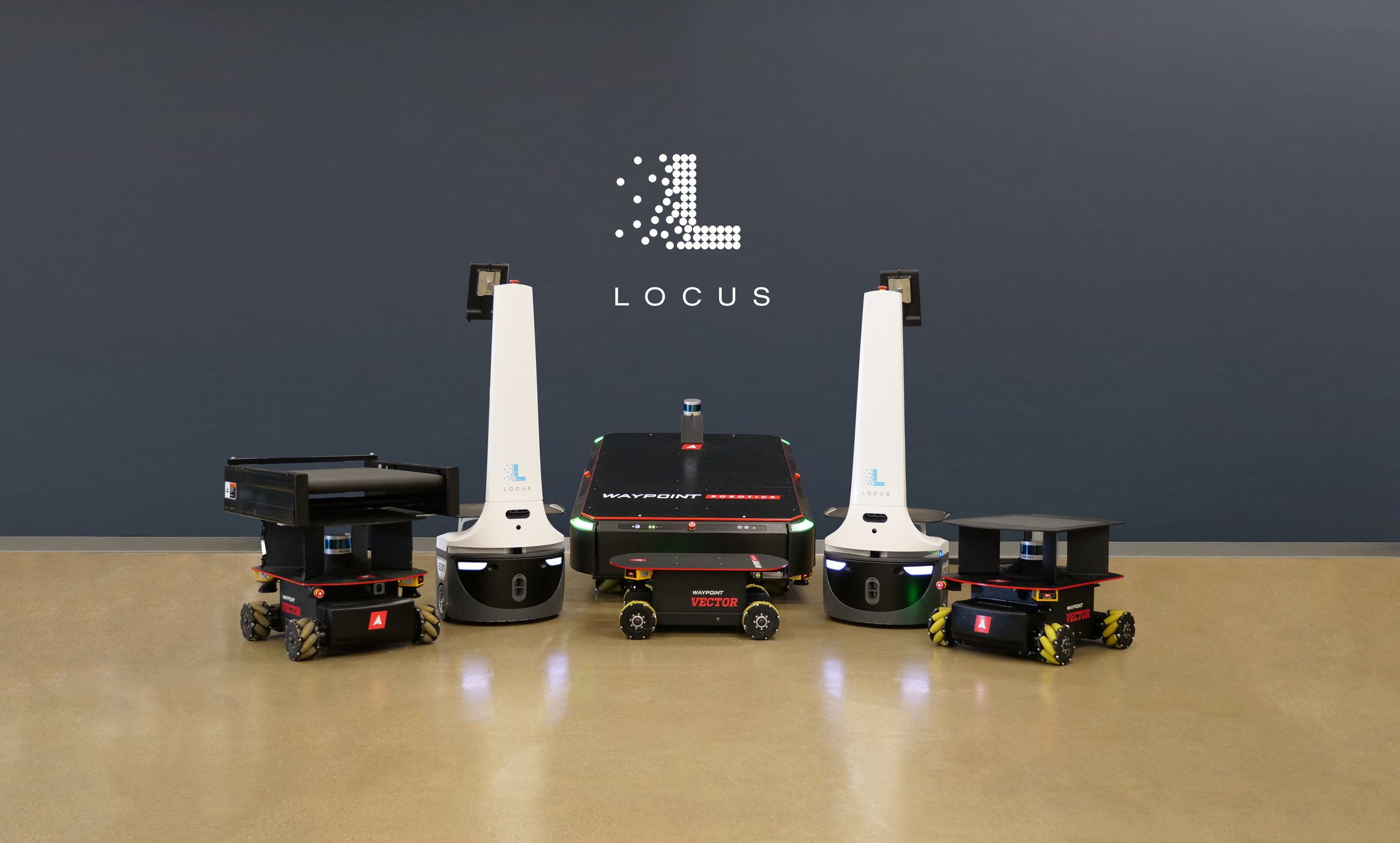
Image Credits: Locus Robotics

Raise news has slowed down a bit. I suspect this is a combination of (1) things generally slowing down in this dead space between Thanksgiving and Christmas here in the U.S., and (2) the general slowdown in VC as economic headwinds persist.

I anticipate asking anyone with funding news during this period the same basic questions, including “Why now?” and “How tough is this macroenvironment?” broadly speaking. Here’s what Locus Robotics’ CEO Rick Faulk had to say on the subject:

In today’s environment, investors are focused on high-quality companies that have both strong growth/market leadership and business unit economics. Therefore, it is important to have a track record and forecast that supports both. Late-stage private companies are competing with beaten down public companies for investment dollars.

Companies are focused on improving operational efficiency and Locus assists with exactly that…therefore, there is strong excitement around being a differentiated solution in a very large end market. The raise will enable Locus to continue to extend its leadership in the market.

Certainly external forces weren’t enough to slow down its massive to-date funding. A new $117 million Series F led by Goldman Sachs, G2 Venture Partners and Stack brings its total north of $400 million, while placing its valuation “close to” $2 billion. In the crowded fulfillment category, the Massachusetts company has made a name for itself with flexible, brownfield robotic systems that can easily adapt to existing warehouse environments.

finger pointing at a tiny, remote-controlled medical robots

Image Credits: Bionaut Labs

And there was a $43.2 million Series B for Bionaut Labs. Based in Los Angeles, the firm is working to commercialize research into magnetically controlled microrobots that can be used to deliver drugs to the midbrain — a more direct application than standard systemically delivered (intravenously, orally, etc.) drugs.

The company’s co-founders, Michael Shpigelmacher and Aviad Maizels, were both involved in PrimeSense, which developed the 3D imaging technology behind Microsoft’s Kinect. Apple acquired the firm in 2013 and has since used its tech as the basis for Face ID.

“There has been a dearth of innovation around treatments for conditions that cause tremendous suffering, in large part because past failures have discouraged even the best of researchers,” Shpigelmacher says about this latest round. “Bionaut Labs remains committed to finding new ways to treat these devastating diseases, which are long overdue for a breakthrough.”

This round will go toward development of a treatment for malignant glioma brain tumors and Dandy-Walker syndrome, as well as future R&D. Bionaut has set a 2023 timeline for preclinical studies, with human trials potentially following the next year.

Bay Area agtech firm Verdant Robotics, meanwhile, recently closed a Series A. Following an $11.5 million 2019 round (initially reported as a Series A, which the company is referring to as its seed), the company has raised $46.5 million to date. Verdant’s aim is to be more than simply a robotic weeder, adding fertilization and pest control to its offering, along with the kind of data collection/analysis that’s really the secret sauce for these sorts of systems.

Image Credits: Owlchemy Labs

All right, that’s it for this week — and for the next few. Your boy is finally getting some of his vacation days in before the end of the year and boldly exploring what it might feel like to not be burned out all the time. I’ll let you know how it goes. In the meantime, I’ve spoken to bigwig industry folks and asked for their thoughts on 2022, 2023, and beyond. We’ll be publishing those in my stead the next few weeks.

See you in just under a month when I go into full CES panic mode.

Image Credits: Bryce Durbin/TechCrunch

Give yourself the gift of Actuator this holiday season.

Macro machines by Brian Heater originally published on TechCrunch


from https://ift.tt/meM1Bhf
via Technews
Share:

Amazon CodeCatalyst provides blueprints for collaborative app development

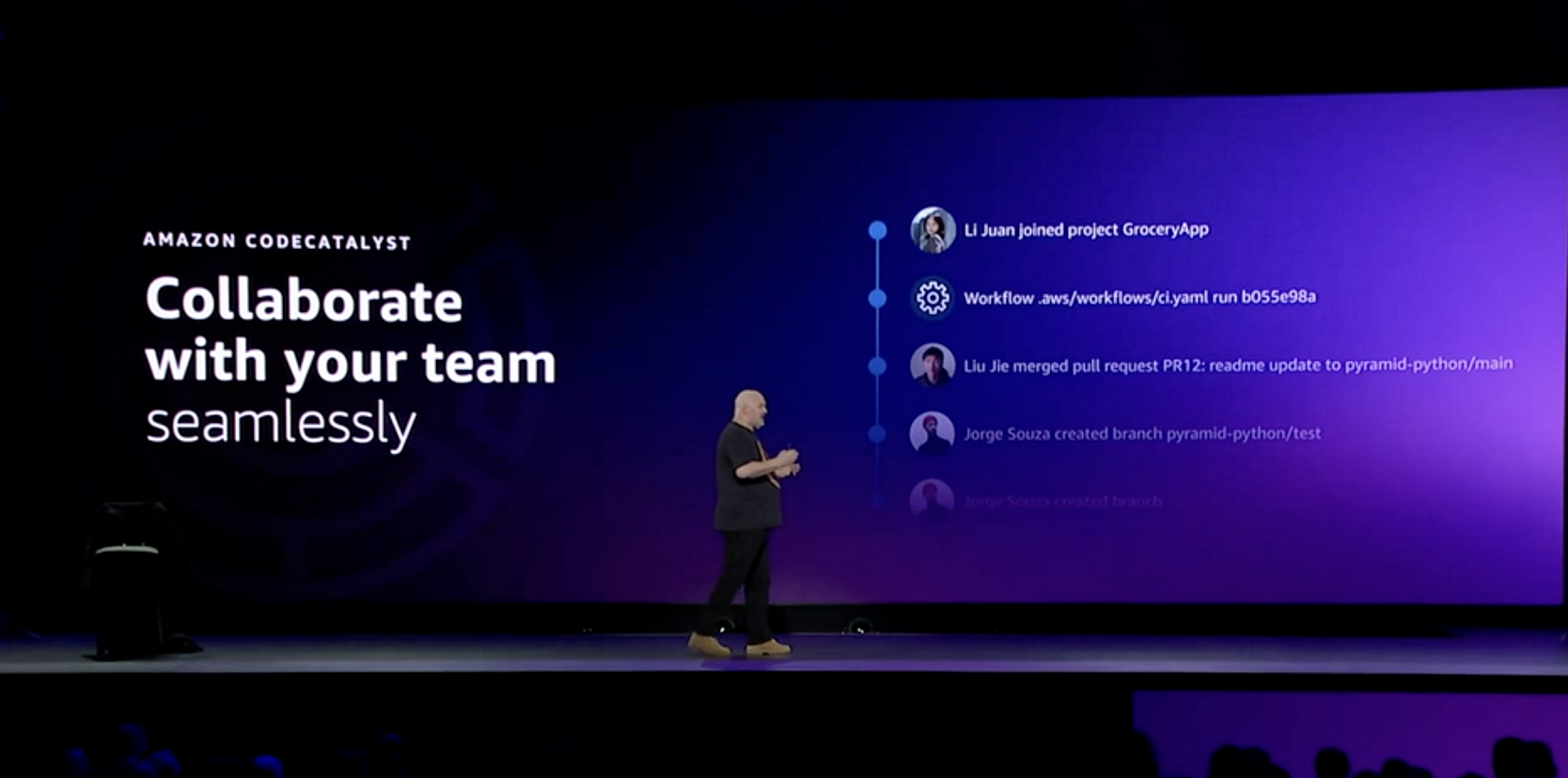
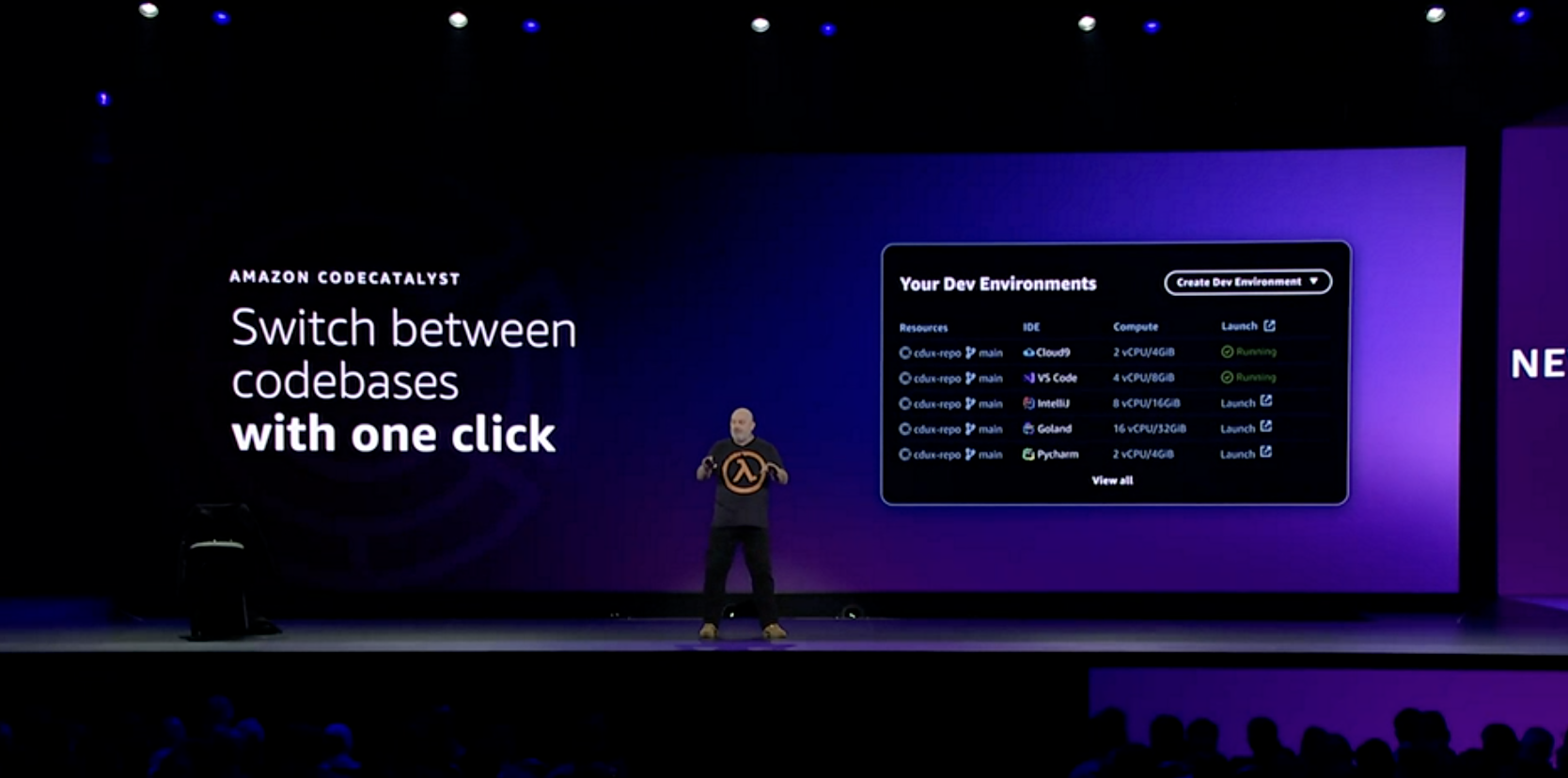
During a keynote at re:Invent 2022 today, Amazon announced CodeCatalyst, a service designed to take away the heavy lifting of working across different codebases, tools and environments to build apps. Based on the concept of blueprints, CodeCatalyst — currently in preview — provides a “single place” developers can use to create an app on Amazon Web Services (AWS), Amazon CTO Werner Vogels said onstage.

“CodeCatalyst makes it very easy for you to switch between [different app development] environments” while creating an app, Vogels said. “You can populate a project with code and dependencies and you can use your favorite [integrated development environment].”

It’s true that, with the widespread shift to digital begun during the pandemic, app developers are facing increased pressure from clients to build faster. Disparate, disorganized tools appear to be getting in the way. According to a 2022 survey of developers and IT professionals by Reveal, 36% cited issues with project management within the digital workplace as one of their top challenges.

Amazon CodeCatalyst

Image Credits: AWS

The aforementioned blueprints allow developers using CodeCatalyst to set up an app project’s scaffolding in addition to the resources needed to support the app’s delivery and deployment. CodeCatalyst’s on-demand, cloud-based dev environments and build infrastructure aim to make it easier for developers and developer teams to manage issues, trace changes across code commits and pull requests, and automate build and release pipelines, Vogels said.

“It’s all about moving fast so that you can focus on building the code, and not spend too much time on all the issues around it,” he added.

As Amazon elaborates in a blog post, the resources that a CodeCatalyst blueprint creates for a project include a source code repository with initial sample code and AWS service configuration or an external Git repository. The blueprint can optionally add an issue tracker (e.g. Jira) as well as other integrated tooling like dashboards to surface a feed of project activities (e.g. test reporting) and unified search across users, issues, code and other project resources.

At launch, AWS customers can choose from blueprints with Typescript, Python, Java, .NET and Javascript for languages and React, Angular and Vue frameworks, Amazon says, with more to come in the future. Regarding the build and release pipeline created by CodeCatalyst, Amazon notes that they’re configurable and can leverage on-demand compute or pre-provisioned builds, including a choice of machine sizes, and that developers can incorporate built-in or third-party build actions or a service such as GitHub Actions.

Amazon CodeCatalyst

Image Credits: AWS

CodeCatalyst’s project resources and integrated dev tools make it so that a developer can press “deploy” and get sample code running, Vogels stressed. Collaboration becomes ostensibly easier with the service, too, thanks to an email-based invitation system that allows devs to start working on a project with just an email address, he asserted.

“Amazon CodeCatalyst takes away all the heavy lifting [of app dev] — it has all the tools you need to go from idea to production much faster,” Vogels said.

CodeCatalyst is available for free starting today on the free AWS tier. No word on whether that pricing might change once the service graduates to general availability.

Amazon CodeCatalyst provides blueprints for collaborative app development by Kyle Wiggers originally published on TechCrunch


from https://ift.tt/UG0ehSp
via Technews
Share:

AWS launches Application Composer, a low-code tool for building serverless apps

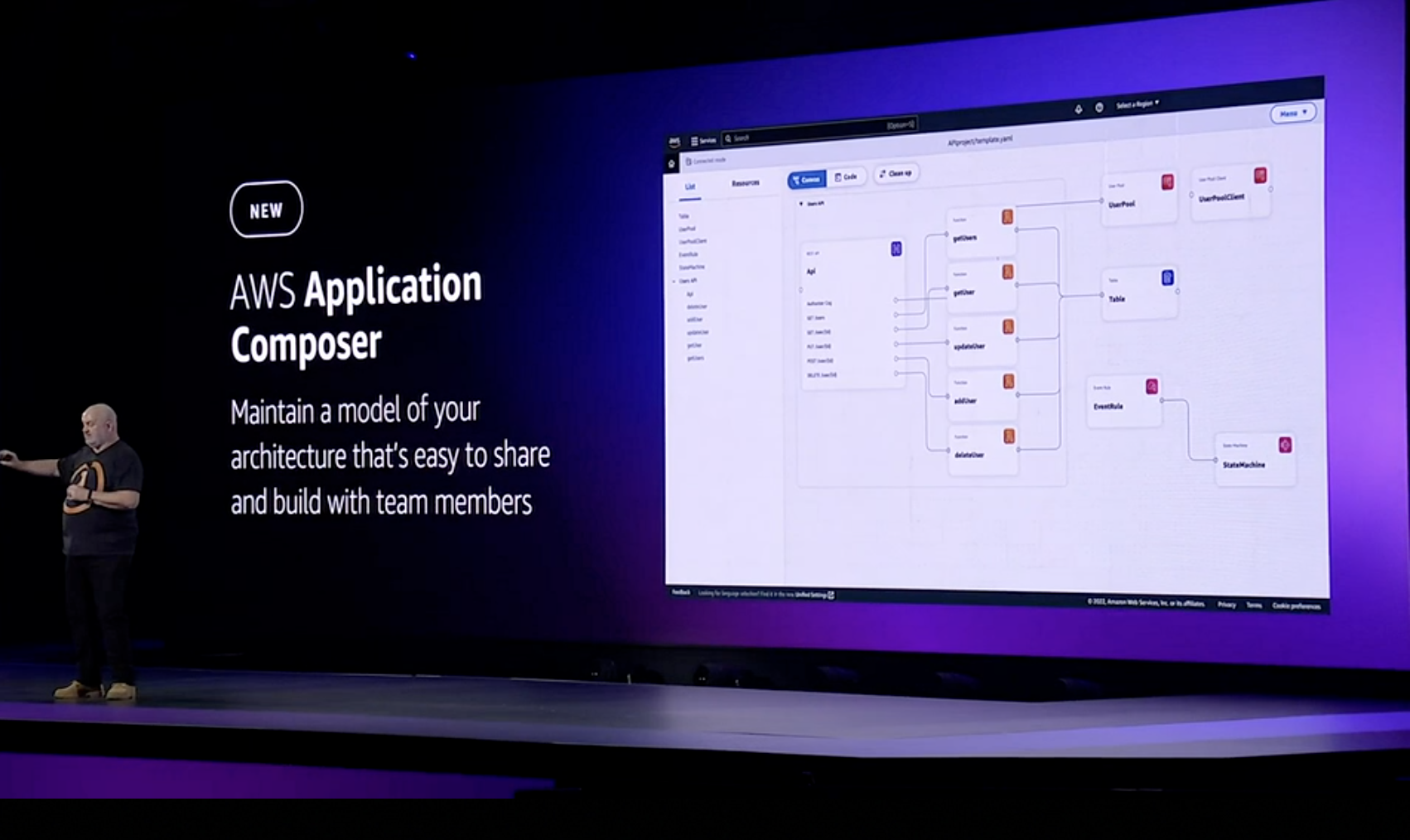
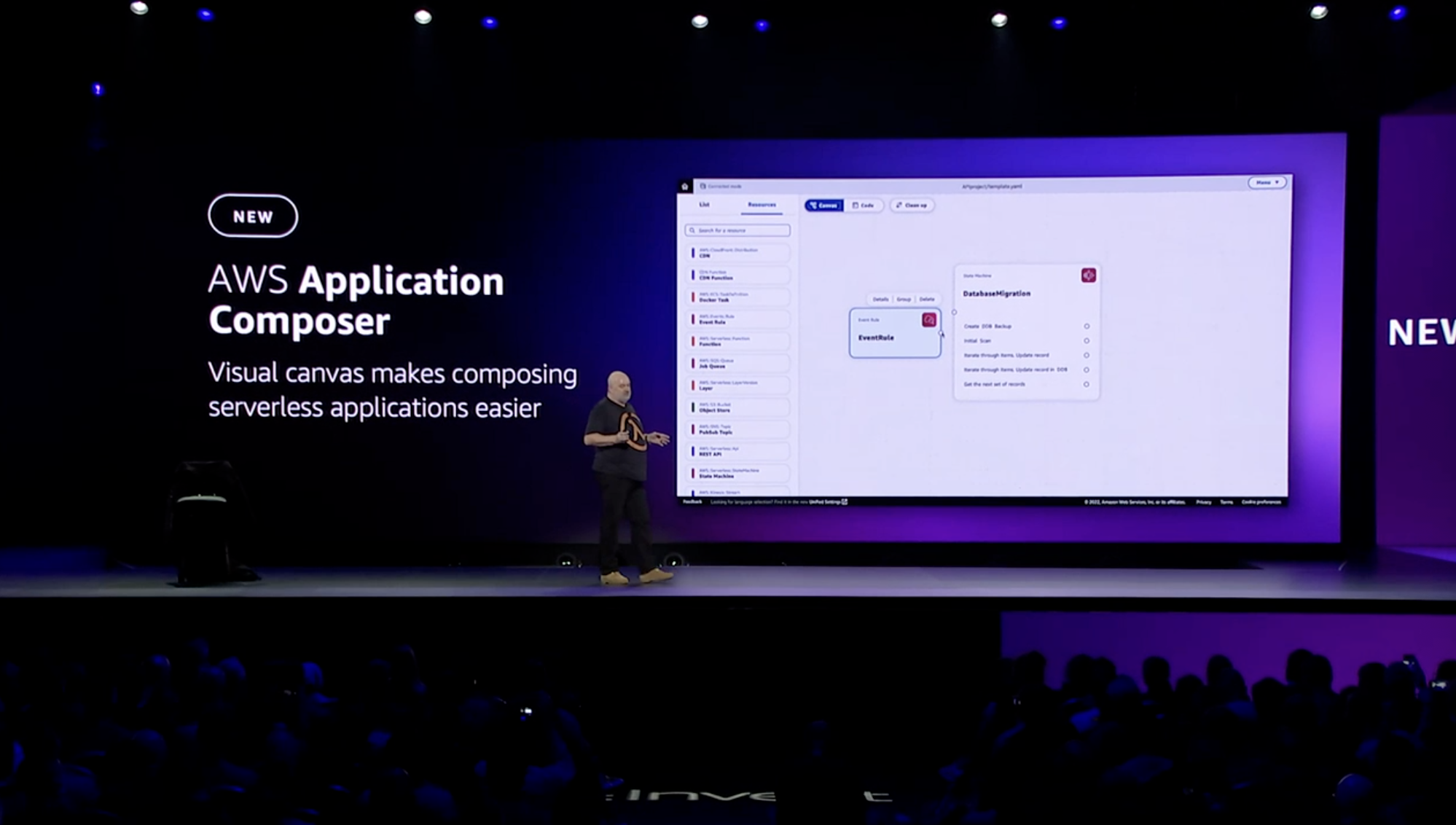
At its re:Invent conference today, AWS announced the launch of AWS Application Composer, a new low-code tool for visually designing and building serverless applications. The service provides developers with a visual canvas and a simple drag-and-drop interface to create the application architecture, connect their resources and design their functions.

As AWS CTO Werner Vogels not during his keynote today, a lot of developers want to get started with building serverless applications but the barrier of entry is still too high for many. In part, that’s because you have to think about serverless applications differently, given that they are generally asynchronous systems (one of the main topics of Vobels’ keynote today). So the team set out to improve this with Application Composer.

“Sometimes developers choose a synchronous system because it’s convenient. They look so much simpler,” he said. “In a synchronous system, you have all these components. In the event-driven [architecture], how they work together can sometimes look a little daunting. So we’ve been thinking about how can we simplify this. How can you make it easier, for example, for developers that never used serverless before? How do you know where to start? Which services do they need? How do they work together? We really wanted to make this easier.”

With Application Composer, developers can easily build functions to perform standard transformation tasks, for example, and then deploy them with just a few clicks.

There is an escape hatch, so developers can then also take this code and continue to work on it in their IDE of choice. But as Vogels noted, because this is a visual system, it’s also now much easier to share this code with colleagues and collaborate on it.

Read more about AWS re:Invent 2022 on TechCrunch

AWS launches Application Composer, a low-code tool for building serverless apps by Frederic Lardinois originally published on TechCrunch


from https://ift.tt/Mr8u431
via Technews
Share:

A tool for analyzing face-to-face sales pitches lands funding from UiPath co-founder

So much software is dedicated to helping businesses improve interactions online, whether it be aimed at sales, marketing or customer service.

But despite the prevalence of the internet and an increase in digital commerce, the fact remains that over 85% of commerce still happens offline in the United States. 

Enter Rillavoice, a new startup with a niche focus: building speech analytics software for field sales teams who sell in person as opposed to via Zoom or over the phone. The company has just raised $3.7 million in seed funding in a round led by Crew Capital, an under-the-radar venture firm co-founded by UiPath co-founder and co-CEO Daniel Dines and UiPath chief strategy officer Brandon Deer.

In its first year of sales, New York-based Rillavoice has grown to seven figures of annual recurring revenue and is “cash flow positive,” according to co-founder and CEO Sebastian Jimenez Bienen, who declined to reveal hard figures. Interestingly, before even launching its software to the public, the startup received significant inbound from “very large” companies, which validated the need for the offering, he said.

“In May and June of 2020, we started getting some of the biggest companies in retail looking inbound on our site, including Fortune 500s and 50s,” Bienen recalls. “They would ask ‘Is this a real thing? How big are you guys?’ We were doing no marketing. But that [interest] told me we had something. And some of them are customers today.” 

Due to competitive reasons, Rillavoice is reluctant to name many of its clients, but Bienen did share a few of its “dozens” of customers, including Window Nation, Rebath and Fortune 500 company Duke Energy. Its software is industry-agnostic and can be applied to a variety of industries, including home services, telecom, solar energy, pharma, insurance, CPG, payments and retail.

“Most sales people in America and around the world do not spend their days sitting in an office, talking to their customers on Zoom,” Bienen said. “They speak with their customers offline, face to face, in their businesses, in their homes, and in their stores…there are billions of face-to-face interactions every month.”

Rillavoice’s software works by allowing sales reps to record conversations with customers, automatically transcribing those conversations to text and then applying machine learning to gain insights that can be used to improve sales practices.” In simpler terms, the aim of the software is to  analyze outside sales teams’ conversations with customers, understand what they say and how they say it and generate insights for managers.

That collection and analysis of data serves a few other purposes: to save time on the part of sales managers, who often spend many hours shadowing sales reps or manually listening to recorded sales calls to provide feedback. Ultimately, the end goal is to help boost revenue for the company.

“The software offers 100 to 1000x more visibility and gives insights 100x faster,” Bienen said. “Our AI is basically doing the ride along for you.”

What gives Rillavoice’s software edge, according to Bienen, can be traced back to one of its co-founders, Michael Castellanos, who previously figured out a way to better predict autism by the sound of children’s voices. In doing so, Castellanos became “obsessed” with artificial intelligence. That ability to apply deep learning to analyze sound has been the foundation of Rillavoice’s software, which the company says leverages “proprietary signal processing and natural language processing algorithms.” 

“It’s really difficult to process audio in person at scale in an accurate way,” said Bienen. “Others who have tried just didn’t figure out the technical complexities.”

Rillavoice spent its early days building and iterating on its offering. It formally started selling its software in January, and is growing ARR by 30% to 50% monthly, according to Bienen. Other co-founders include Chris Martin and Lukasz Niepolski.

The company received significant interest from investors but ultimately agreed to Crew Capital leading its round mostly due to the fact that the team were operators themselves. It also was impressed with the level of due diligence that the venture firm’s team conducted.

“We talked to some other funds but Crew Capital were so number-driven. They called our customers and asked them the right questions. They really dug deep, and we actually learned a lot as founders, such as what numbers we needed to be tracking,” Bienen told TechCrunch.

For the unacquainted, UiPath is one of the leaders in the quickly growing robotic process automation (RPA) space. In early 2021, that company raised $750 million at a staggering $35 billion valuation.

“Rillavoice is transforming outside sales,” said Dylan Reider, partner at Crew Capital. “Many industries’ sales are predicated on reps engaging customers in the field, away from an office setting. Customers love Rillavoice’s mobile-first, user-friendly SaaS platform because it increases sales rep productivity, drives more revenue for the business, and increases managers’ coaching efficiency. At Crew Capital, we back founders with a bold vision to augment or completely reshape an industry through technology, and that is exactly what Rillavoice is doing in outside sales.” 

The firm has quietly backed over 40 companies in the U.S., Europe and Latin America since it was founded two years ago. It started out as a vehicle for joint angel investing for the two general partners, who later brought in Reider to lead the investment team. It is completely separately from UiPath and its venture arm. 

Our model is that a founder has a high degree of flexibility similar to what you’d expect from an angel. We’re willing to either take board seats or target ownership percentages, but we call that flexibility with a really high degree of support,” Reider told TechCrunch. “We’re hands-on to the extent our founders want us to be.”

Check sizes tend to be in the low digit single millions of dollars, and the firm doesn’t typically lead investments but rather serves as more of a “strategic” investor.

Also participating in Rillavoice’s seed financing are Entrepreneurs Roundtable Fund, Jason Calacanis’s Launch Fund, Broom Ventures, Comma Capital and the NYU Innovation Venture Fund. 

Rillavoice plans to use its new capital primarily to 5x its team of 10. 

TechCrunch’s weekly fintech newsletter, The Interchange, launched on May 1! Sign up here to get it in your inbox.

A tool for analyzing face-to-face sales pitches lands funding from UiPath co-founder by Mary Ann Azevedo originally published on TechCrunch


from https://ift.tt/jJYueDg
via Technews
Share:

X1 gets 50% valuation boost, aims to give consumers a way to buy stocks via credit card reward points

X1, a consumer fintech startup which recently launched an income-based credit card to the public, has raised an additional $15 million in funding. 

This round caught our attention for a few reasons. For one, a consumer fintech raising in this environment is a bit counter to the narrative that startups in the space are generally struggling. (For example, digital bank Chime recently laid off 12% of its workforce, or about 160 people.)

Also, notably, X1’s latest financing comes just six months after the San Francisco-based company raised $25 million in a July Series B round. It also is not only not a down or a flat round, the cash infusion boosts X1’s valuation by 50%, according to Deepak Rao, co-founder & CEO of X1.

Rao unfortunately declined to reveal the new valuation or number of cardholders but he did share some other very interesting information around the company’s financials. When X1 started raising for its Series B in late March/early April, it was generating about $1 million per month in revenue, he said. By October, the startup was doing about $3 million in revenue. With these numbers, the company’s annual revenue run rate is $36 million. Very impressive for a company that only went live in private beta 13 months ago and launched its credit card to the public in mid-September – after amassing 600,000 people on its waitlist. 

Gross merchandise value (GMV), also known as spend, too has jumped, according to Rao – from $50 million in July to $55 million in October to an expected $60 million this month. The company is projecting $1 billion in annualized spend for 2022.

That sort of rapid growth caught the attention of several investors, who reached out to X1, Rao told TechCrunch in an interview.

“In the beginning we weren’t considering [raising more money so soon],” he said. “But since it felt like we are one of the few companies in the consumer fintech space getting interest and growing at a good pace and responsibly, we thought we should capitalize on it.”

New investor Soma Capital led X1’s B1 raise, which Rao said was not an extension and closed in early November. Also participating in the latest financing was The Points Guy founder & CEO, Brian Kelly, and Cruise CEO, Kyle Vogt, bringing the series B round total to $40 million. The startup’s long list of previous backers include FPV, Craft Ventures, Spark Capital, Harrison Metal, SV Angel, Abstract Ventures, the Chainsmokers, Global Founders Capital, actor Jared Leto, Box co-founder and CEO Aaron Levie, Jeremy Stoppelman, Affirm and PayPal co-founder Max Levchin and Y Combinator Partner Ali Rowghani.

X1 has raised over $60 million since inception, including a $12 million Series A that closed in 2020 but was announced in January of 2021.

Interestingly, X1 did not fundraise at all in 2021, opting instead to keep its “head down focused on growth and long-term customer value.” This might have actually worked in the company’s favor considering that it was not among the many fintechs that raised at inflated valuations that they are currently trying to defend.

“There just aren’t that many fairly priced companies out there,” Rao told TechCrunch.

In conjunction with the B1 raise, X1 also announced today the launch of a new investing platform that will allow its cardholders to buy stocks with their earned reward points.

The new trading platform will live within X1’s app and will be rolling out to a select number of cardholders in beta in the next several weeks. The plan is for it to be live to the general public by year’s end or early January depending on how the initial rollout goes. Unlike users of current trading apps,  X1 cardholders with access will be able to buy stocks by using earned reward points.

“By using credit card points to buy stock instead of cash or their savings, we feel this is a safe way for many consumers to start investing,” said Rao, who admits the company is hoping to compete with the likes of Robinhood. “There is no real downside as their investing is technically free.”

The startup first made headlines for its unique model which allows it to underwrite customers based on their income rather than their credit scores. (Since then, other players have emerged with similar models – such as Tomo Credit, which offers credit based on cash flow rather than credit). 

X1 doesn’t charge an annual fee for its stainless steel Visa card, has no late or foreign transaction fees and rewards users with “points.” The company also claims that its card is “smart” in that it has built software features that work with the credit card. For instance, my colleague Romain Dillet wrote in 2020, “you can track your subscriptions from the X1 app, you can also generate an auto-expiring virtual card for free trials that require a credit card. You also get notifications for refunds.”

To date, X1 has given over $10 million in reward points.

Interchange fees on purchases represent X1’s primary source of revenue. But it also makes money by giving users incentives – in the form of additional rewards – to shop directly in the shopping portal inside its app using its card. When its cardholders do shop via that portal, X1 gets commission from the featured merchants, which include the likes of Nike.com, Sephora, Kate Spade, Apple, Macy’s and Warby Parker, among others.

X1’s plans for its new capital is market expansion, building out new products and hiring its product and engineering teams. Presently, the company has 36 employees and Rao claims all its growth thus far has been organic.

In recent months, X1 has already made a couple of very high-profile hires, including luring away Abhi Pabba from Apple, where he worked as manager of credit risk out of the tech giant’s Austin office. for the Apple Card, Abhi Pabba, has left the company. Pabba today serves as X1’s chief risk officer.

The company also recently hired Kieran Brady – a former managing director of Barclays, where he started the British bank’s fintech practice – to serve as X1’s chief financial officer (CFO).

 When asked if the CFO hire meant that X1 had its sights on going public, Rao said that is the goal in the longer term.

“We want to do things the right way, and not get caught up in the hype cycle,” he said. “It’s extremely critical for a consumer fintech business to meet all the regulatory requirements and have all the foundations set up to build an enduring business.” (For example, he said the company already does audits – something other companies could learn from).

Rao started X1 with Siddharth Batra, who also previously served as Twitter’s director of engineering, in 2020 after previously founding ThriveCash together.

“There is so much to love about X1 and at the heart of it are Deepak and Siddharth – the visionary founders with an uncanny knack for product and the superlative ability to listen to the customer’s voice,” said Mir Faiyaz, partner at Soma Capital. “X1’s radical product-market-fit, and the team’s ability to be a magnet for top-tier talent and investors alike is a symptom of the perfect storm of founder-market-fit, a bold vision, and brilliant execution.”

X1 is not the only fintech company to raise an up round in recent months. TripActions, which in 2020 expanded from being a travel expense management company to a general corporate spend management startup, in October raised a combination of equity and debt at a post-money valuation of $9.2 billion, up from its prior valuation of $7.5 billion.

TechCrunch’s weekly fintech newsletter, The Interchange, launched on May 1! Sign up here to get it in your inbox.

X1 gets 50% valuation boost, aims to give consumers a way to buy stocks via credit card reward points by Mary Ann Azevedo originally published on TechCrunch


from https://ift.tt/lq3DMEY
via Technews
Share:

Google’s Reading Mode app helps visually impaired people read long-form content

Along with its Android update for December, Google has launched a new app called Reading Mode today. It helps people with visual imparities and dyslexia read the content on the screen — especially articles.

The newly released app works on any device running Android 9.0 or above. Once you install it on your phone, you will have to turn on the toggle for the app under the Accessibility settings. This allows the app to have a floating button on the screen all the time, so you can turn any app or webpage into a more accessible version.

You will have to enable shortcut for the app from Settings to use the app Image Credits: Google

Reading Mode turns the content on the current screen into a simpler format. It features controls for adjusting contrast, font type, line space, and size. What’s more, you can ask it to read out the content on the screen and control the playback speed. The app also allows you to quickly change the reading voice as well. Users can also turn on a toggle to have the app highlight current text being read by the voiceover feature.

Image Credits: Google

Google already offers a number of accessibility tools including a screen reader with TalkBack and a built-in Braille keyboard. As the name suggests, Reading Mode have been specifically designed to read or listen to long text, such as online articles. It isn’t meant to read everything that is on the screen like buttons and their purposes

Google’s Reading Mode app helps visually impaired people read long-form content by Ivan Mehta originally published on TechCrunch


from https://ift.tt/qRVgtki
via Technews
Share:

Android’s December update features includes accessible reading mode and sharable car keys

Google is rolling out its Android feature updates for December across phones, watches, and Google TV. These updates include an accessible reader mode, a new YouTube Search widget, shareable digital car keys, new action tiles for Wear OS, along with some holiday special features.

Here’s a roundup of everything Google is rolling out.

Phone

  • The Android December update brings an accessible reader mode that helps folks with dyslexia or visual imparity to consumer content better. The mode lets users control contrast, font type, and size for better visibility. Plus, it has a text-to-speech function with speed control so they can listen to the articles online. You have to install the Reading Mode app on your phone and follow the instruction to turn on the shortcut.

Image Credits: Google

  • Google is also introducing a new YouTube home screen widget that has easy access to the search bar, Home, Shorts, Subscriptions, and Library.

  • Beginning next week, users will be able to cast a title to a compatible TV directly from the Google TV app. This allows you to play something while looking for other stuff to watch, switch to another app to check an update, and use the phone as a remote as well. The company first talked about this feature back in May at its Google IO developer conference.
  • Google Photos is adding new designs for collages, made by Australian husband-and-wife visual duo DABSMYLA and renowned watercolor artist Yao Cheng Design, for the holiday season. You can select photos in the Google Photos app, add them to a collage, and browse through these new styles to create a final frame.
  • Gboard’s Emoji Kitech also adding support for the blue heart 💙,  snowman ⛄, and snowflake ❄ for emoji mashups during the holiday season.
Car

  • Google first started rolling out support for digital car keys to unlock your car last year. With this new update, it will now allow you to share access to your car with friends and family on Pixel and iPhones. The company said you can use the digital wallet app to view and change access to the digital car key. It added that this feature will soon be available on some other devices running Android 12 and up.

Watch

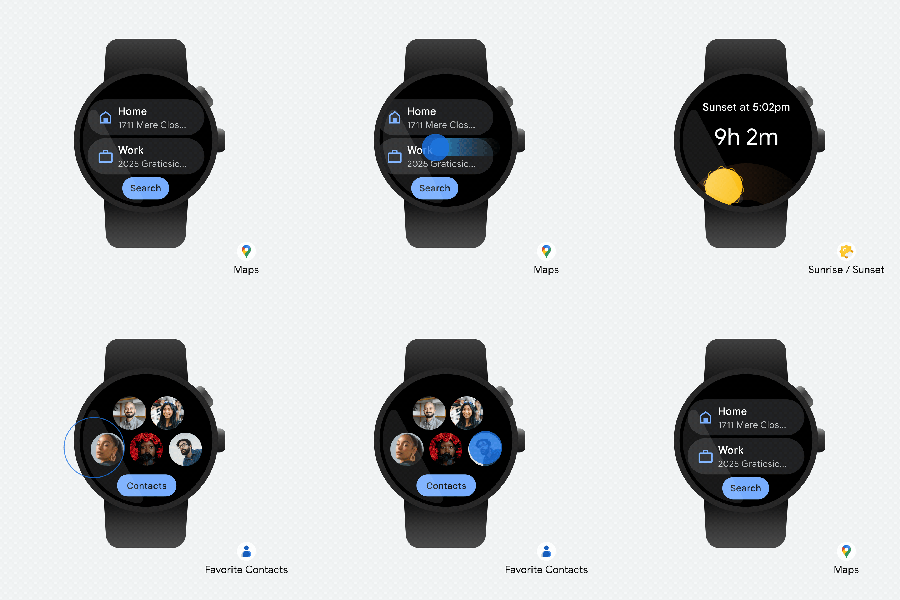
  • Wear OS update includes the introduction of new Tiles — widget-like screens to access information quickly — including favorite contacts and time of sunrise and sunset. It already has Tiles for Google Maps to let you access directions to saved places like work and home, and Google Keep to start a new note or a list. The company also has an API for third-party developers to take advantage of the Tiles format on Wear OS.
Google Tiles

Google Tiles

  • Google has updated the Keep app on Wear OS to make notes and lists have a better format to be read on a watch with support for custom backgrounds, photos, and drawings. Plus, you can view labels and collaborators to a list.
  • The search giant is adding support for the Adidas running app to Google Assistant. The update, rolling out over the next week, will allow you to use the Assistant to start more than 30 exercises through a voice command on your watch. You can say “Hey Google, start a run with Adidas Running” to start tracking your run with the app.

For enabling new features in individual apps like Google TV and Gboard, you will need to update those apps to their latest version.

Android’s December update features includes accessible reading mode and sharable car keys by Ivan Mehta originally published on TechCrunch


from https://ift.tt/OhIQULw
via Technews
Share:

Popular Post

Search This Blog

Powered by Blogger.

Labels

Labels

Most view post

Facebook Page

Recent Posts

Blog Archive