


‘Buy American’ shouldn’t block our progress toward ‘Internet for All’

The finish line is within sight. “Internet for All,” as the Biden administration put it, will soon be a reality if America keeps its priorities straight.

During his State of the Union address, President Joe Biden set a high bar, “We’re going to buy American,” as the U.S. spends billions of dollars on new broadband connections. This is a smart strategy to create American jobs and boost the U.S. economy, but our leaders must not sacrifice speed in the race to close the digital divide in cases where “Buy American” isn’t yet a realistic option.

Strengthened during the pandemic when all finally understood that broadband is a necessity, bipartisan cooperation brought America a once-in-a-generation opportunity to achieve universal connectivity. To date, more than $90 billion has been earmarked by Congress and the administration to finish the private sector’s work of connecting every home in America with broadband internet service.

During this sprint toward “Internet for All,” America’s leaders should avoid creating hurdles that will delay progress.

Under the $42.45 billion Broadband Equity, Access, and Deployment (BEAD) Program, for example, every participating state — as well as Puerto Rico and the District of Columbia — will receive a minimum of $100 million for internet infrastructure, with more to be doled out based on each state’s proportional number of unserved locations. Cartesian estimates that fiber providers will contribute another $22 billion in funds for $64 billion in total, which is “sufficient to achieve the program’s availability goal” of making broadband service “available to all eligible locations.” That’s a first.

The Infrastructure Investment and Jobs Act (IIJA), signed into law by President Biden on November 15, 2021, also included $14.2 billion for the Affordable Connectivity Program, which has helped over 17 million American families pay for a home broadband connection that they otherwise would struggle to afford. What’s more, the bill set aside $2.75 billion for Digital Equity programs; $2 billion for the Tribal Broadband Connectivity Program; $2 billion for the Rural Utilities Service Distance Learning, Telemedicine and Broadband Program; and $1 billion for a new Middle Mile grant program. This truly is broadband’s moment in the sun.

During this sprint toward “Internet for All,” America’s leaders should avoid creating hurdles that will delay progress. Every American deserves to have the chance to “attend class, start a small business, visit with their doctor, and participate in the modern economy.”

The Build America Buy America Act, which was enacted as part of the IIJA, requires infrastructure projects (including internet infrastructure funded by the BEAD Program) to use domestically sourced materials. But broadband networks are complex; they’re more than just fiber cables. Some essential pieces of the puzzle like certain electronic products aren’t currently manufactured in America and the components that make up those products are not available in the United States.

We should always do our best to honor President Biden’s goal to “Buy American,” but not at the expense of leaving Americans offline while they wait for every switch, router and radio to be made in the U.S. After all, the Government Accountability Office recently estimated that the BEAD Program alone could create 23,000 jobs for skilled telecommunications workers … just to build out the infrastructure. Spending will predominantly go toward U.S. paychecks and balance sheets, even if we need to rely on foreign manufacturers for a limited number of network components.

U.S. Secretary of Commerce Gina Raimondo recently announced that CommScope and Corning are investing nearly $550 million and creating hundreds of new jobs in America to build fiber optic cables. Although the Obama administration provided a blanket “Buy American” waiver for IT products in the American Recovery and Reinvestment Act of 2009 (ARRA), recognizing that the U.S. share of global computer and electronics output had dropped 8.2 percentage points between 1999 and 2009, the Biden administration is right to seek a solution that is balanced, maximizing U.S. production when possible while permitting select network components to be sourced from outside our borders when necessary.

There are so many good things happening to close the digital divide, including the Federal Communications Commission recently devoting $66 million to Affordable Broadband Outreach Grants. Let’s not lose that momentum. Let’s not sacrifice the great for the perfect.

It’s time for the Biden administration to guard against the unintended consequences of the “Buy American” ideal and keep its eye on the prize: Everyone in America — including communities of color, rural communities and older Americans — needs broadband now.

‘Buy American’ shouldn’t block our progress toward ‘Internet for All’ by Ram Iyer originally published on TechCrunch


from https://ift.tt/VLAYhXZ
via Technews
Share:

Elon exposes his burner, Tile embraces the cat life, and Elizabeth Holmes avoids prison

Hey, TechCrunch people. If you’re looking for a recap of the week’s news in tech, you’ve come to the right place. It’s Week in Review (WiR), TechCrunch’s regular recap column. Glad to have you.

Before we get on with the meat of it, a PSA that tickets for TechCrunch Disrupt 2023 are available now. Disrupt, of course, is TechCrunch’s flagship in-person event, focused on founders, investors and the future of tech year after year. In San Francisco on September 19–21, expect to hear from thought leaders in the fields of AI, fintech, hardware, sustainability, SaaS, security and more. It’ll be well worth the trip.

In the nearer term, tune into the next TechCrunch Live show, which will spotlight Cambrian BioPharma, a startup billing itself as a pharmaceutical outfit with a revolutionary approach to managing drug development. Founder James Peyer will be joined by Maryanna Saenko of Future Ventures, who invested in Cambrian’s Series A, B and C rounds.

Now, without further ado!

most read

Elon exposed: Elon Musk tweeted a photo on Monday night that showed him logged into his Twitter account, advertising to content creators how they can activate monetization features on Twitter. Unfortunately for Musk, people weren’t paying much attention to the fact that he has 24.7K paid subscribers — instead, some users realized that he appeared to be logged into another account, Amanda writes — possibly his burner. Oops.

SpaceX finds success in failure: SpaceX launched a fully integrated Starship launch vehicle for the first time last Thursday, a long-awaited and highly anticipated milestone in the vehicle development program. Despite its fiery fate, the test was a success, Aria reports: SpaceX got tons of valuable data that will inform future Starship and Super Heavy prototypes.

Tile, but for cats: Tile, the AirTag rival now owned by Life360, this week launched a new cat-tracking tag to help pet owners find their furry friends. The new device, “Tile for Cats,” is essentially a modified version of the Tile Sticker with a silicone collar attachment that costs $39.99. Ivan has more.

Epic loss: Apple has won its antitrust-focused appeals court battle with Fortnite maker Epic Games over its App Store policies, Sarah reports. The U.S. Ninth Circuit Court of Appeals largely upheld the district court’s earlier ruling related to Epic Games’ antitrust claims in favor of Apple, but it also upheld the lower court’s judgment in favor of Epic under California’s Unfair Competition Law.

Holmes avoids prison: Theranos founder Elizabeth Holmes will not be heading off to prison this week to begin serving an 11-year sentence, as first reported by the WSJ. Though earlier this month U.S. District Court Judge Edward Davila denied her request to remain free while she appeals her conviction, this week she asked the Ninth U.S. Circuit Court of Appeals directly if she could stay out of prison while her case makes its way through the appeals process; the request automatically puts her reporting date on hold while the court considers her request, writes Connie.

Protestors sting back: A Missouri government tip site for submitting complaints and concerns about gender-affirming care is down after people flooded it with fanfiction, rambling anecdotes and the “Bee Movie” script. The Missouri Attorney General’s office launched the online form for “Transgender Center Concerns” in late March, inviting those who’ve witnessed “troubling practices” at clinics that provide gender-affirming care to submit tips, Morgan reports.

Twitter pushes advertisers to pay up: As Twitter’s legacy blue check mark system finally comes to an end, the social network’s new paid-for verification system is causing more than a little chaos, with CEO Elon Musk himself stepping in to pay for some celebrities’ verification when they refuse to do so. However, another little nugget to emerge from the carnage this week is that anyone looking to advertise on Twitter will now seemingly have to have a verified account, Paul reports.

WhatsApp across devices: WhatsApp is finally rolling out multidevice login support for more than one phone. Mark Zuckerberg announced the feature’s rollout on Facebook and Instagram, clarifying that users can log into the same WhatsApp account on up to four phones. Until now, you could only use one WhatsApp account on one phone and multiple companion desktop devices.

audio

TechCrunch is cross-medium, in case you weren’t aware. The crew maintains a fantastic (in this writer’s humble opinion) slate of podcasts for your edification and enjoyment — so consider giving them a listen if you haven’t already. This week on Equity, Ankur Nagpal, the entrepreneur behind Teachable, Ocho and Vibe Capital, spoke about the future of solo GPs; how Ankur built, sold, pivoted and launched in public; and the importance of brand and succession. And Found — live from TechCrunch’s Early Stage event in Boston — was joined by Russ Wilcox, who founded E Ink and is currently a partner at Pillar VC.

TechCrunch+

TC+ subscribers get access to in-depth commentary, analysis and surveys — which you know if you’re already a subscriber. If you’re not, consider signing up. Here are a few highlights from this week:

Slow revenue growth: Public tech firms are for the most part on a moderate pace of trailing growth in the most recent fiscal quarter. Alex breaks down what that means — as well as the broader implications.

Founders change their pitch: More and more founders are adapting their pitches and business strategies to be more downturn-friendly, Natasha M writes. Now that it’s been over a year since tech’s current period correction first began, founders are getting more innovative in how they approach breaking their pitch.

Capital efficiency is the new VC filter for startups: Igor Shaversky, a partner at Waveup, writes about which metrics startups should track to understand where they stand on the capital efficiency scale.

Elon exposes his burner, Tile embraces the cat life, and Elizabeth Holmes avoids prison by Kyle Wiggers originally published on TechCrunch


from https://ift.tt/PWwHoe3
via Technews
Share:

Pitch for the check you want 

Welcome to Startups Weekly, a nuanced take on this week’s startup news and trends by Senior Reporter and Equity co-host Natasha Mascarenhas. To get this in your inbox, subscribe here.

Tech’s guiding principles these days aren’t too difficult to find: discipline, focus and cash conservation. But I’ve always found those same focuses to be especially in conflict with what it means to be an early-stage founder pitching your vision: You have to have Elon Musk-level ambition, big dreams and the ability to sell a company to investors before there are any real metrics behind it.

In some ways, it’s the job of the investor to see the reason to say yes anyway. In other ways, the downturn is very much making early-stage founders professionalize sooner and sooner; philosophically looking more like the late-stage company pitching for its Series C than the buzzy pre-seed.

I’ve been noticing small things about how early-stage founders have changed their pitches, suggesting that the checks are currently less about the messiah and more about the monetization.

Read the rest of my column on TC+: “Founders change their pitch.”

In the rest of this newsletter we’re talking about AI attribution, venture layoffs and modern entrepreneurship. As always, you can follow me on Twitter or Instagram to continue the conversation. If you feel like supporting me extra, subscribe to my very free Substack.

We’re actually starting to see AI be a factor in tech layoffs

Layoffs are almost a daily occurrence during this news cycle — I covered Chief and Clubhouse layoffs within an hour of each other — but the reasons behind each reduction often lack specificity. Dropbox surprised me. CEO Drew Houston, who laid off 16% of staff this week, cited “the AI era of computing” in relation to the layoffs. “We’ve believed for many years that AI will give us new superpowers and completely transform knowledge work. And we’ve been building toward this future for a long time, as this year’s product pipeline will demonstrate,” he said.

Here’s what to know: I expect there to be more redundancies in workforces that are partially attributed to artificial intelligence. It’s not a new take: The concern I hear most often around AI is its ability, or intent, to replace everyone’s jobs. To break from that pattern is to land lots of snaps: Harvey AI, backed by Sequoia this week, is the buzz all over tech dinners for its pitch to supercharge lawyers.

dropbox glitch

Image Credits: TechCrunch

Venture’s down

TC’s Mary Ann Azevedo broke news this week: “Fintech-focused VC firm Anthemis Group lays off 28% of staff as part of restructuring.” She reports, “Anthemis declined to provide further specifics around its strategy moving forward, instead pointing me to this blog post from co-founder Amy Nauiokas. In the post, Nauiokas writes that the firm aims to “translate 2022’s reckoning in private markets into enduring change in the structure and method of early-stage investing.”

Here’s what to know: We don’t see venture layoffs often, even though I have a feeling many are ghosts these days. Reductions will continue — and maybe more loudly this time. Last June, Backstage Capital fired most of its staff, with now only two people remaining at the venture firm.  

Image Credits: PM Images (opens in a new window) / Getty Images

A modern take on an entrepreneur

On Equity this week, I interviewed Ocho’s Ankur Nagpal, the founder of the business owner-focused fintech, as well as Teachable and Vibe Capital. We spoke about everything from the temperature of solo GPs and how building in public has impacted his trajectory.

Here’s an excerpt we got within minutes of recording: “A great CEO … you have to be mildly sociopathic. And there’s a lot of stuff that I just like struggled with when it came to being CEO, because it would be against my values as a person,” Nagpal said.

Bright multi colored balls randomly arranged on pink strings blue background, used in post about Betterdata

Image Credits: Getty Images

Etc., etc.

  • A weird parallel: Instacart’s co-founder and former CEO Apoorva Mehta raised $30 million for his new healthcare startup, WSJ reported last year. That news makes it all the more interesting that Instacart’s current CEO, Fidji Simo, co-founded a healthcare clinic, according to Fortune. According to TechCrunch, what a weird parallel between a grocery delivery startup’s past and present leadership! Jokes aside, maybe it’s a nod to what Amazon tried to do with Whole Foods and One Medical, Instacart edition.
  • Big apologies: to those who I missed in Boston last week. I was ready to jump on stage but then food poisoning — from a coffee shop that shall remain unnamed — got the best of me. I heard it was a hoot, though, so check out TC+ recap posts coming at you soon.
  • Programming note: If you’re reading this on a browser, get this in your inbox too! Subscribe here and share it with your friends.
  • Of course: It’s already Disrupt season. Reminder that there’s a ticket for every budget and role.
  • And finally, I have a shameless plug: Scoops make me! If you hear about a venture firm or startup winning, raising, flailing, or, oh I don’t know, booting an executive because of internal happenings, tell me. I love seeing early pitch decks and term sheets too. Happy to talk about anonymity and explain more of my process and what I’m looking for. You can tell me stuff on Signal at +1 925 271 0912. No pitches, please.

Seen on TechCrunch

Muslims come into the frame in Southeast Asia’s fintech boom

Founded by Adyen and Affirm alums, Ansa aims to help merchants create virtual wallets for customers

There was just one fintech unicorn minted in the first quarter

Snap stock down 24% on weak earnings, ad revenue slump

Seen on TechCrunch+

After initially defying the global slowdown, African startups’ first quarter venture results fall

First Republic’s results are proof that the SVB meltdown was brutal for smaller banks

It’s beyond time we started worrying about unicorn exits

Threading the needle: 5 questions for National Grid Partners’ Lisa Lambert

Take care of yourself,

N

Pitch for the check you want  by Natasha Mascarenhas originally published on TechCrunch


from https://ift.tt/8jyqxGL
via Technews
Share:

EV owners in Texas face $200 annual fee

States have taxed motorists at the pump for more than a century. Yet, as electric cars gain ground, what happens when folks stop refueling altogether?

State lawmakers are increasingly imposing annual fees on EV owners, arguing they should pay up because they still rely on public infrastructure to get around. Texas is on track to become the latest state to levy such a tax, following more than a dozen others, including Georgia, Michigan and Ohio.

The Texas Senate passed SB 505 at the end of March. This week, the state’s House has cleared a similar bill, sending it on to Gov. Greg Abbott’s desk. The latest version of the bill lays out a $200 yearly registration fee for electric vehicles, with exceptions carved out for slow “Neighborhood Electric Vehicles,” as well as autocycles, mopeds and motorcycles. The bill states that the resulting fees “must be deposited to the credit of the state highway fund.”

Though Texas is certainly not alone in moving forward with such a bill, its $200 fee is on the high end, matching only Georgia. Colorado is the state with the lowest EV fee (excluding states that have no fees), at $50 per year.

Speaking against the bill in a statement to local media outlet KRLD, Environment Texas director Luke Metzger argued the $200 fee is punitive and “will make it harder for Texans to afford these clean vehicles which are so critical to reducing air pollution in Texas.”

Electric cars are still priced out of reach for many Americans. In September 2022, the average price for EVs sat at $65,291, versus $48,094 for gas guzzlers, per Cox Automotive.

EV owners in Texas face $200 annual fee by Harri Weber originally published on TechCrunch


from https://ift.tt/krnSgmK
via Technews
Share:

Satellite-to-phone race heats up with voice calls and cross-Canada access

The prospect of contacting a satellite to send a text or contact emergency services may soon be an effortless reality as startups move from proof of concept to actual product. Canadians on the Rogers network, which just inked a deal with Lynk, will get direct satellite-phone connections across the country; and not to be outdone, AST SpaceMobile claims to have made the first satellite voice call using a regular cell phone as well.

Connecting a stock smartphone like last year’s Samsung or iPhone to a satellite would have sounded like a fantasy a few years ago, when we all knew it was impossible. But now companies are jostling for position as it becomes clear that satellite services will be a compelling offering on any mobile plan or phone model over the next few years.

Lynk’s approach is to offer as universal as possible an SMS service to as much of the planet as possible, in the hopes that no one who needs help or is off the grid for any other reason will ever have to face “no signal.” It has demonstrated texting from the middle of nowhere (in fact the founder texted me) and also can blanket an area unexpected without signal — due to a power outage or natural disaster — with crucial info like where to find shelter.

The company has been striking deals across the world with various carriers, and is now at the very doorstep of the U.S. (which has a tough regulatory environment and entrenched mobile players) with a deal with Canada’s biggest provider, Rogers.

Although the idea is that everyone will be able to use this, every satellite cellular station still needs to operate through a licensed carrier. The Rogers deal doesn’t mean total exclusivity (for example, you’re lost and need help but have a different carrier) but it is the carrier that is paying Lynk, and will take payment from customers across Canada as the local partner. I’ve asked for more details on this and will update if I hear back.

Bringing a more comprehensive connectivity package to the table is AST SpaceMobile, which has launched its first test satellite and for the first time demonstrated a direct phone-to-satellite call using an unmodified consumer handset. I double checked (this stuff can be tricky) and the connection was a continuous two-way data exchange between the phone and the satellite, which relayed it to the terrestrial network:

Abel’s phone in Texas was connected directly to the satellite for both send and receive two-way communications, without any other intermediary. He made the phone call by typing in the number to the regular Samsung dial app on the Galaxy S22, just like you would make any regular phone call. The other end of the phone call in Japan was received via the normal terrestrial communications network (a cell tower).

Demonstrating the capability is a huge step forward, since the engineering involved in getting a regular phone to connect with something in low Earth orbit is already difficult — maintaining that connection to the point where data can flow constantly between them is even harder. Scaling is yet another problem that AST SpaceMobile will face, but having proven the capability, that challenge probably seems less daunting now.

The company’s BW3 satellite is the prototype for a constellation that will provide “2G, 3G, 4G LTE and 5G” coverage from space, which is great because I lose 5G just going down the block. Help me out, AST SpaceMobile.

Of course Apple has made headlines with its emergency SOS service, which connects to the Iridium network but requires you to sort of sight your phone on a passing satellite in order to exchange a set of mostly premade messages. Useful if you’re stuck in a canyon and need a helicopter to scoop you up, but not if you want to check the weather or tell your spouse your backpacking trip is going fine.

And then there’s T-Mobile and SpaceX, which plan to provide a Starlink data connection to the network’s customers. While no one can gainsay Starlink’s ability to provide a signal from orbit, it has not yet demonstrated an orbital connection to an unmodified phone, something it supposedly will do this year.

Pretty soon these services will graduate from experiment to line item and we’ll be back to the days when texts cost a dime each. Still, it’s better than nothing, and that’s definitely what a lot of people have once they leave the city to take a hike or go fishing. Let’s hope the connection stays on-demand, though — no one needs to get spam messages from orbit while they’re waiting for the trout to bite in a remote mountain lake. That’s not a future anyone wants.

Satellite-to-phone race heats up with voice calls and cross-Canada access by Devin Coldewey originally published on TechCrunch


from https://ift.tt/832NgEX
via Technews
Share:

A claw machine does not a robotic gripper make

A refrain I hear from a lot of startups is that there’s “no need to rethink the gripper.” It’s something I appreciate from an economic standpoint. It’s expensive, resource intensive and both your time and money are probably best spent elsewhere when there are already so many effectors on the market.

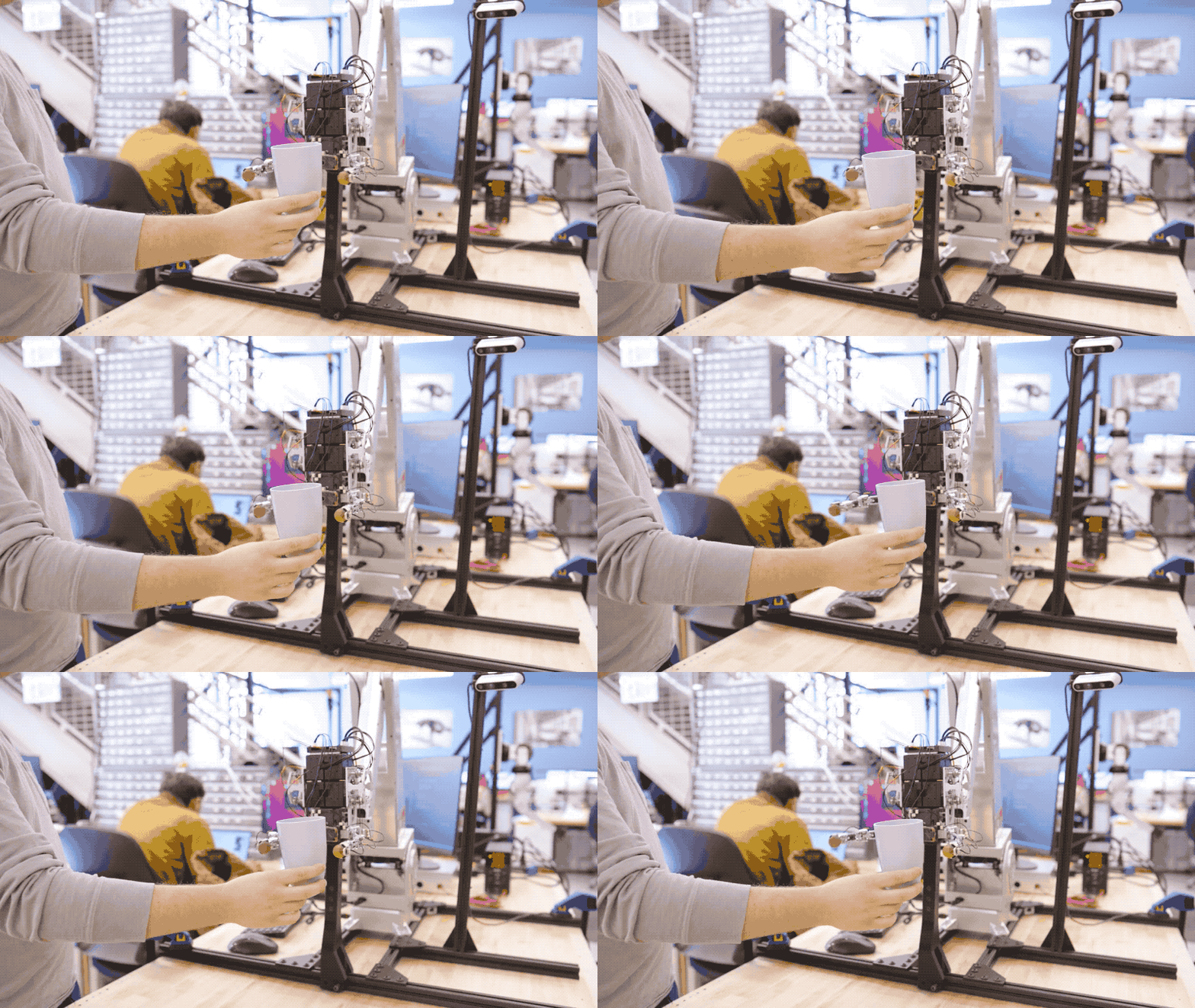
I also recently made an analogy to a claw machine during an interview — and got some pushback. I understand a bit better now why that’s the case — at least in part. Discussing its new approach to robotic gripping, MIT invokes the perennial arcade favorite, noting, “When manipulating an arcade claw, a player can plan all she wants. But once she presses the joystick button, it’s a game of wait-and-see. If the claw misses its target, she’ll have to start from scratch for another chance at a prize.”

Image Credits: MIT

If you think about that for a moment, you realize that you’re suddenly faced with something that comes up over and over again in this field of study: That’s not how humans approach the job — and there’s a reason for that. If you’re say, grabbing an object with a strange or unexpected weight distribution, you generally don’t need to withdraw your hand and try again. You adjust.

The team describes a system that adjusts to an object in real time, using reflexes and feedback. Says MIT:

If the gripper fails to grab hold of the object, rather than back out and start again as most grippers do, the team wrote an algorithm that instructs the robot to quickly act out any of three grasp maneuvers, which they call “reflexes,” in response to real-time measurements at the fingertips. The three reflexes kick in within the last centimeter of the robot approaching an object and enable the fingers to grab, pinch, or drag an object until it has a better hold.

Interestingly, the project builds on actuators developed for the school’s mini cheetah robot, which were designed to help it react to uneven terrain on the fly. The new system is built around an arm with two multi-joint fingers. There’s a camera on the base and sensors on the tips that record feedback. The system uses that data to adjust accordingly.

Currently the team is using the gripper to clean up around the lab. Says MIT:

They set a variety of household objects on a shelf, including a bowl, a cup, a can, an apple, and a bag of coffee grounds. They showed that the robot was able to quickly adapt its grasp to each object’s particular shape and, in the case of the coffee grounds, squishiness. Out of 117 attempts, the gripper quickly and successfully picked and placed objects more than 90 percent of the time, without having to back out and start over after a failed grasp.

A claw machine does not a robotic gripper make by Brian Heater originally published on TechCrunch


from https://ift.tt/ToyZ9mF
via Technews
Share:

#NotMyAI and other TC news

Snapchat Rolled out their generative AI chatbot, My AI to their 750 million monthly users so it feels like the right time to pause and ask whether we’re ready for the real thing – and ready or not, whether anybody wants one. This week on the TechCrunch Podcast, we’re talking to TechCrunch reporter Amanda Silberling about making robot friends on the internet.

Articles from the episode:

#NotMyAI and other TC news by Darrell Etherington originally published on TechCrunch


from https://ift.tt/wUIg9Kr
via Technews
Share:

Popular Post

Search This Blog

Powered by Blogger.

Labels

Labels

Most view post

Facebook Page

Recent Posts

Blog Archive