



As $100M venture rounds evaporate IPOs might have to carry the weight

Earlier this year we wrote that the “the $100 million venture round is going extinct.” Often our predictions wind up sideways. This time we were on the right track.

According to new data from PitchBook, the U.S. venture market is continuing to endure lackluster velocity for nine-figure investments into private companies, colloquially referred to as “mega-rounds.”


The Exchange explores startups, markets and money.

Read it every morning on TechCrunch+ or get The Exchange newsletter every Saturday.


In the first half of 2023, PitchBook counted just 108 mega-rounds in the United States. If we presumed that this rate will hold throughout the year, we’re looking at just over 200 nine-figure deals in the U.S. in 2023. That’s a dramatic decline from prior levels. Starting in Q4 2020 through Q3 2022, there were more than 100 mega-rounds recorded per quarter. In 2021, the average was more than 200 per quarter. To see perhaps 200 this year implies that the number of late-stage startups that will be able to raise an IPO-sized round is in free fall.

The rounds are also getting smaller, with data indicating that the average nine-figure round size has fallen under the $200 million mark, exclusive of a few rounds that are hardly traditional venture deals, like OpenAI’s massive round earlier this year. Smaller mega-rounds, and fewer of them, is a tough mix for unicorns of all stripes and sizes.

Of course, we could see nine-figure rounds rebound in other markets. Europe and Asia have seen their fair share of the transactions historically. But as the United States’ venture market is the largest in the world and was once the leading player in mega-round financings, where the U.S. goes, so, too, goes the world.

If unicorns here are struggling to find fodder in the quantity that they became accustomed to, other startups around the world are likely enduring a similar dearth of capital.

Notably PitchBook thinks that “the need for capital likely leading to an uptick in mega-rounds as the year progresses” thanks to “the notion that depleting cash runways will force more of these startups to raise in the harsher dealmaking environment,” it still expects full-year mega-round tallies to come in at dramatically reduced levels compared to prior years.

As $100M+ venture rounds evaporate, IPOs might have to carry the weight by Alex Wilhelm originally published on TechCrunch


from https://ift.tt/V6HrxgM
via Technews
Share:

Techstars raising $150 million for new accelerator fund

Startup accelerator Techstars is raising $150 million for its new fund, SEC filings show. The accelerator is seeking new capital ahead of the end of the deployment period of its third institutionally-backed fund, Techstars Accelerator 2021, later this year.

Techstars declined to offer details on how it intends to use or deploy the funding, citing regulatory restrictions. However, like its predecessors, the new fund, Techstars Accelerator 2024, is expected to be used for accelerator-stage and/or post-accelerator investments.

Notably, the Boulder-based early-stage investor has used its current fund only for accelerator-stage investments. Its previous funds backed startups both during the accelerator stage and with follow-on investments after the program.

Fund 3 aimed to back over 800 pre-seed and seed startups that are part of its global accelerator programs by the end of 2023. Through its accelerator groups, Techstars has so far backed over 3,500 early-stage startups in various sectors including healthtech, fintech, web3 and cleantech.

Startups going through Techstars’ three-month program receive $20,000 and a $100,000 convertible note in exchange for 6% to 9% of common stock, in addition to access to its network and mentorship, amongst other resources.

Founded in 2006, Techstars runs over 50 accelerator groups in major cities across the globe, including New York, Los Angeles, London, Boston, Tel Aviv and Lagos. The accelerator launched the Lagos arm last year in partnership with ARM Labs as part of its plan to expand its specialist and generalist programs globally.

To double down on its growth and expansion plans, Techstars recently launched new funds to bolster its investment efforts.

Last year, for instance, it launched Rising Stars, a fund to back startups that are too early for its accelerator programs. Under this fund, Techstars will issue $100,000 checks in exchange for 7% to 10% equity.

The accelerator also launched the $80 million Advancing Cities Fund in partnership with JPMorgan to back over 400 startups by diverse founders in nine cities across the U.S.

Techstars raising $150 million for new accelerator fund by Annie Njanja originally published on TechCrunch


from https://ift.tt/oic1kaZ
via Technews
Share:

OpenAI brings the competition to DeepMinds doorstep with new London office

OpenAI is expanding overseas. To London, specifically.

Today, the Microsoft-backed AI startup announced that it plans to open an office in London, its first international outpost. When OpenAI’s London location opens its doors, it’ll focus on advancing “research and engineering capabilities” while balancing collaborating with “local communities and policymakers,” according to CEO Sam Altman.

“We see this expansion as an opportunity to attract world-class talent and drive innovation in AGI development and policy,” Altman, who reportedly had floated Poland and France as alternatives for the office, said in a canned statement. “We’re excited about what the future holds and to see the contributions our London office will make towards building and deploying safe AI.”

London is a conspicuous choice for OpenAI, which hasn’t expanded beyond its San Francisco headquarters since its founding in 2015. The city is the longtime home base of DeepMind, Google’s largest AI research division, and a wellspring of data science talent, owing to its rich academic history and renowned universities.

Broadly speaking, London is also becoming a booming center for AI startup ventures. According to a recent report, as of 2021, over 1,300 AI companies were based in London and the city was the top-funded in the U.K. in terms of venture dollars invested.

The city is also important politically to tech companies heavily invested in AI, like OpenAI, who seek to convince the U.K.’s governing bodies to regulate AI with a light touch. On a recent lobbying tour, Altman made an appearance at the University College London, where he called for “balanced” regulation and warned of the risks of deepfake disinformation.

At that same appearance, Altman said that OpenAI would “cease operating” in the European Union if it’s unable to comply with the provisions of the bloc’s AI Act, one of the first comprehensive set of regulations for the AI industry. He later backed down from the comments — but the play was made.

OpenAI brings the competition to DeepMind’s doorstep with new London office by Kyle Wiggers originally published on TechCrunch


from https://ift.tt/GgUiZaJ
via Technews
Share:

Vertical AI: The next logical iteration of vertical SaaS

At Index Ventures, we view the emergence of vertical SaaS (vSaaS) — cloud-based software tailor-made for specific industries — as part of a broader trend of end users increasingly demanding superior technology products.

Consumers want solutions-oriented software made specifically to solve their exact business problems. In an environment where we are inundated with software, narrow and specific is well-positioned versus broad and generalized.

The concept is not new: Even the largest horizontal tech companies verticalize their sales organizations and product features when they have enough scale within each vertical for that to be a sensible approach.

Cloud giants AWS, Azure, and Google Cloud Platform prominently feature vertical industry solutions with dedicated sales teams, as do other large platforms like Salesforce, ServiceNow, Snowflake and Workday.

These tech leaders verticalize their offerings over time because it’s a high-quality experience for customers and end users when a technology vendor deeply understands the industry, has sales and support reps attending the same conferences as users, and is rapidly evolving the product to suit customer needs.

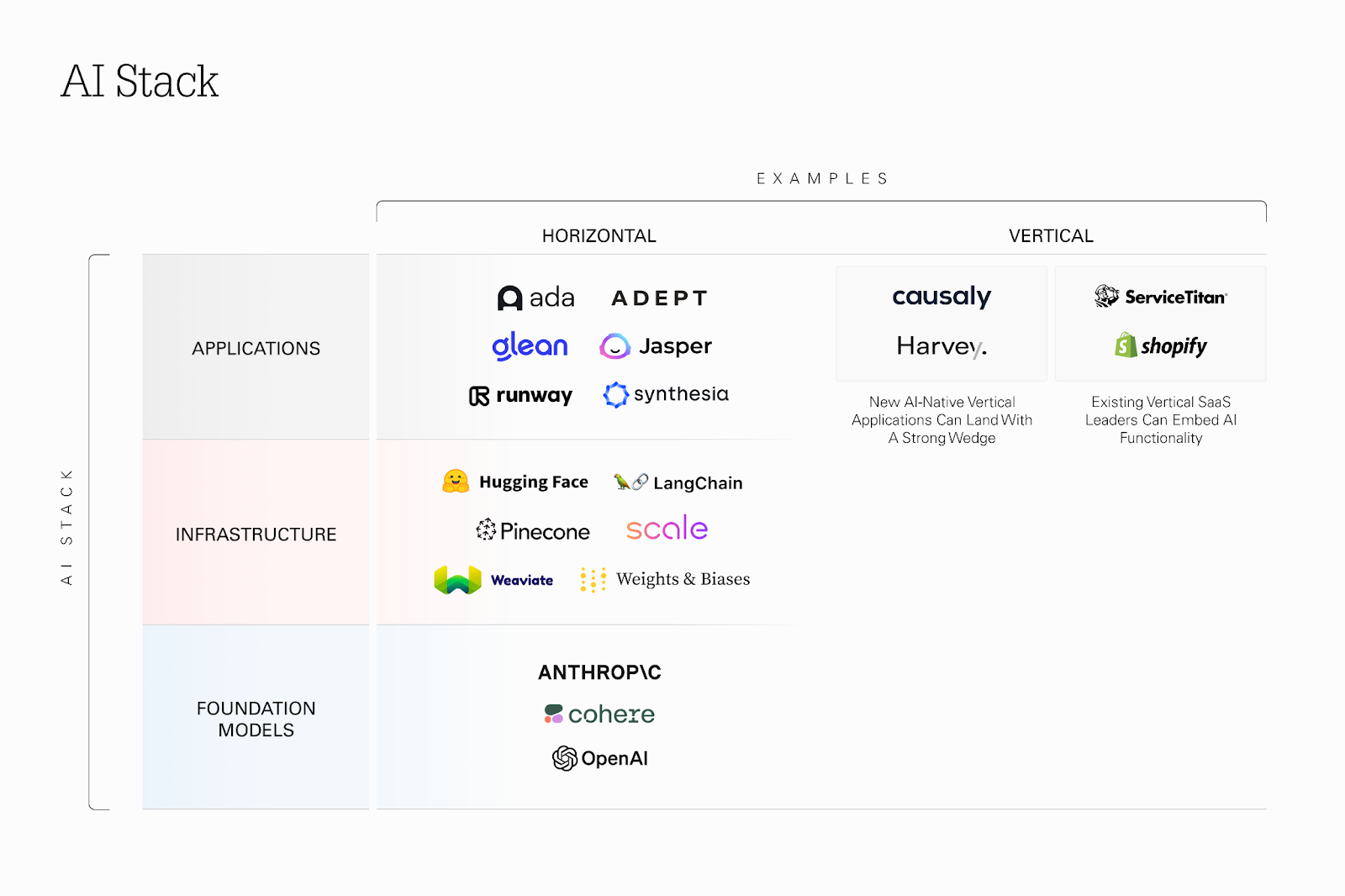
The AI category is rapidly evolving, but developing into three layers: foundational models, AI infrastructure, and AI applications.

With the AI platform shift upon us, we believe that the next logical iteration of vertical SaaS will be vertical AI – vertically-focused AI platforms, bundled alongside workflow SaaS, built on top of models which have been uniquely trained on industry-specific datasets.

Why vertical AI?

The AI category is rapidly evolving, but developing into three layers: foundational models, AI infrastructure, and AI applications.

Examples of AI stack companies

Examples of AI stack startups. (Index Ventures is an investor in Causaly, Cohere, Scale, ServiceTitan and Weaviate.) Image Credits: Index Ventures

Foundational models are the bedrock of the AI stack. Leaders in this space include Anthropic, Cohere, and OpenAI. It’s likely there will be a limited number of vendors in the foundational LLM space given the high capital requirements to build and train models.

The “picks and shovels” of AI sit at the infrastructure layer, a catch-all which includes a variety of categories including data enhancement, fine-tuning, databases, and model training tools. For example, vector databases like Pinecone and Weaviate are gaining significant adoption.

Other companies like Scale are being used for data generation, labeling, and training. Hugging Face has emerged as a leader for model discovery and inference. Weights & Biases is widely recognized within MLOps. LangChain is an open-source development framework used to simplify the creation of new applications using LLMs. These are a few of many companies which are helping companies transform models and data into products.

Foundational models and infrastructure are enabling an explosion of AI business applications. These AI-powered applications could be used by any end user, in any industry, to accomplish an array of tasks.

Vertical AI: The next logical iteration of vertical SaaS by Walter Thompson originally published on TechCrunch


from https://ift.tt/mh7vNSP
via Technews
Share:

Reka emerges from stealth to build custom AI models for the enterprise

Large language models (LLMs) like OpenAI’s GPT-4 are all the rage these days, owing to their unparalleled ability to analyze and generate text. But for organizations looking to leverage LLMs for specific tasks — say, writing ad copy in a brand’s style — their generalist nature can become a liability.

When the instructions get too precise, even the best LLMs struggle with consistency. Fine-tuning, or narrowing an LLM’s scope, is one solution. But it’s often challenging from a technical standpoint, not to mention costly.

Motivated to find an easier way, a team of researchers from DeepMind, Google, Baidu and Meta founded Reka, which emerged from stealth today with $58 million. DST Global Partners and Radical Ventures led the tranche with participation from strategic partner Snowflake Ventures, alongside a cohort of angel investors that included former GitHub CEO Nat Friedman.

San Francisco-based Reka is the brainchild of Dani Yogatama, Cyprien de Masson, Qi Liu Head and Yi Tay. While working on AI systems including DeepMind’s AlphaCode and Bard, they four co-founders say that they realized it was impractical to expect a large LLM to be deployed for all possible use cases.

“We understand the transformative power of AI and would like to bring the benefits of this technology to the world in a responsible way,” Yogatama told TechCrunch in an email interview. “Reka is a research and product company that develops models to benefit humanity, organizations and enterprises.”

Reka’s first commercial product, Yasa, doesn’t quite meet those lofty ambitions. But it exemplifies the startup’s early approach. Going beyond text, Yasa is a multimodal AI “assistant” trained to understand images, videos and tabular data in addition to words and phrases. It can be used to generate ideas and answer basic questions, Yogatama says, as well as derive insights from a company’s internal data.

In this way, Yasa, which is in closed beta, isn’t dissimilar to models like GPT-4, which can also understand text and images. But the twist is that Yasa can be easily personalized to proprietary data and applications.

“Our technology allows enterprises to benefit from progress in LLMs in a way that satisfies their deployment constraints without requiring a team of in-house expert AI engineers,” Yogatama said.

Yasa is just the start. Next, Reka plans to turn its attention to AI that can accept and generate even more types of data and continuously self-improve, staying up to date without the need for retraining.

To that end, only available to select customers for now, Reka also provides a service to adapt LLMs it developed to custom or proprietary company data sets. Customers can run the “distilled” models on their own infrastructure or via Reka’s API, depending on the application and project constraints.

Reka, it should be noted, isn’t the only startup chasing after models better suited for enterprise use cases. Writer lets customers fine-tune LLMs on their own content and style guides. Contextual AI and LlamaIndex, which recently emerged from stealth, are developing tools to allow companies to add their own data to existing LLMs. And Cohere trains LLMs to customers’ specifications.

Not to be outdone, incumbents like OpenAI now offer tools for fine-tuning models and connecting them to the internet and other sources to ensure that they remain up to date.

But Reka’s sales pitch won over one early customer (and investor), Snowflake, which partnered with the startup to let Snowflake customers deploy Yasa from their accounts. Appen, the big data analytics company, also recently announced that it’s working with Reka to build tailored multimodal model-powered apps for the enterprise.

Rob Toews, a partner at Radical Ventures, had this to say when asked why he invested in Reka:

“What makes Reka unique is how it offers every business the power and potential of an LLM without having to put up with many tradeoffs,” Toews said via email. “Reka’s distilled Yasa models keep the data within the enterprise, they’re incredibly efficient in terms of cost and energy and they don’t require costly research teams building models from scratch. If every business will become an ‘AI’ business, Reka’s ambition is to give each of those businesses its own, production-quality foundation model.”

Yogatama says Reka, which currently isn’t generating revenue, will use its funding to date to acquire computing power from Nvidia and build a business team.

Reka emerges from stealth to build custom AI models for the enterprise by Kyle Wiggers originally published on TechCrunch


from https://ift.tt/nvW0Jwu
via Technews
Share:

How Sheins influencer trip to a Chinese factory backfired

As Shein eyes an IPO, the company’s image needs a serious makeover. From stealing indie designers’ work, to violating local labor laws, Shein has fallen out of vogue on social media, so the company invited a group of influencers to tour one of its factories in Guangzhou, China.

“I expected the facility to be so filled with people just slaving away, but I was actually pleasantly surprised that most of these things were robotic,” said Destene (@itsdestene_), a creator with more than 4 million followers, in a TikTok. “Honestly, everyone was just working like normal, like chill, sitting down, they weren’t even sweating.”

In a now-deleted video, fashion influencer Dani (@itsdanidmc) reflected on her trip with Shein by saying that “there is a narrative fed to us in the U.S” about Shein, but that her biggest takeaway from the trip was to be an “independent thinker, get the facts, and see it with your own two eyes.”

As commenters were quick to point out on these influencers’ posts, it’s difficult to believe that what we see in these videos reflects the reality of Shein factory working conditions. Rather, this was a highly curated brand trip wherein influencers are offered free travel opportunities and gifts, encouraging them to promote a favorable image of the company.

“It feels like they used you for damage control and it’s disturbing,” one commenter wrote on Destene’s video.

“If they wanted to really show they ain’t on nothing they’d invite investigative journalists, not influencers they can pay off lol,” another commenter said.

A TikToker who posts about sustainable fashion, Ella (@myweeklyyarn) spoofed the ordeal by making a video pretending to tour the Triangle Shirtwaist Factory, which was the site of one of the deadliest industrial fires in U.S. history.

“Surely this collab will have no consequences for me or any of the real #sheinfactory workers,” Ella wrote in the TikTok’s caption.

The Chinese fast fashion giant Shein has become one of fastest growing e-commerce companies in the world; according to TIME, the company did $100 billion in sales in 2022, up from $10 billion in 2020. With low prices, trendy items and a wide range of sizes, Shein has surpassed Amazon on the App Store, ranking #2 on the Shopping charts and #14 overall for free apps.

Amid Shein’s ascent to international dominance, customers have been skeptical — if a company can add thousands of new items each day while keeping prices shockingly low, how can it be operating ethically? While Shein haul videos are abundant on TikTok, Instagram and YouTube, more creators have spoken out against the company for exemplifying the worst of fast fashion’s environmental impact. A CBC investigation found that some Shein items contained significant amounts of lead — one toddler jacket had almost 20 times the amount of lead that Canadian health officials consider safe for kids.

“Shein is committed to transparency and this trip reflects one way in which we are listening to feedback, providing an opportunity to show a group of influencers how Shein works through a visit to our innovation center and enabling them to share their own insights with their followers,” Shein said in an emailed statement. “Their social media videos and commentary are authentic, and we respect and stand by each influencer’s perspective and voice on their experience.”

As the backlash against these influencers hit a crescendo, Dani DMC went on Instagram to respond to critics. She said that when she went on a trip to Lake Tahoe with Shein a few months ago, she relayed questions from her fans about Shein’s labor practices to higher-ups at the company, who gave her “what felt like authentic” answers.

“[Shein] brought this China trip to my attention, and they’re like, ‘You know, we’re aware of all these rumors and all this stuff that’s going on, and we want to put an end to it,'” Dani said in the video. “We want to put our money where our mouth is, show you what’s going on, and for me to be confident in having a future with them or working with them.”

As a plus size model, Dani said she was excited to be working with Shein, since they are one of the only brands selling affordable and trendy plus size clothing. But she admitted that she didn’t do enough background research before going to China with Shein.

“This whole experience has caused me to reevaluate myself, my brand, and to fight even harder for sustainable options for plus size people, and to just be so much more particular with who I’m working with,” she said.

How Shein’s influencer trip to a Chinese factory backfired by Amanda Silberling originally published on TechCrunch


from https://ift.tt/Fuy2GiB
via Technews
Share:

Apple Arcade is adding Stardew Valley Ridiculous Fishing and more in July

Apple Arcade is a getting a trio of notable indie games in July, including Stardew Valley, Slay the Spire and Ridiculous Fishing. Launched in 2016, Stardew Valley is an open-ended country-life RPG that gained popularity for its gentle art style and calm vibes. Apple Arcade’s version of the game will include recent updates, including new town upgrades, dating events, crops, fishing ponds, hats, clothing and pets. The game will launch on Apple Arcade on July 21.

As for Ridiculous Fishing, the tech giant says the Apple Arcade version is a full and expanded remaster of the original game and is now in 3D. The remastered version of the game, called Ridiculous Fishing EX, includes a competitive mode and game plus mode. The idea behind the game is to catch as many fish as possible, then flick them up into the sky and shoot them with your shotgun. Ridiculous Fishing EX will launch on Apple Arcade on July 14.

A screenshot of ridiculous fishing

Image Credits: Vlambeer

Slay the Spire, which is a roguelike deck-building game, will roll out on the service on July 7. In the game, players climb The Spire while encountering enemies. Players are led to a final floor where a challenging boss encounter awaits.

In addition to the trio of notable indie games, Apple Arcade is also getting Hello Kitty Island Adventure on July 28. The game sees players solving ancient puzzles, decorating cabins and creating their “ultimate island paradise.” In addition, Lego Duplo World will be launching on July 7. The game is designed to help kids build their imaginations through open-ended play experiences.

Apple Arcade is available for $4.99 per month with a one-month free trial. The subscription is also available as part of Apple One’s Individual ($16.95), Family ($22.95), and Premier ($32.95) monthly plans. Apple Arcade games are playable across iPhone, iPad, Mac, and Apple TV.

The upcoming launch of the new titles comes as Apple added 20 games to Apple Arcade service last month, including a new exclusive Teenage Mutant Ninja Turtles title along with classic games like Temple Run and Snake.io.

Apple Arcade is adding Stardew Valley, Ridiculous Fishing and more in July by Aisha Malik originally published on TechCrunch


from https://ift.tt/RPdHKJp
via Technews
Share:

Popular Post

Search This Blog

Powered by Blogger.

Labels

Labels

Most view post

Facebook Page

Recent Posts

Blog Archive