


The bootstrapped are coming, the bootstrapped are coming

Welcome to Startups Weekly, a fresh human-first take on this week’s startup news and trends. To get this in your inbox, subscribe here.

Bootstrapped startups, or companies that use their own revenue or existing cash flow to fund growth instead of relying on external capital sources, sit in a very separate box than venture-backed startups. By nature of asset class, bootstrapped startups prioritize revenue to keep alive, while venture-backed startups prioritize growth to keep investor buy-in for future runway needs. Bootstrapped companies follow less of an exponential growth curve, while venture-backed companies need to be an outlier.

Enter a downturn and both sides get a tad more interesting. The built-in business discipline of bootstrapped startups may feel especially downturn-proof as the overfunded companies announce rounds of layoffs. As venture starts to be more interested in the stable fundamentals of the startup bunch, is it the bootstrapper’s time to swing big?

For Healthie, a payments processor for healthcare companies, now felt like the right time to get on the “treadmill” of venture capital after six years of bootstrapping, according to co-founder Cavan Klinsky.

“If you’re a bootstrapped company who is not yet on the [venture] treadmill, you have that kind of optionality or that ability to choose when to get on,” he said. “Once you’ve already raised a bunch of ventures, you’re kind of building a business for venture scale, whereas if you are bootstrapped … you can be really really opportunistic about what that right time is.

For my full take, read my TechCrunch+ column: Will once-bootstrapped startups turn to venture during a watershed moment?

In the rest of this newsletter, we’ll get into a play on Honey for the real world and behind some significant layoffs happening in tech. As always, you can support me by forwarding this newsletter to a friend or following me on Twitter.

Deal of the week

If Pogo had its way, you’d get paid every time you stroll down Market Street in San Francisco. Or check your email. Or open its app. The only catch is that you give your personal data to the consumer-focused fintech in return. Put differently, Pogo wants to give users cash in return for their data.

I dug into the startup, which just raised a $12.3 million seed round led by Josh Buckley and a previously unannounced $2.5 million pre-seed round, and its goals for TechCrunch this week.

Here’s why it’s important:  Pogo is going to have an intimate window into someone’s life, from where they live to their favorite coffee shop to just how many subscriptions they own. It’s similar to what a bank would see, but it’s a venture-backed startup that it wants you to trust.

The Electronic Frontier Foundation, a nonprofit that has defended civil liberties in the digital world since 1990, describes the idea of exchanging data for money as “data dividends.” In an essay, the organization urges consumers to rethink if getting money for their data really fixes the existent imbalance between users and corporations.

The EFF asks a series of questions, such as who will determine what the cost of certain data is and what makes your data valuable to companies? Plus, what does the average person gain from a data dividend and what do they lose in exchange for that extra cash?

iPhone security: image of iPhone with green background

Image Credits: Getty Images

The layoffs continue

There were a number of significant layoffs this week, not limited to but including:

Here’s why it’s important: This format almost doesn’t work for layoff coverage, because it’s clear why people losing jobs is an important dynamic to cover. What’s new more recently, which I’ll get into next week, is that we’re seeing founders conduct two rounds of layoffs in quick succession.

Badly burnt, rightly toasted and plain bread slice on yellow background.

Image Credits: jayk7 (opens in a new window) / Getty Images

If you missed last week’s newsletter

Read it here: “Great Resignation meets Great Reset meets (Great R…un down those valuations please).” I also recorded a companion podcast with my co-author on the piece, Anita Ramaswamy, which you can listen to here: “A niche facet of startup employee pay, explained.” 

Any requests for topics for me to dig into, either on Startups Weekly or on the show? Tweet me a big question and I’ll take a swing at it, either on an upcoming Startups Weekly or on the podcast.

Seen on TechCrunch

Equal Ventures has a new pair of funds, filings show

Instagram gets worse with dark patterns lifted from TikTok

If you think Instagram is bad now, you won’t like Zuckerberg’s plans

Here’s why a gold rush of NLP startups is about to arrive

Sports community platform Stadium Live raises $10M to expand its digital world for Gen Z

Seen on TechCrunch+

Build a solid deck for your quarterly board meetings

Venture investors shrug at proposed changes to US carried interest taxation

Pitch Deck Teardown: Alto Pharmacy’s $200M Series E deck

You can now get startup shares on the cheap

The right questions to ask investors when fundraising in a down market

Ok! I’m headed to the mountains. Until next time,

N


from https://ift.tt/YLl19J5
via Technews
Share:

India blocks Krafton’s battle-royale game BGMI two years after PUBG ban

Google has pulled the popular battle royale game Battlegrounds Mobile India, more popularly known as BGMI, from its Play Store in India after a government order, a year after developer Krafton launched the app following a ban on its other similar title PUBG in the South Asian market. The BGMI game has also been delisted from Apple’s App Store in the country.

The Android-maker confirmed the development shortly after publication of the story. “On receipt of the order, following established process, we have notified the affected developer and have blocked access to the app that remained available on the Play Store in India,” a Google spokesperson told TechCrunch.

The app was delisted by Google from the Play Store on Thursday evening, and Krafton itself delisted the app from the Apple App Store shortly afterwards, a person with direct knowledge of the matter told TechCrunch. The iPhone-maker didn’t respond to a request for comment.

A Krafton spokesperson acknowledged the delisting and said the company was seeking clarification. Shares of Krafton tumbled over 9% on Friday, until partial recovery.

The development follows a growing tension between India and China, two nuclear-armed neighboring nations that have been especially at odds since deadly skirmishes along the Himalayan border in 2020. India has since reacted to the move by banning over 300 China-linked apps including PUBG and TikTok, both of which counted India as their largest overseas market by users.

Of the hundreds of apps that New Delhi has banned in the country, Krafton’s PUBG was the only title that made a return — though with a completely revamped avatar.

Krafton said it had cut ties with its publishing partner Tencent, which is also a major investor in the firm, and pledged to invest $100 million in India’s gaming ecosystem. Krafton — which has backed a number of Indian startups including Nodwin Gaming, Loco, Pratilipi and Kuku FM in the past one and a half years — told TechCrunch earlier this week that it estimated that its investment in India will touch about $140 million by next month.

The South Korean-headquartered firm said earlier this week that over 100 million users had signed up for the game in India in the past one year since launch. According to Sensor Tower, Battlegrounds Mobile India had amassed over 16.5 million monthly active users in the country.

It was unclear why the Indian government had ordered to block Battlegrounds Mobile India. New Delhi has cited national security concerns when banning other apps. (Reuters reported Friday that India has banned BGMI under section 69A of local IT law.)

Last month, a local media report — whose authenticity has been questioned by many — claimed that a child had killed his mother under the influence of the game. The report gained wide popularity on social media and reached the nation’s parliament this month. India’s Junior IT Minister Rajeev Chandrasekhar said last week that law enforcement agencies were investigating the subject.

Indian authorities have raided the local offices of Chinese phonemakers Xiaomi, Vivo and Oppo in recent months and levelled charges of tax fraud against them. China’s embassy in India criticized Indian authorities earlier this month for “frequent investigations” into the local units of the phonemakers and warned that such moves “impede the improvement of [the] business environment” in India and “chills the confidence and willingness” of other foreign nation’s businesses to invest and operate in the South Asian nation.

Krafton has repeatedly stated that BGMI and PUBG are different games and said the firm had put in place safeguards — such as enforcing a time limit on the usage of its games, login authentication — to address any misuse of its titles.

“The game is extremely popular, and these issues come with the territory. We don’t know the details of the fraud and how it was committed, but these are extreme cases. We constantly work towards securing a safe gameplay experience for users,” Krafton’s India CEO Sean Hyunil Sohn told TechCrunch earlier this week.

He added: “The government does not intervene in which apps can function and which cannot. They intervene in digital security and privacy concerns, and BGMI complies with all guidelines. MeitY (Ministry of Electronics and Information Technology) has also noted that PUBG and BGMI are different games,” he added.

Hyunil Sohn said the company was open to investing an additional $100 million or more into the Indian gaming ecosystem this year.


from https://ift.tt/J5RV943
via Technews
Share:

Beyond volatility: How semiconductor companies can thrive with a focused sector strategy

Semiconductors are critical to the economy of almost every country in the world. However, the industry is facing significant challenges.

Even with fabs operating at full capacity, companies have struggled to keep pace with demand, pushing lead times to six months or longer. Moreover, the impact of the pandemic, a talent crunch and spiraling design complexity mean an industry that should be riding high is under increasing pressure.

Amid soaring demand, semiconductor markets have boomed, with sales growing by more than 20% to around $600 billion in 2021. However, global chip shortages have caused manufacturing slowdowns in industries from autos to agriculture, and led to debates over the reliability of an industry that is vital to the global economy.

In the U.S., the federal government has responded with a swath of legislation, including the CHIPS for America Act, which authorizes $52 billion in funding for the expansion of the domestic semiconductor industry. The new rules aim to protect industries against supply shortages and reduce their reliance on fabrication plants in Asia. Companies including Intel, Samsung, Texas Instruments and GlobalFoundries are planning on adding more capacity in the U.S., and Europe is also seeing significant investment.

The recent ramp up in productive capacity reflects the consensus that, notwithstanding the current environment, the longer-term outlook for the semiconductor industry remains positive. From domestic kitchens to the most advanced manufacturing plants, semiconductors are embedded in modern economies. Combine that with the rise in home working, and it’s not difficult to predict the industry’s direction of travel.

We estimate 6% to 8% growth per year up to 2030, amid expanding demand for digital services, the growth of artificial intelligence and machine learning (AI/ML), and mass migration to electric mobility. On that trajectory, we predict a trillion-dollar industry by the end of the decade.

Image Credits: McKinsey & Company


from https://ift.tt/OQlEFJ0
via Technews
Share:

TechCrunch+ roundup: SaaS burn multiples, 8 fintech VCs spill the tea, all my apes gone

Despite the ongoing correction in the public markets, mass layoffs in the tech sector and high inflation, U.S. Treasury Secretary Janet Yellen says we’re not yet in a recession.

At the same time, it’s taking a lot longer to secure startup funding than it did just a few months ago, which means many companies are burning cash faster than they can raise it.


Full TechCrunch+ articles are only available to members.
Use discount code TCPLUSROUNDUP to save 20% off a one- or two-year subscription.


For SaaS startups, laying off staff and going fully remote isn’t enough: to add more time to the countdown clock, founders must calculate their burn multiple (net burn/net new ARR), says Alex Zekoff, CEO and co-founder of Thoughtful Automation:

The gold standard is a burn multiple of one — for every dollar you burn, you add a net new dollar in subscription revenue. At less than zero, you are in a cash-flow-positive position, which is really hard to do. But say that you are burning $2 million in a quarter, and you are only adding $500,000 of net new ARR. You are at a 4x burn multiple, and you probably need to start thinking about how to reduce that.

Thanks very much for reading, and have a great weekend.

Walter Thompson
Editorial Manager, TechCrunch+
@yourprotagonist

The right questions to ask investors when fundraising in a down market

Image of a yellow question mark glowing amid black question marks on black background.

Image Credits: MicroStockHub (opens in a new window) / Getty Images

Fundraising chats still start off with small talk, but startup teams are under more pressure than ever to make the best possible use of these rare opportunities.

Blair Silverberg, CEO and co-founder of Hum Capital, says entrepreneurs need to resist the urge to become defensive in these sessions.

“In fact, the more a founder can push the questions back to the investor in a way that gives a better understanding of their business and investment strategy, the easier the rest of the conversation will be.”

All my apes gone: Legal disputes at the intersection of IP and NFTs

Missing bored apes illustration; IP law and NFTs

Image Credits: Bryce Durbin / TechCrunch

When Andy Warhol appropriated images of Campbell’s soup cans in 1962, he was lucky: For a host of reasons, the company decided not to sue him for infringing its trademark.

One wonders how the situation would have played out 60 years later if Warhol had minted a series of NFTs with the iconic labels.

In her latest TC+ post, CORPlaw founder Kristen Corpion examined “the most interesting and important IP legal issues that are currently impacting the creation, transfer and use of NFTs,” including trademark infringement, the first sale doctrine, and why Seth Green ended up paying a $100,000 premium to buy back his stolen Bored Ape.

Fundraising in turbulent markets: Why we moved up our Series B

Catching dollar bills with a net; fundraising in turbulent market

Image Credits: PM Images (opens in a new window) / Getty Images

OpenPhone successfully raised a $14 million Series A in November 2020, but when co-founder and CEO Mahyar Raissi realized they needed another round a year later, “it was becoming obvious that the market was turning.”

In classic TC+ “how to” style, Raissi, a former software engineer, explains the process his team used to accelerate their Series B, the tactics they used to manage investors and how the strategy led to a $40 million round.

“To ensure a timely process, you must be armed with a complete and bulletproof case for investing in your company. You need to spend a couple of weeks preparing your data and the story behind it before you start talking to VCs,” Raissi advises.

“There is no time to test the waters and get early feedback. Do all of that before you start the countdown.”

Pitch Deck Teardown: Alto Pharmacy’s $200M Series E deck

If your company raises a $200 million Series E, it’s fair to debate whether you can still call it a startup.

Still, convincing investors to part with enough money to produce your own sequel to “The Gray Man” is an impressive feat, which is why we were eager to review the deck that helped Alto Pharmacy close such a large round.

8 fintech VCs discuss the shifting investing landscape and how to pitch them in Q3 2022

Empty road winding across moorland.

Image Credits: James Osmond / Getty Images

What are fintech investors willing to bet on in this climate?

To get a sense of how their viewpoints and strategy have changed in recent months, Mary Ann Azevedo asked eight active investors about the advice they’re offering portfolio companies, how they expect the next few quarters to unfold and their pitch preferences:

  • Paul Stamas, managing partner and co-head of financial services, General Atlantic
  • Alda Leu Dennis, general partner, Initialized Capital
  • Michael Gilroy, general partner and co-head of fintech, Coatue
  • Justin Overdorff, partner, Lightspeed Venture Partners
  • Addie Lerner, founder and managing partner, Avid Ventures
  • David Jegen, managing partner, F-Prime Capital
  • Nik Milanovic, general partner, the Fintech Fund
  • Jay Ganatra, co-founder and managing partner, Infinity Ventures

from https://ift.tt/Oc4SUgJ
via Technews
Share:

Clearco cuts 25% of staff, considers ‘strategic options’ for international operations

Clearco, a Toronto-based fintech capital provider for online companies, tells TechCrunch that it has laid off 125 people, or 25% of its entire staff. Those impacted will receive severance pay, a two-year window to exercise equity and job transition support from the leadership team, according to Clearco. The company did not say which teams and roles were impacted, or if any C-suite members were let go.

Since launch, the startup, formerly known as Clearbanc, has been built around helping e-commerce businesses land non-dilutive capital, sales and deals. Now, as consumers pull back, e-commerce surge is turning creaky; challenging startups such as Clearco that depend on a constant stream of activity from the cohort.

Michele Romanow, Clearco CEO and co-founder, and Andrew D’Souza, co-founder and executive chairman, sent a memo to staff Friday morning citing the macroeconomic environment as reasoning for the latest workforce reduction.

“We have rising interest rates not seen since the mid-90s, the highest inflation in four decades, one of the biggest swings in European currency since the founding of the Euro, all compounded with a slowdown in e-commerce growth that’s been well documented and continued supply chain issues for companies of all sizes,” the duo wrote in a memo. Alongside the layoffs, Clearco said that it is “considering strategic options” for its international options. After starting in Toronto, Clearco launched in the U.K., Netherlands and other EU markets through 2021. But the expansion hasn’t been all smooth.

Clearco expanded to Germany in June but simultaneously cut 10% of its staff in Ireland, just three months after breaking into the market and announcing plans to hire over 100 employees, reports Independent.ie. It’s unclear if there are more geographically focused layoffs to come, or what exactly “strategic” options there are — but we do know that Clearco does have lots of international competitors.

A Clearco spokesperson wrote over e-mail that the company is not taking any interviews today and did not clarify the future of the startup’s international positions. The startup previously conducted another round of layoffs in March 2020, a reduction that impacted 8% of staff then reasoned to the “long-term economic impact of COVID-19.”

D’Souza stepped back from his role as chief executive of the company in February but continues to be the largest shareholder in the business.

D’Souza’s departure from the chief executive role came as the business began hinting at a need to focus on financial results. “For a company of our level of maturity, candidly we built this company in a time where capital was cheap and it was growth at all costs,” D’Souza said in February. “And now we’re moving into a time where you balance capital efficiency and growth — we have to start putting out forecasts and hitting those forecasts.”

He added: “Those things come much more naturally to Michele and less naturally to me, and that was just going to be the job of a CEO as the company got more and more mature.” Romanow has been in the chief executive role for nearly five months.

It’s been around a year since Clearco announced that it secured funding from SoftBank, a $215 million tranche closed just weeks after the company landed a $100 million round that quintupled its valuation to $2 billion.

Romanow and D’Souza’s full memo is below:

Hi All,

This is the note no founders want to write. Today we have made the hard decision to reduce our workforce by 125 people and are considering strategic options for our international operations. No words can soften the blow of being part of a significant layoff and I won’t pretend that hearing “I’m sorry” from us will make it any easier. We’re deeply saddened to lose so many talented, hardworking and entrepreneurial people across every part of our organization and will work tirelessly to open our networks directly to ensure you find a great next home.

Invites will go out shortly to those who are part of this reduction in force followed by meetings with team leads.

How Did This Happen?

The short answer is the current macroeconomic environment looks very different today than in 2021. We have rising interest rates not seen since the mid-90s, the highest inflation in four decades, one of the biggest swings in European currency since the founding of the Euro, all compounded with a slowdown in e-commerce growth that’s been well documented and continued supply chain issues for companies of all sizes.

We were building to match the growth of the economy and now face significant headwinds that simply didn’t exist six months ago. We grew our headcount too quickly in anticipation of continued economic growth and that decision rests on us alone.

After assessing the current market conditions and uncertainty we’re seeing across the e-commerce sector, this was the most prudent action to take and was necessary to:

  1. Ensure we’re able to support as many founders as possible, today and in the future, in their growth journey and;
  2. To come out of this economic downturn a sustainable and profitable company

To Those Leaving Our ClearCrew

We know each of you will process this difficult news in your own way. Whether you’ve been here for months or years, please know that if not for you and your efforts, there is no way we would have been able to build Clearco into the category leader it is today. We are so grateful to have had you as part of this journey.

Our People team will be working with each departing employee to ensure they are supported through this transition, including:

  • providing severance pay;
  • two year window to exercise equity;
  • extended health coverage; and
  • job transition support directly from our leadership team.

We will do everything we can to support you getting to your next chapter.

What Will Happen Next?

Our ethos has always been to support entrepreneurs as they grow and scale, especially the people unable to get funding historically. Even through a recession, we’re committed to helping fund as many founders as possible. We know we have to do everything we can to support the 10,000+ founders who have taken $5B+ from us, the people who need the capital the most.

Resiliency is built into every entrepreneur’s DNA. They inspire who we are as individuals and as a company. We’ve pivoted this business countless times, from funding Uber drivers to Airbnb hosts, and that was all after being told revenue-based financing would never take off. We’ve created a category, and now there’s a company that looks like us in almost every country in the world.

As painful as today is, it should remind us to move forward with more focus, determination and purpose than ever.

– Michele & Andrew


from https://ift.tt/fobOYd3
via Technews
Share:

Application deadline extended for the Startup Battlefield 200

Here’s an exciting reprieve for time-strapped or procrastination-prone early-stage startup founders. We’re extending the application deadline for the Startup Battlefield 200! Take your shot at joining this elite group for a new and awesome opportunity at TechCrunch Disrupt. It’s positively packed with perks and possibilities.

Don’t delay: Apply to the Startup Battlefield 200 by August 5 at 11:59 p.m. PT.

TechCrunch editors will vet every application, and the companies they choose for this curated cohort will be the only startups allowed to exhibit at Disrupt. From that cohort, TechCrunch will select 20 companies to be the Startup Battlefield pitch competition finalists.

We mentioned perks. Check out what SBF 200 startups will enjoy at Disrupt on October 18–20 in San Francisco.

Full, free access to Disrupt: SBF 200 founders attend Disrupt for free and receive VIP access to all the presentations, breakouts and roundtables.

Free exhibition space for all three days of the show: The SBF 200 will be the only early-stage startups allowed to exhibit at Disrupt. Pay-to-play is gone, and no one can buy their way onto the exhibition floor.

Investor interest and media exposure: The TechCrunch seal of approval is not easy to earn, and it carries weight in the startup world. You can bet investors hunting for future unicorns and journalists looking for the next big story will gravitate to the SBF 200.

Workshops and pitch training: SBF 200 founders will be invited to exclusive workshops and masterclasses. They’ll receive special pitch training from TechCrunch staff and one free year of TechCrunch+ membership.

Flash-pitch in front of investors and TechCrunch editors: That special training will come in handy when it comes time to make your pitch count. You’ll receive invaluable feedback, and who knows? You might even catch an investor’s interest.

A shot at competing for $100,000 in Startup Battlefield: We saved the best for last. TechCrunch editors will select 20 startups from the SBF 200 to be Startup Battlefield Finalists. Founders from those 20 companies will receive private pitch coaching, be featured on TechCrunch and pitch live onstage in front of the entire Disrupt audience. The ultimate winner takes home the $100,000 equity-free prize and all the glory.

TechCrunch Disrupt takes place in San Francisco on October 18–20 with an online day on October 21. Take full advantage of this weeklong reprieve and apply to TechCrunch Startup Battlefield 200 by August 5 at 11:59 p.m. PT!

Is your company interested in sponsoring or exhibiting at TechCrunch Disrupt 2022? Contact our sponsorship sales team by filling out this form.


from https://ift.tt/rzek4YL
via Technews
Share:

Social subscription Snapchat+ is already faring better than Twitter Blue

Snapchat’s recent move into premium subscriptions has gained a bit of traction in its first weeks on the market. Though the social app maker just last week reported a disappointing second quarter with an earnings miss amid a weak advertising landscape, its brand-new subscription Snapchat+ has already helped the app rake in over $5 million in revenue in its first month, according to new estimates.

The figure is a massive jump over the five-figure in-app purchase revenue number Snapchat had seen before the subscription’s arrival. In addition, the number is already larger than Twitter’s in-app revenue which totals nearly $4 million since Twitter Blue’s June 2021 launch, per data from app market intelligence firm Sensor Tower.

The Snapchat+ paid consumer subscription launched on June 29, 2022 offering users access to various premium features, while also importantly giving the company a means of diversifying its revenue streams beyond advertising. This is critical for the social app given that the ad market is currently impacted by broader macroeconomic forces, which have slowed demand. In addition, Snapchat continues to feel the effects of Apple’s 2021 privacy changes that allowed users to opt-out of tracking and is facing increased competition from rival TikTok.

For $3.99 per month, the Snapchat+ subscription allows devoted app users to see who has rewatched their Stories, change their app icon, pin another user as a “#1 Best Friend,” try out pre-release features, and more. Earlier this month, the company also made web access a part of the Snapchat+ subscription.

Since the subscription’s arrival, Snapchat’s mobile app has generated approximately $7.3 million in worldwide consumer spending across iOS and Android according to Sensor Tower, provided to TechCrunch. This represents the first 30 days of Snapchat+’s availability, June 29, 2022 – July 26, 2022, the firm notes. The figure is also around 116 times higher than the $63,000 the app pulled in via in-app purchases in the 30 days prior from May 30, 2022 – June 28, 2022, indicating the bulk of the new revenue was driven by Snapchat+.

Currently, Snapchat offers a few other in-app purchases for things like geofilters and tokens, per its App Store listing. But as of the time of writing, the app’s top three in-app purchases were all tiers of Snapchat+, said Sensor Tower. The $3.99 monthly plan was in the top spot, followed by the 12-month and 6-month subscriptions at $39.99 and $21.99, respectively.

For all time, Sensor Tower estimates Snapchat’s app has generated approximately $27.7 million in worldwide consumer spending.

Of course, in-app mobile spending represents only a small fraction of how a company like Snap makes money. The company pulled in $1.11 billion in revenue in Q2 2022, nearly all of which is from its advertising products including Snap Ads and AR Ads (like Sponsored Filters and Sponsored Lenses). The company also sells hardware products, like its Spectacles eyewear and new Pixy drone, but these have no substantial impact on its revenue at present.

Without first-party data, it’s not possible to exactly contrast how Snapchat+ is faring versus other social app subscriptions aimed at power users, like Twitter Blue. The audience demographics differ and Twitter offers a variety of other in-app purchases — like those associated with Super Follows (creator subscriptions) and live audio Spaces, for example. Snapchat also offers other in-app purchases. However, Sensor Tower reports that during Twitter Blue’s first 30 days, the app saw only around $9,000 in in-app spending. This comparison is a bit unfair, though, because the subscription was limited to select markets at launch.

Still, it seems Twitter Blue hasn’t yet proven to be a big winner. The Twitter app has seen nearly $4 million in worldwide spending across the App Store and Google Play since the launch of Twitter Blue on June 3, 2021, Sensor Tower estimates. The majority of that spending ($3.4 million) has been on iOS. This suggests Snapchat+’s first month could have already outpaced Twitter Blue’s lifetime revenue. (Snap declined to comment on Sensor Tower’s estimates.)

Sensor Tower analysts suggest Snapchat+ could be faring better because of Snapchat’s power users.

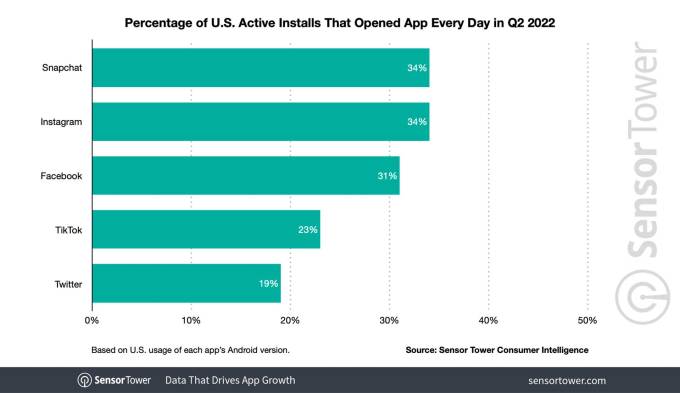
The app is tied with Instagram as having the highest percentage of power users in the U.S. in Q2 2022. That is, Snapchat and Instagram saw 34% of their active installs open the app every single day during the second quarter. This is in comparison to Facebook (31%), TikTok (23%), and Twitter (19%).

Image Credits: Sensor Tower


from https://ift.tt/R9VDCN6
via Technews
Share:

Popular Post

Search This Blog

Powered by Blogger.

Labels

Labels

Most view post

Facebook Page

Recent Posts

Blog Archive