Angry Miao’s Cyberblade gaming earbuds are the pinnacle of overengineering

We review a lot of headphones and earbuds here at TechCrunch, and most of them compete for the low- or mid-range of the earbud market. With price points ranging from $75 through $300 or so, they’re often awfully same-ish. The feature set is not dissimilar. They sound different, yes, but not by so much that you’d feel like your life would be ruined if you’d picked one set over the other. It’s a rare moment, then, that I get a piece of equipment shipped to me that breaks the mold. That’s precisely what happened with Angry Miao‘s Cyberblade headphones. The base station (yes, there’s a base station) feels like it was carved out of steel and glass. The whole setup weighs in at a whopping 370 grams — that’s 13 ounces. It’s also rare that a company refuses to tell me what their price point is.

Like much of Angry Miao’s line, this is a product that appears to be aimed at gamers — from the multicolor LED feast for your eyes, to the ludicrously fancy base station, to the carrying case for the device, which includes a rotating volume knob that controls the volume on your computer or phone. There was a whole lot of “What the ever-loving heavens is going on here?” in the unboxing and setup process of these earbuds. They cram a stupid amount of tech into it all, as well — and it’s a refreshing take on the “What if we didn’t have to make earphones that are as small and light as possible?” paradigm.

[gallery ids="2364010,2364011,2364012"]

The company shared with me why it is making earbuds at all. They point out that wireless earbuds have been around for a hot minute but that they are plagued with lag. As such, they’re not great for gaming, and the company claims you can do a lot with the audio-processing chips that already exist in earbuds.

Angry Miao decided to flip things on its head. It created a base station that includes an audio processing chip. Because it’s designed to be plugged into the computer, it matters a lot less how power-hungry the chip is, which in turn unlocks a lot of additional computing power in the charging base. In fact, when you pair the earbuds to your phone, you don’t actually pair the earbuds themselves; you pair the charger case. That means that the earbuds can be controlled from the case using a private audio stream protocol. It also unlocks a bunch of additional audio processing possibilities. The company maintains that this unlocks the next generation of high-definition audio with all the bells and whistles without sacrificing battery life on the earbuds.

When the earbuds are plugged into a computer, and with its Active Sound Enhancement (ASE) enabled, the company claims it gives users superfast ultra-low latency audio at approximately 40 ms delay (compared to AirPods Pro’s supposed 200 ms delay, according to Angry Miao). The company claims that this means it can deliver high-quality audio with low latency, as opposed to other low-latency products that sacrifice audio quality for speed. In addition, the company offers the usual battery of active noise cancellation and audio-source-dependent sound optimizations — for Zoom meetings, for gaming, for music, for movies, you name it.

[gallery ids="2364014,2364013,2364015,2364016,2364017,2364018"]

Is it fantastically cool? Absolutely. Do the earbuds have notably better audio quality than my Sony LinkBuds S earphones? Not really. Was I able to notice the difference in latency of the sound when I was playing games? Not really, but then, I’m not exactly a pro gamer.

I spoke to the company’s CEO, Li Nan, in a pretty chaotic interview, but he assures me that lag is a terrible problem for everyone, including people who are not gamers, without really being able to explain why.

“Old apps like a movie player, have higher latency and use a software trick to fix the latency problem. But in the future, the hardware must step forward,” says Nan. “Our product is fast enough that we do not need any additional work at software level. We all have very good latency. That will make it much harder for other brands.”

I challenge Nan on why 200 milliseconds — a fifth of a second — was a big deal when I’m watching Netflix. Yes, there’s a software adjustment, potentially, to make the audio sync up with the video, but…so what?

No clear answer was forthcoming, and it still isn’t entirely clear to me why these earphones need to exist, nor what their price is — the company resolutely refused to tell me, other than that “they are slightly more expensive than Apple AirPods Pro,” before Nan asked me if I would buy them at that price. I told him I didn’t know what the price was, and he reconfirmed that they were a little bit more expensive than the AirPods Pro.

Chaos aside — and honestly, the only reason I’m even writing this article — these are some of the best-manufactured in-ear headphones I’ve ever seen. I don’t give two craps about the weight, and I don’t need RGB LEDs in my headphones, the base station, or the carrying pouch, but I’ll be damned if these aren’t some of the most overengineered earphones I’ve ever seen. And, in a world where everyone is optimizing for price, they stood out for that reason.

The company is supposedly doing a round of preorders on Kickstarter starting today, and will then offer the product for sale from its website. Presumably, the price is listed on the Kickstarter page, but if I’m being honest, given the level of secrecy the company has had so far, I wouldn’t bet on it.

Angry Miao Cyberblade earbuds

Angry Miao Cyberblade earbuds — I’m definitely not cool enough for these things. Image Credit; TechCrunch / Haje Kamps


from https://ift.tt/w2oMWy9
via Technews
Share:

Netflix’s ad-supported plan could cost as low as $7

Netflix’s upcoming ad-supported plan could cost anywhere from $7 to $9 per month according to a Bloomberg report published over the weekend. For comparison, the streaming service offers a basic single-screen plan in the U.S. for $9.99 per month, while its most popular plan, which offers full HD streaming on two screens, costs $15.99 per month.

The Bloomberg report noted that Netflix plans to show roughly four minutes of commercials for an hour of programming, which is on par or less than its competitors. It also said that the company might show ads before and during a show, but won’t show anything after an episode ends.

In April, the streaming giant said it plans to offer its ad-supported plan next year. But since then multiple reports have remarked that the firm might launch this plan by the end of the year. The new report says Netflix might launch its ad-fueled tier in at least half a dozen markets in the last quarter of the calendar year.

During its recent earnings call, Netflix confirmed that users subscribing to the ad-supported plan wouldn’t have access to its whole catalog initially — that could be due to its licensing deal with different studios. Recent reports have also revealed that Netflix might now allow offline viewing in its upcoming plan.

What’s more, a report from Bloomberg last week suggested Netflix might not run ads on kids’ content — even on the ad-supported plan. The report noted the company might initially refrain from showing ads on its original movie programming.

The streaming giant has tried to garner more users by experimenting with cheaper plans like mobile-only plans available in India, Malaysia, Nigeria, Kenya, and South Africa. However, the ad-supported plan could become available globally after launch. Estimates suggest that ads on Netflix will generate $8.5 billion in revenue by 2027. A study published by Digital TV Research in May suggests that the global ad-supported video on demand (AVOD) market will grow to $70 billion by 2027 — with the U.S. generating $31 billion.

Netflix is not the only streaming service looking to rely on an ad-supported plan to expand its user base. In March, Disney+ confirmed that it is planning to introduce a similar tier by the end of the year. Earlier this month, the company confirmed the launch for December with $7.99 per month pricing. During its earnings call for Q2 2022, Warner Bros. Discovery also said it’s exploring an ad-fueled plan for the new service — slotted to launch in 2023 — created by the merger of HBO Max and Discovery+.


from https://ift.tt/zI96suX
via Technews
Share:

The majority of early-stage VC deals fall apart in due diligence

Covering Five Flute’s fundraising and tearing down the deck the company used to raise its $1.2 million seed round had me wondering: How the hell do investors decide whether to invest in a company at the earliest stages?

VC firm Baukunst led the Five Flute investment, and I sat down with Axel Bichara and Tyler Mincey to learn how they evaluate a potential early-stage deal. They told me that the vast majority of the deals they look at fall apart at the due diligence stage and helped me get a deeper understanding of what that process looks like from the inside.

“Common wisdom tends to generate mediocrity. That’s not helpful. In VC, we are looking for the outliers.” Axel Bichara, co-founder and general partner, Baukunst

“The decision to take a second meeting is one of the biggest decisions in venture capital because, from that [moment] onward, you are committing significant time,” Bichara said, explaining that, in his experience, they only invest in one out of every 250 deals or so that they see. Only about 1 in 40 first meetings result in a second meeting. “Everything you do after the first meeting, I consider due diligence. You’re evaluating the founders. At the stage we invest, most of our due diligence focuses on two things: The quality of the founding time and the size/attractiveness of the market opportunity. If you get those two right, everything else will fall into place, almost by definition.”

With the right team and a huge market, everything else can be figured out later, Bichara argued, saying that if you have a great “founder-market fit,” you’re off to the races.

“The right founding team will do the right thing [in that case]. They will execute well, and there will be capital-efficient market opportunities. You enter with a competitive advantage, find a niche and scale from there. If you don’t get a resounding ‘yes’ from those two, you shouldn’t invest,” Bichara explained. “All the due diligence you do is geared toward answering those two questions.”

In the case of Baukunst, the firm’s investment thesis means that for an investment to make sense, the startup needs to at least have the possibility of a $1 billion outcome or more — which means that the market opportunity needs to be big enough to enable that if the founding team executes well.

“You just work backward from there,” Bichara said, “and all the due diligence we do will be in support of that.”


from https://ift.tt/6YePGCt
via Technews
Share:

Can battery recycling help end US reliance on China?

The Inflation Reduction Act, signed into law by President Joe Biden earlier this month, puts the U.S. on the path toward realizing its carbon reduction goals, in part by spurring its EV market. It has also plunged that same market into short-term chaos by requiring entire supply chains to be restructured in just a few years.

The catalyst is the IRA’s steep requirements around where automakers can shop for critical battery materials if they want to be eligible for the $7,500 Clean Vehicle tax credit. China, the world’s largest producer of such supplies, is not on the list.

As a result, many in the industry are swiveling their heads toward battery recycling companies that promise to supply automakers with at least some of the materials they’ll need in the coming years to produce the wave of EVs coming to market. This space has already seen substantial recent VC investment, particularly as millions of tons of lithium-ion batteries are expected to retire by 2030.

The new legislation has sent a signal to recyclers, battery producers and automakers that 2030 is not soon enough.

Ending reliance on China


from https://ift.tt/4hi6Mg2
via Technews
Share:

Aston Martin Valhalla plug-in hybrid to shape future EVs

Aston Martin is using its upcoming Valhalla high-performance plug-in hybrid to develop a playbook for its future EVs.

Executives said that the 937-horsepower Valhalla supercar exhibited at the Pebble Beach Concours d’Elegance on Sunday showcases lessons in driver engagement, visual effects and sound that could surface in its first EV in 2025.

“If we get that performance hybrid recipe right, it’s something we could see elsewhere later on in the range,” said Alex Long, head of Product & Market Strategy for Aston Martin Lagonda.

The Valhalla’s engineers were especially concerned with retaining the brand’s racetrack-ready driving dynamics when developing the mid-engine two seater, he said. Electric vehicles can feel less engaging as the driver cedes control to the electrical systems and advanced driver assistance functions that govern them.

“EVs are more like daily drivers and less of a weekend thrill,” Long said.

Engineers strived to put the driver back in control of the Valhalla’s hybrid powertrain, which combines a twin-turbo V8 with two e-motors, by dialing in “a little bit of oversteer and lots of feedback from the front end” among other tweaks.

“One thing we’ve been very careful to do is with tuning the responses of the car back to the driver,” he said. “If you over assist the drive, then there’s a level of disengagement.”

Electric motors provide quicker acceleration, hybrids and EVs are heavier and tend to be less nimble than their gas-engine counterparts. The additional weight from the battery powertrain presented several challenges, including figuring out how to change direction quickly without overloading the brake system.

The Valhalla is also pioneering the exterior design for the brand’s electrified portfolio, said Chief Creative Officer Marek Reichman. Its body displays both painted and carbon surfaces to create shadows that help make the car appear to be in motion when standing still.

“There has to be a great visual balance, so how do you break up the car, whether it’s the carbon or the body color, or paint it to give a vernacular to electrification? I think it has to have its own language.”

Sound, too, came in to play. Historically, engine noise has been crucial to the perception of a sports car’s performance. “It’s a big challenge with EVs because you lose a lot of the emotion with the sound quality, and you don’t have that step process of gearing up,” Long said.

The Valhalla is “a nearly silent operation” in EV mode, he added. “All of the noise will come from the V8, which is going to be loud.”


from https://ift.tt/SLx109J
via Technews
Share:

Burn, baby, burn. Real estate-focused fintech startups feel the heat

Welcome to The Interchange! If you received this in your inbox, thank you for signing up and your vote of confidence. If you’re reading this as a post on our site, sign up here so you can receive it directly in the future. Every week, I’ll take a look at the hottest fintech news of the previous week. This will include everything from funding rounds to trends to an analysis of a particular space to hot takes on a particular company or phenomenon. There’s a lot of fintech news out there and it’s my job to stay on top of it — and make sense of it — so you can stay in the know. — Mary Ann

As we all know, the housing market goes through cycles. Low interest rates mean more purchases and refinances. Higher interest rates mean far fewer purchases and refinances — and lots of business for fintechs operating in the real estate industry.

In 2020, historically low interest rates led to a surge in both rates and purchases. Existing home buyers rushed to alter the terms of their loans and aspiring home buyers took advantage of those low rates to purchase homes. Factor in that more people were spending more time at home than ever due to COVID shelter-in-place orders, home took on new meaning. Suddenly, many needed more space. Others took advantage of new remote work policies and being constrained by commutes to relocate to new homes.

This led to a boom in business for startups catering to home buyers. Companies (like digital mortgage lender Better.com) couldn’t keep up and had to go on a hiring spree to meet all the consumer demand. Venture dollars flowed into proptech after proptech.

Then 2022 came.

Mortgage interest rates, which began their ascent in 2021, continued to climb…significantly. Prospective home buyers, turned off by the rate surge as well as the competitive and overheated housing markets, began to reconsider their plans, as buying was suddenly far less appealing. At the same time, as the venture market slowed dramatically and suddenly, raising capital was much harder.

Layoffs in the sector began — and they took place in a range of real estate tech companies, big and small. Digital mortgage lender Better.com conducted its first of four layoffs in the past nine months on December 1, 2021. Its fourth layoff was scheduled to take place last week before news of it leaked to some employees, and the media. (You can read my story on that here).

And, real estate tech startup Reali announced last week that it had begun a shutdown and would be laying off most of its workforce on September 9.

In a press release, co-founder and chairman Amit Haller said “the challenging real estate and financial market conditions and unfavorable capital-raising environment” led to the decision to wind down operations.

“Reali was one of the pioneering companies to offer the ‘buy before you sell’ and ‘cash offer’ programs to homeowners,” he said in the release. “We believed deeply in benefiting the consumer foremost in every transaction.”

Readers reacted with shock that a company could burn through so much cash, so fast.

Indeed, a little birdie told me that six-year-old Reali had been burning through cash and is in debt as it tries to sell off parts of its business. The company did not respond to my requests for comment.

Now, to be fair, Reali and Better.com aren’t the only ones facing challenges in the real estate tech world. Earlier this month, another “buy before you sell” startup Homeward laid off 20% of its staff. And Redfin and Compass let go of a combined 900+ people in mid-June. In February, online brokerage Homie laid off about one-third of its staff, or some 90 to 100 people.

While Better.com and Reali aren’t in the same exact space, they both cater(ed) to home buyers. And they both apparently burned a lot of cash in 2021. In case you missed it, Better.com CEO Vishal Garg was recorded — in a meeting held after the company’s first round of layoffs last year — saying: “Today we acknowledge that we over hired, and hired the wrong people. And in doing that we failed. I failed. I was not disciplined over the past 18 months. We made $250 million last year, and you know what, we probably pissed away $200 million.”

Oof.

Frankly, it’s both mind-blowing and offensive to hear of companies that can blow through enough cash to help millions of people in need like it’s nothing.

Personally, I’m all about the lean-and-mean mentality. Operate capital efficiently all the time, downturn or no downturn, and you won’t be as panicked and sinking when the going gets tough. That means not hiring for the sake of hiring, thinking long-term and not spending like there’s no tomorrow.

More fintechs are focusing on nonprofits

Last week, I came across, or was pitched, several tidbits of news that made me realize that an increasing number of fintech companies are launching products to help nonprofits and charities more efficiently move, raise and distribute more money.

First up, fintech startups Highnote and GiveCard said they are partnering to help nonprofits, shelters and governments issue prepaid debit cards to the “financially vulnerable” communities they serve. Via email, they told me: “Studies show direct cash payments can put people on a path to permanent housing and end their reliance on predatory lenders. But buying a bunch of prepaid debit cards from the local corner store and then surveying the recipients every week to see if it’s helping isn’t a scalable solution, and the lack of data is a major reason why city governments are reluctant to fund it. The tech behind Highnote allows GiveCard to rapidly deploy cards to its network of nonprofits and collect enough top-level anonymized data to figure out whether the programs are working, and whether the amount or the frequency of the payments needs to be adjusted, opening the possibility for more city governments to start adopting these programs.”

Los Angeles–based B Generous, a self-described “fintech for good” platform, has launched Donate Now, Pay Later (DNPL), a new tool it says allows donors “to make contributions to their favorite nonprofits through a proprietary philanthropic credit product called a Point of Donation Loan™ (PoDL). Using Donate Now, Pay Later™, B Generous says the nonprofit receives the donation immediately, and the donor gets the tax receipt right away, but the donor pays nothing out of pocket at the point of donation and instead pays over time, with no interest, costs or fees.” The goal, it says, is to increase average donation values for nonprofits.

It’s not only startups getting in the nonprofit space. TC’s Sarah Perez reports that “PayPal is expanding further into the charitable donations business with its August 25 launch of support for Grant Payments. The new product has been created in partnership with National Philanthropic Trust (NPT) and Vanguard Charitable and allows Donor-Advised Fund (DAF) sponsors, community foundations and other grantmakers to move their donations electronically through PayPal’s platform.” Notably, Sarah adds that PayPal cited “a sizable market in charitable giving as a reason for entering this space with a new product.”

Fintech for good? Love it.

Climber giving another climber a helping hand up to the top of a rock.

Image Credits: kieferpix / Getty Images

Weekly News

Within half a year of going to market with its bill pay feature, Ramp went from launch to more than $1 billion in annualized bill pay volume, according to co-founder and CEO Eric Glyman. Last week, he told me that Ramp has now added financing and overlay to its bill pay product with a new offering called Flex. With the new Flex feature, customers will have the option “in one click” to add financing to pay the money back up to 30, 60 or 90 days later for a fee while the vendor “gets paid right away.” Besides the extra time, bill pay gives the business the flexibility to pay any way they wish or the vendor requires, including via ACH, check or card. Read more, by me, here.

Natasha Mascarenhas broke the news that Argyle, which at one point aimed to be the “Plaid for employment records,” has laid off 6.5% of its staff — five months after raising a $55 million Series B. The company blamed the decision on a move upstream to serve more enterprise customers rather than SMBs (sound familiar? Ahem, Brex). Yet, it’s still hiring. Confused? So were we. But we can only infer that it needs to hire more people with enterprise experience and let go of those with smaller company–focused skill sets.

News that T. Rowe Price cut the value of its stake in fintech giant Stripe made headlines last week, the new data point coming in the wake of similar cuts by other investment houses regarding their ownership in late-stage startups. However, while it is true that T. Rowe Price reduced the value of its stake in Stripe, part of its Global Technology Fund, the latest reduction in its worth is not unique. Not only has Fidelity disclosed that it now values its Stripe shares at a discount to prior marks, but the latest T. Rowe Price news also comes after a similar cut in March. But the company is not the only fintech under pressure, Alex Wilhelm and I write in this piece. Meanwhile, at least one VC wants to cash in on Stripe’s lowered valuation. Homebrew’s Hunter Walk tweeted: “pls let me know if you find anyone selling preferred shares at this latest valuation because I’d like to purchase.”

Google Wallet is now available in South Africa, the first market for this product in Africa, to make it easy for users to save and easily and securely access their payment cards, loyalty cards and boarding passes,” reported Annie Njanja.

MANTL, a provider of account origination solutions, has partnered with Alliant Credit Union — a $17 billion digital financial institution — to expand into the credit union market with MANTL for Credit Unions. Via email, the company said the software was designed to improve application conversion rates and reduce the time to open new or additional accounts.

Personal finance company MX announced that Wes Hummel — who previously served as PayPal’s vice president of site reliability and cloud engineering — has been named chief technology officer (CTO) of MX. The company told TechCrunch Hummel joins MX just weeks after Jim Magats, also formerly of PayPal, was named CEO of the company.
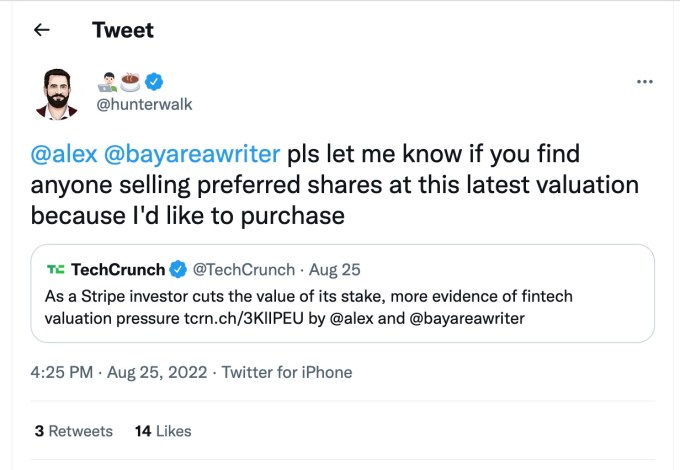
Image Credits: Twitter

Fundings and M&A

Seen on TechCrunch

  • Complete has raised $4 million in seed funding led by Accel, with support from Y Combinator and executives at Calm, Opendoor and Stripe. The San Francisco startup helps startups think through the “why” and “how” of employee pay. Anita Ramaswamy digs in here.
  • Dubai-based Zywa, a neobank for Gen Z, plans to fuel its growth in the United Arab Emirates (UAE), and to kick-start its expansion to Saudi Arabia and Egypt after raising $3 million seed funding at over $30 million (110 million AED) valuation. Read more from Annie Njanja here.
  • Deposits, a Dallas-based startup offering a cloud-based, plug-and-play feature to simplify the implementation of digital banking tools for credit unions, community banks, insurers, retailers and brands, raised $5 million.  Christine Hall gives us the story here.
  • Lastly, CSI, a decades-old fintech solutions vendor, agrees to be acquired for $1.6 billion.

And elsewhere


Now for an important PSA: TechCrunch Disrupt finally returns — live and in person — to San Francisco on October 18–20. We’re excited to share the complete agenda, where you’ll hear from game-changing leaders like Serena Williams (Serena Ventures), Marc Lore (Wonder Group), Ami Gan (OnlyFans), Johanna Faries (Call of Duty), Chris Dixon (a16z), and many more!

In addition to hearing from these leaders, you can get your how-to on over at the TechCrunch+ stage, check out roundtable discussions and breakout sessions. Whatever you do, start planning your schedule now so you don’t miss a lick of all this startup goodness.  Register before September 16 and save $1,100. This will be my first Disrupt and I am beyond excited!


That’s it for this week. Thanks for joining me on this wild fintech ride. See you next week! xoxo, Mary Ann


from https://ift.tt/p0tyYSw
via Technews
Share:

India’s Akasa Air exposed sensitive records of thousands of customers

Akasa Air, India’s newly launched airline that began operations earlier this month, exposed the personal data of thousands of its customers because of a technical glitch that affected its login and sign-up service.

The exposed data, discovered by cybersecurity researcher Ashutosh Barot, included full names, gender, email addresses and phone numbers of customers signing up and logging in on the Akasa Air website.

The researcher found an HTTP request disclosing the data minutes after looking at Akasa Air’s website on its inaugural day on August 7. He had initially tried to communicate with the security team at the Mumbai-based airline directly but did not find a direct contact.

“I reached out to the airline via their official Twitter account, asking them for an email ID to report the issue. They gave me the info@akasa email ID to which I didn’t share the vulnerability details because it might be handled by support staff or third party vendors. So, I emailed them again and asked [the airline] to provide [the] email address of someone from their security team. I received no further communication from Akasa,” the researcher said.

After not getting a response from the airline on how he can connect with the security team, the researcher informed TechCrunch about the issue.

Akasa Air quickly responded when we reached out and acknowledged that the issue had put 34,533 unique customer records at risk. The airline also said the exposed data did not include travel-related information or payment records.

On being made aware of the incident, Akasa Air shut down its sign-up service. The airline also said that it added additional controls before resuming its service to the general public.

Additionally, the airline told TechCrunch that it carried additional reviews to ensure the security of all its systems.

Akasa Air reported the incident to India’s nodal cybersecurity agency CERT-In and notified its affected users through a statement that it also made public on Sunday. It advised users “to be conscious of possible phishing attempts” due to the data exposure. Further, it confirmed to TechCrunch that it did not see an “untoward spike in access” to the data.

“At Akasa Air, system security and protection of customer information is paramount, and our focus is to always provide a secure and reliable customer experience. While extensive protocols are in place to prevent incidents of such nature, we have undertaken additional measures to ensure that the security of all our systems is even further enhanced. We will continue to maintain our robust security protocols, engaging wherever applicable, with partners, researchers, and security experts from whom we can benefit to strengthen our systems,” Anand Srinivasan, Co-Founder and Chief Information Officer at Akasa Air, said in a prepared statement on the matter.

“I am glad the airline fixed the issue on short notice and reported it to CERT-In as well as informed its customers about the incident, which is an exemplary step,” the researcher said.

Incidents of data exposure and leaks are becoming common in India, which withdrew the last iteration of its data protection bill earlier this month. A number of domestic companies in the country also do not have dedicated programs to award and incentivize researchers helping to find flaws in their systems.


from https://ift.tt/aADViZS
via Technews
Share:

Popular Post

Search This Blog

Powered by Blogger.

Labels

Labels

Most view post

Facebook Page

Recent Posts

Blog Archive