The success of any piece of visual communication depends on colour. Research into the impact of colour in marketing tells us that it takes the average person just 90 seconds
If you've been hard at work in your spare time creating stunning paper art or impressive poster designs, selling your merchandise online can be a quick way to...
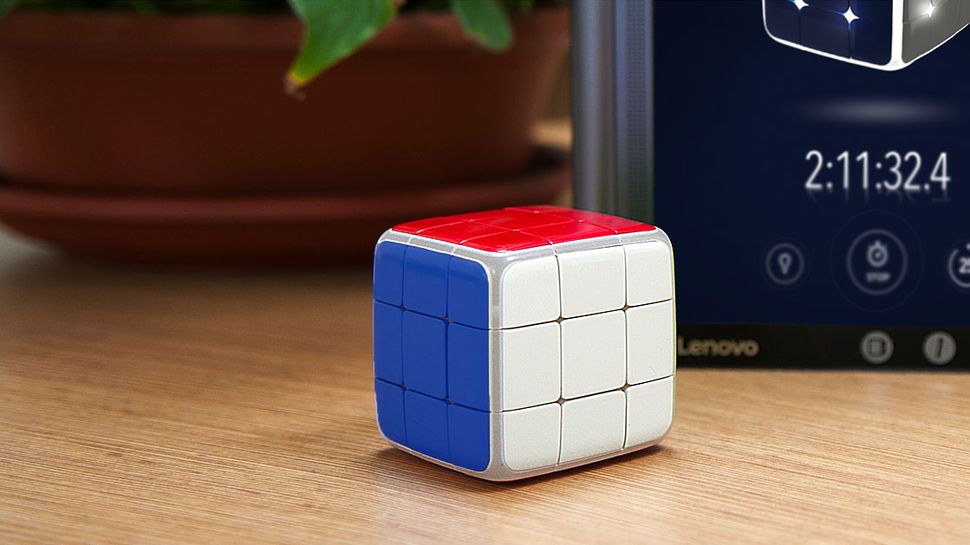
Originally designed in 1974 and launched internationally in 1980, Rubik's Cube is a design classic that's sold by the hundreds of millions. Over the years, it...
Your design portfolio is one of your most useful tools. It can win you commissions, help you snag a new design job, attract collaborators, and get your work in...
Editorial design can be a daunting task for someone who isn’t used to formatting large amounts of text. The skills you'll need are different to those of...
Amazon is launching two new designs for its Echo Dot Kids devices, the company announced at its virtual event today. The Echo Dot Kids devices now come in new Owl and Dragon designs. The two new designs join Amazon’s current Echo Dot Kids devices: the Tiger and the Panda. The new designs will be available starting next month for $59.99.
Amazon’s Echo Dot devices are designed to help kids learn and grow, as kids can ask Alexa questions, set alarms and get help with their homework. The devices also include parental controls that you set daily time limits, filter explicit songs and review activity in the Amazon Parent Dashboard.
The company also noted that the devices come with one year of Amazon Kids+, which is its kid-focused content service that includes ad-free book, games, apps and Alexa Skills. Amazon also teased that soon kids will get access to new partner and premium options with Amazon Kids+.
On the topic of kids, Amazon also revealed a new a new AI-powered feature will allow kids to co-create characters and visual stories with Alexa with parental consent. Following Alexa’s prompts, kids will be able to select or customize animated characters and Alexa will create a unique story with visuals and music. The company says this feature is made possible by advancements in conversational and generative AI across language and audio. Kids will be able to use the feature this holiday season.
Amazon also announced that Disney’s wearable device that lets guests enter theme parks and more, the MagicBand+, will be compatible with “Hey, Disney!” and work with Echo devices.
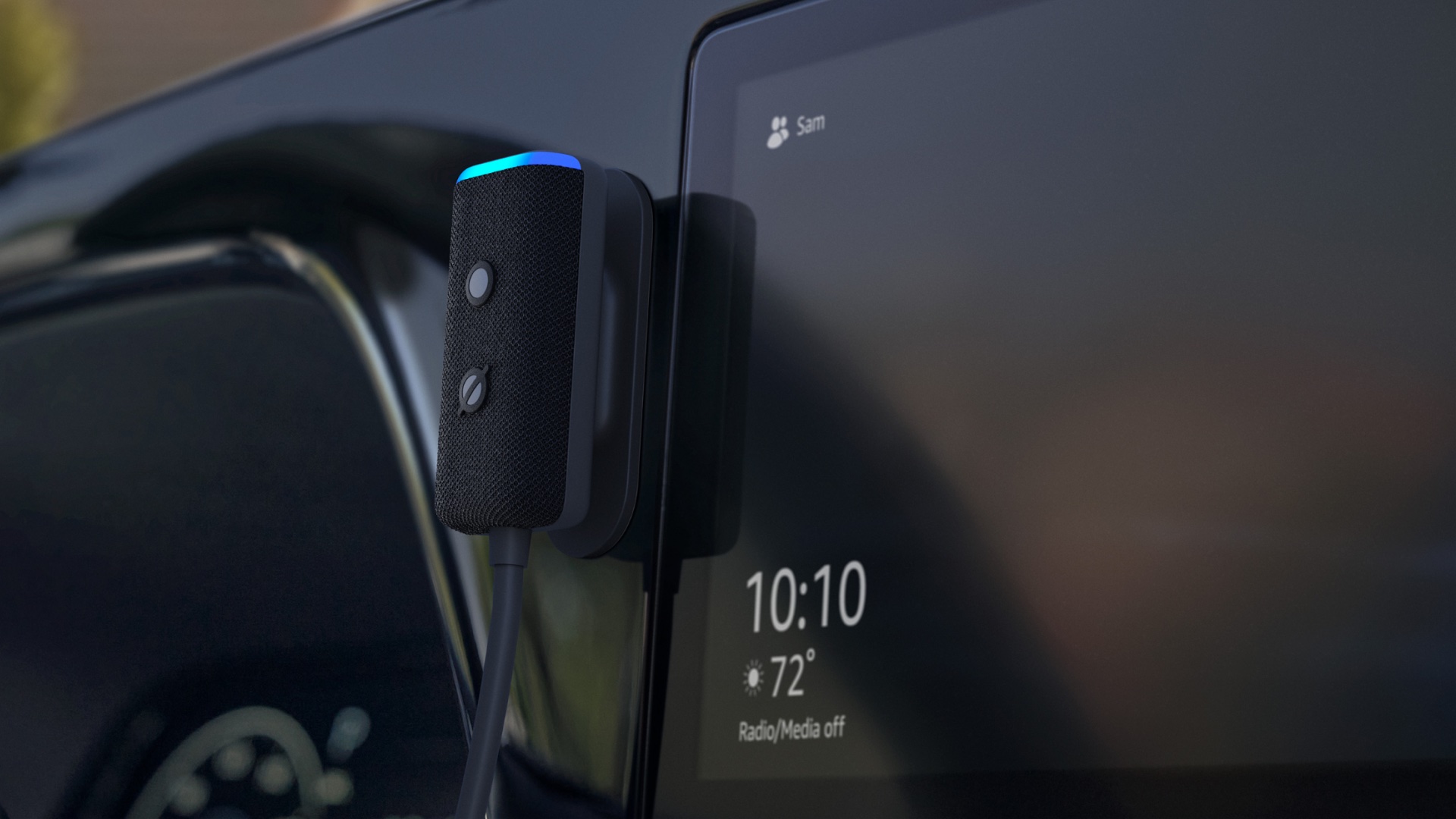
Amazon released Wednesday the second-generation version of Echo Auto, a smaller and slicker device aimed to broaden the e-commerce giant’s reach by bringing its Alexa voice assistant into more vehicles.
Echo Auto, which first came to market in 2018, connects to a vehicle’s infotainment system to bring the Alexa assistant into the vehicle. A driver can either plug the device into the vehicle’s auxiliary port or via a smartphone’s Bluetooth connection and the Alexa app.
The most notable changes in the second-generation version, which costs $54.99, is its smaller size and slicker styling as well as a new adhesive mount to allow drivers some flexibility in where they might want to secure the device.
Image Credits: Amazon
The Echo Auto now has five microphones to ensure a driver’s request is heard over typical background road noise or even music, according to Amazon. It also comes with a Quick Charge 3.0 certified adapter that can be used to fast charge a phone.
On the feature front, Amazon has added roadside assistance to Alexa, which means it’s also coming to Echo Auto. Users can say “Alexa, call Roadside Assistance,” to connect with an agent who will request help on a driver or passengers’ behalf for problems such as a running out of gas or a flat tire.
Users can also turn their smartphone into a driver friendly display via a feature called Auto Mode, which is launched via the Alexa app on their smartphone. Auto Mode isn’t new — it was first talked about two years ago — but it’s sticking around for good reason.
Amazon wants to offer another option to owners of older vehicles that lack the higher resolution and larger displays commonly found in new models. And it shows that Amazon is keen to capture the entire vehicle marketplace not simply via automaker partnerships in which Alexa is embedded technology in the car.
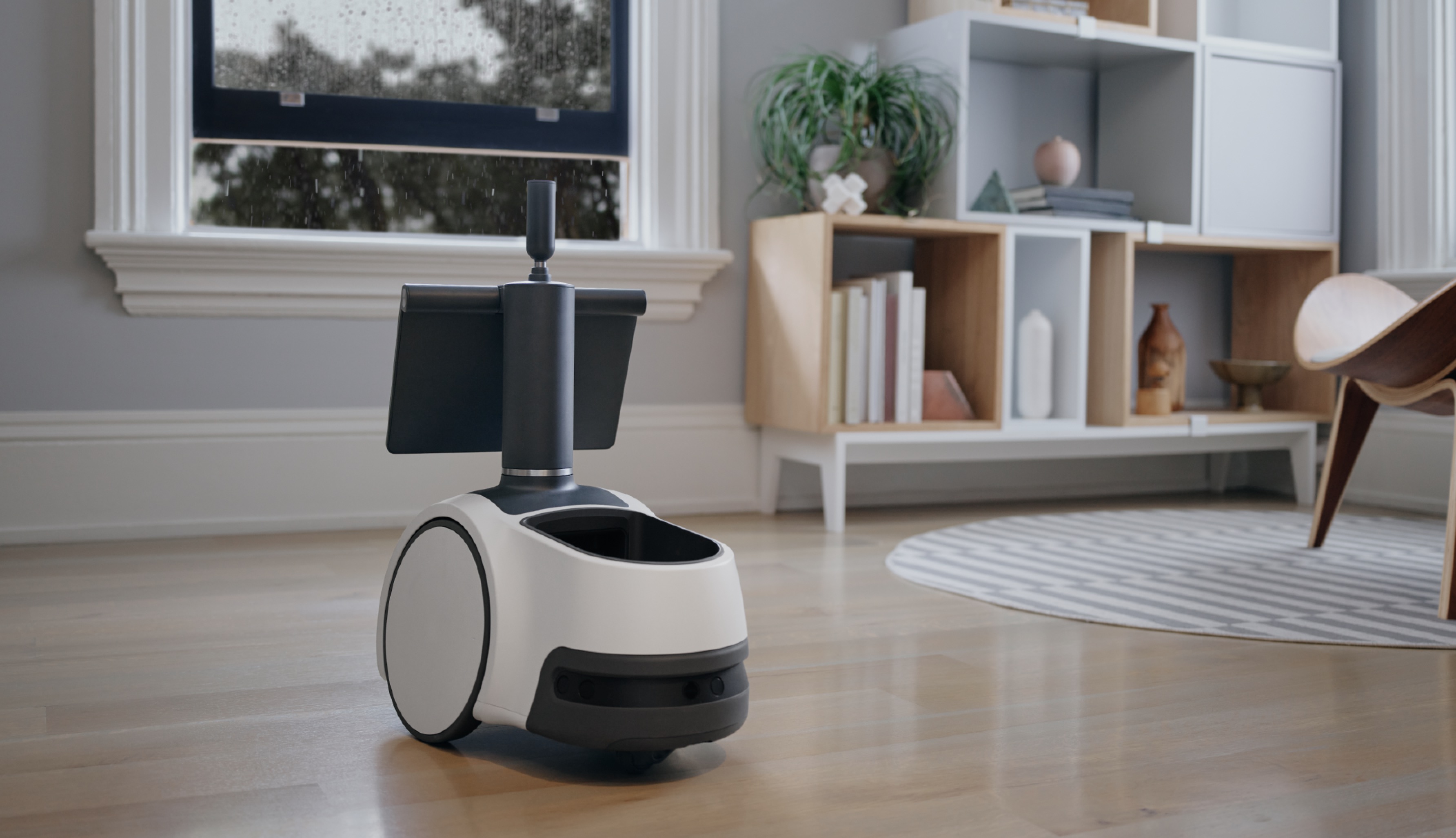
There’s been a standing question surrounding how seriously we should ultimately take Astro. The product was launched exactly one year ago, in limited quantities as a Day One offering for $1,500 a pop. My interaction with the robot was (at the time) limited to a few pre-launch demos. I came away from the experience thinking the home robot was cute and largely said what it did on the tin.
Haje took a unit home and left the experience wondering, broadly, what Astro is for. The question of “why” is an important part of the review process, of course, and that import only increases as the price goes up. That is to say that a $1,500 product has a much larger burden of “why” to answer than a $150 or $15 one.
Ken Washington, who now serves as the head of the Amazon’s consumer robotics category, bristles at my characterizing of Astro’s rollout as either a pilot or a testing of the wider for potential wider availability.
“[Day One] is a way for us to put these products in their hands quickly,” the executive tells TechCrunch. “Not for us to — not learn their interest — learn what they want to see most to be added to it . […] We’ve had hundreds of thousands of inbound requests and we continue to manufacture and deploy Astros to those customers who make those requests. I can’t the actual sales quantity because we don’t share the data. But we’re off to a great start.”
Image Credits: Amazon
This time out, those customer-inspired features include pet detection and the ability to recognize and check specific windows and doors in your home. It’s part of Astro’s current core competency of servicing as a kind of rolling security system that augments stationary cameras from brands like Ring (and can, for that can be viewed through the same app).
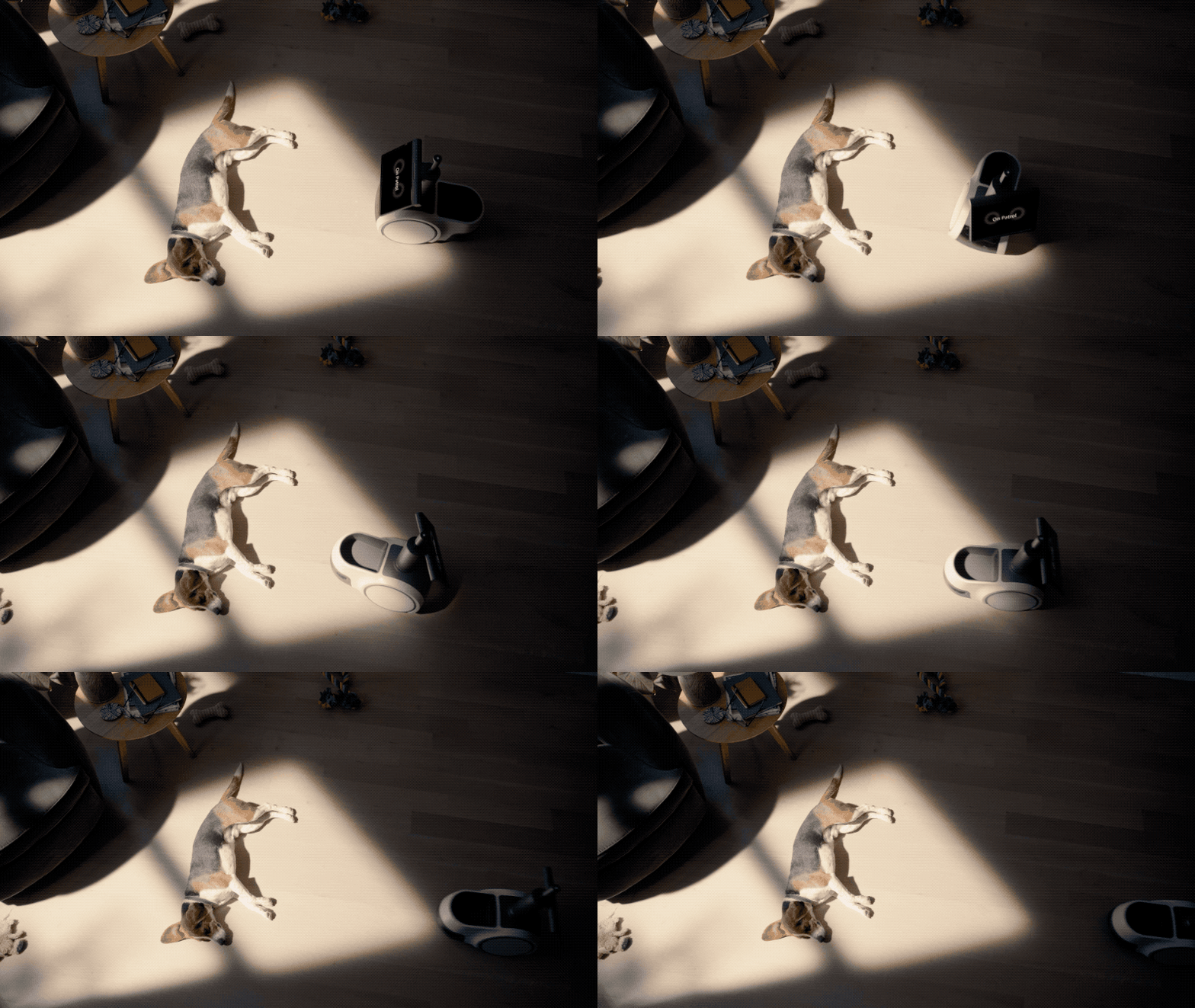
Pet detection, meanwhile, was apparently one of the most requested features. It’s able to recognize dogs and cats and send you a video push when it sees movement. As currently implemented, it’s all or nothing with those pushes. Unlike person detection, the robot is not able to distinguish between pets, instead it relies on a broader model trained on cats and dogs.
Amazon developed it in-house, using an SDK the company developed that will be shared with a trio of universities — the University of Michigan, Georgia Tech and the University of Maryland — this year. The idea there is to have robotics students help kickstart third-party feature development for the robot. As has become the case with so much consumer hardware over the past decade, Amazon appears to view Astro as a kind of platform on top of which developers can add expanded functionality.
Image Credits: Amazon
“I know from my experience, that when you give universities access to SDK and technology like this, they come up with all kinds of really great ideas,” Washington says. “And so we were excited and can’t wait to see what they come up with. This is the beginning, and we know, just like in the early days of Alexa, that when you provide a SDK for a platform is interesting as Astro, that all kinds of innovations can happen.”
“Early days” is really the key phrase in all of this stuff. The world of consumer electronics is littered with decommissioned robots — many cute, most pointless. From hardware startups like Anki to giant multinational corporations like Sony, this stuff is extremely hard to get around. Really, only iRobot figured out a way around it with the purpose-built Roomba line. Good thing for Amazon, then, that it’s acquiring the firm, FTC approval pending.
Ultimately, one doubts Amazon’s commitment at their own risk. The corporation revolutionized and accelerated warehouse and fulfillment automation, full stop. It undoubtedly has the resources — and, seemingly, the desire — to do something similar with home robotics, even if Astro has to roll around a bit more, in search of meaning.
During Amazon’s hardware event this morning, the company announced new Alexa-powered Echo devices including new Echo Dot and Echo Dot with Clock models. One of the more notable upgrades is Eero Built-in for Echo Dot, which allows Echo Dot devices to serve as Wi-Fi extenders for existing Eero networks.
The Echo Studio — which now comes in a new color, Glacier White — isn’t getting hardware-level improvements. Instead, an over-the-air upgrade will bring spatial audio processing technology that builds on Amazon’s 3D audio to existing Echo Studio devices, designed to offer greater “width” and clarity than standard stereo audio. (Spatial audio is a feature of the Amazon Music Unlimited service, which costs $8.99 a month.) The smart speaker’s frequency range extension tech, another new addition via forthcoming new software, ostensibly delivers better playback performance by improving the mid-range clarity and deepening the bass.
Image Credits: Amazon
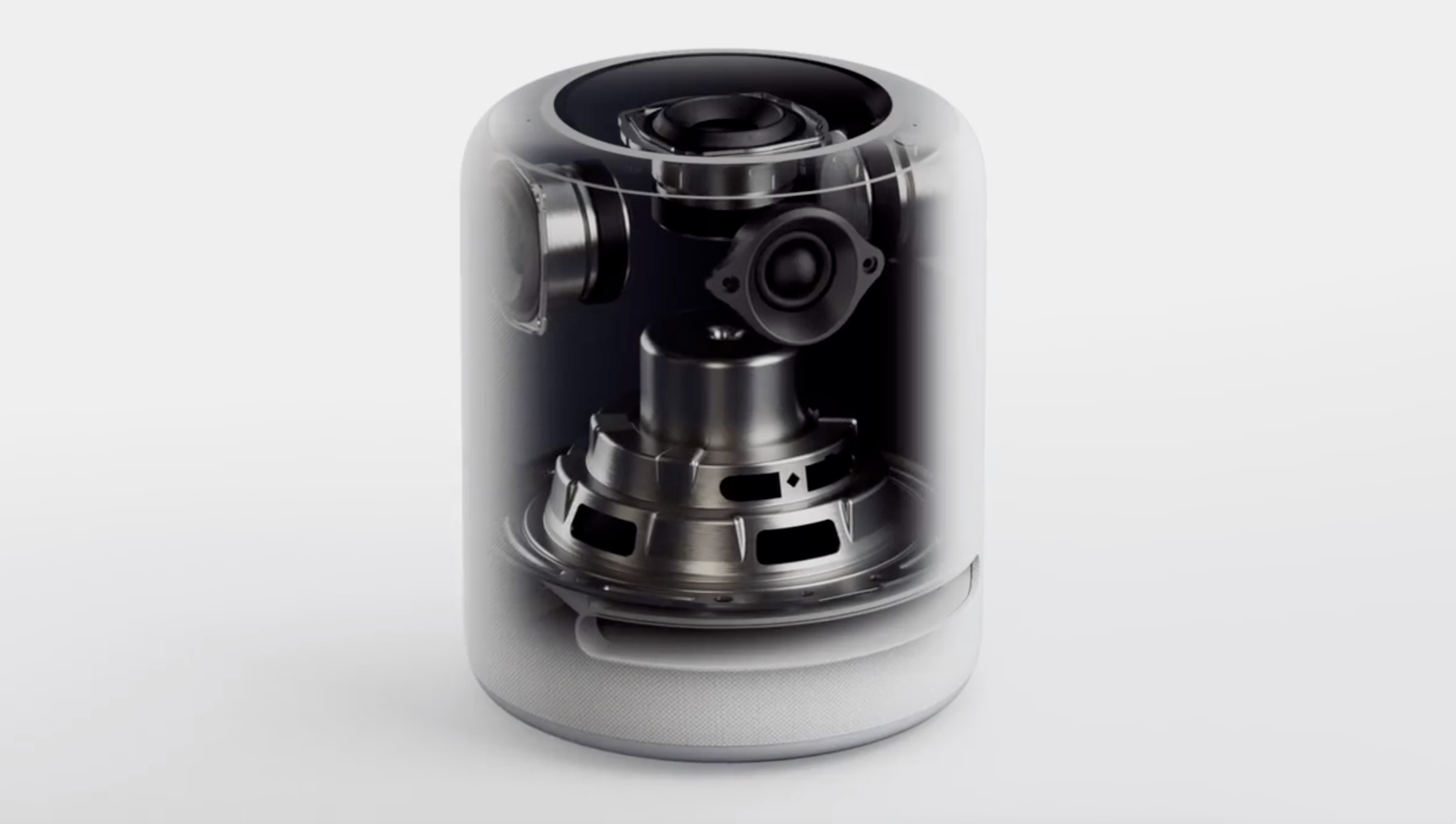
As for the upgraded Echo Dot, which does feature new hardware, it has a redesigned architecture that squeezes a larger speaker into housing that’s the same size as the previous generation — leading to clearer vocals and twice the bass. An enhanced, brighter and higher-resolution display on the Echo Dot with Clock model shows more information, including the time. And new sensors — an accelerometer and temperature sensor — and Amazon’s AZ2 neural edge processor enable things like more tap gesture controls (e.g., tapping the top of the device to pause and restart music, stop a timer or end a call), asking Alexa for the room temperature and triggering temperature-based routines.
The new Echo Dot is also the first to ship with the aforementioned Eero Built-in, which adds up to 1,000 square feet of coverage to an existing Eero wireless network. Fourth-gen Echo Dots including the old Echo Dot with Clock will receive a firmware update that enables this in the coming months, Amazon said.
The improved Echo Dot will be available for $49.99, while the new Echo Dot with Clock will be priced at $59.99. They’re available for pre-order today and will ship next month alongside two new designs for Echo Dot for Kids, Owl and Dragon, both of which will come with a year of Amazon’s kid-focused content service, Amazon Kids+.
Alongside news of new Alexa devices, Amazon today unveiled a refresh of its Ring lineup including new cameras, alarms and more. The flagship addition for consumers is a new “pro-tier” security camera joining Ring’s radar-powered lineup, the Spotlight Cam Pro. However, the more interesting (or creepy?) news is Amazon’s plan to integrate its Ring Virtual Security Guard subscription service for third-party monitoring with its Amazon Astro robot.
Originally designed as a home helper, Amazon hadn’t been quite sure which direction it wanted to take its new robot. Now, it seems the company is testing out whether or not Astro could be used for security monitoring purposes.
The company says the new solution could make sense for those businesses that can’t afford an on-site security patrol but still want to keep an eye on their business after hours. Longer term, Amazon envisions a world where robots could complement or even take the place of security guards.
The integration as it stands today, however, will tie into Ring Alarm or Alarm Pro devices. When an alarm is triggered, the Astro robot could go investigate and observe the scene using its onboard camera. It can also be set to autonomously patrol a property when the Ring Alarm is set to “Away” mode. As a part of the Ring Virtual Security Guard service, the agents would also be able to remotely operate the robot when an alarm is triggered, allowing them to get a closer look at the scene, as well as use the Two-Way Talk feature to alert an intruder that the authorities have been called.
This seems like a far-fetched use case, to be sure — anyone daring to break into a property will not likely be scared off by the adorable Astro, though it could certainly catch them off guard momentarily. Amazon says it will begin testing this integration with a select group of small business customers in the coming months and will gather feedback.
Image Credits: Amazon
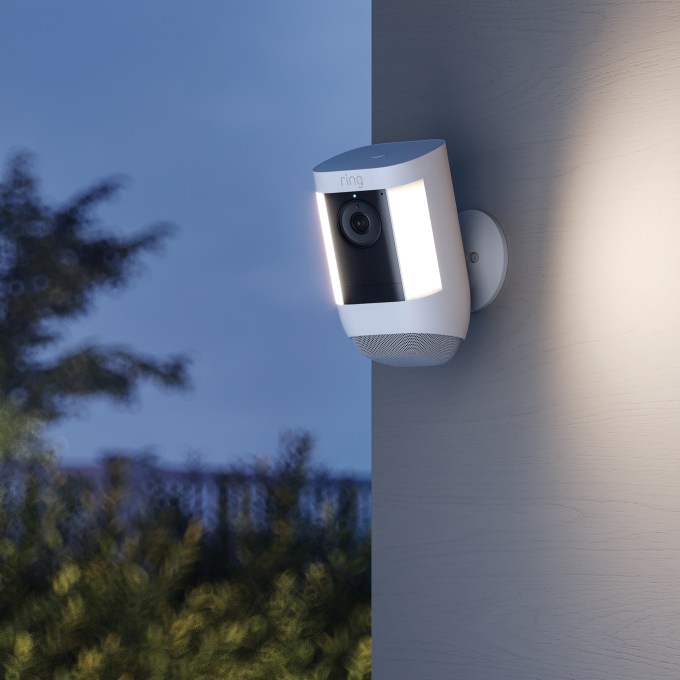
Among the more typical updates, the company also announced a new camera, with the Spotlight Cam Pro. The camera employs radar to measure the distance and angle of an object moving in front of the camera. Its ability to detect motion three-dimensionally leads to more refined and accurate alerts, Amazon claims. Radar also helps to power a “Bird’s Eye View” feature that provides an aerial map of movement across a property, to give the full picture of a motion event. A similar “Bird’s Evey Zones” feature was also recently added to Ring Video Doorbell Pro 2 and Floodlight Cam Wired Pro, the company noted.
Image Credits: Amazon
Users can set their own 3D Motion Detection thresholds on the Spotlight Cam Pro, as well as customizable Motion Zones to trigger recordings and Privacy Zones to exclude areas.
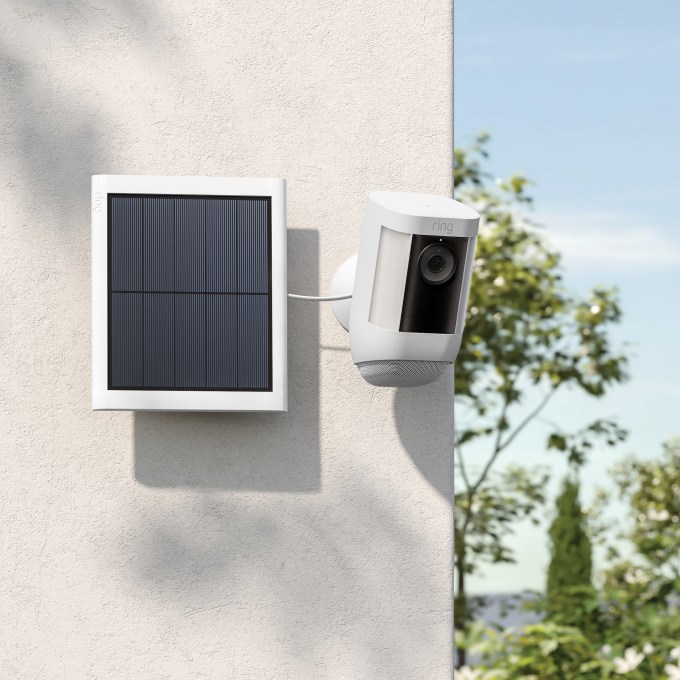
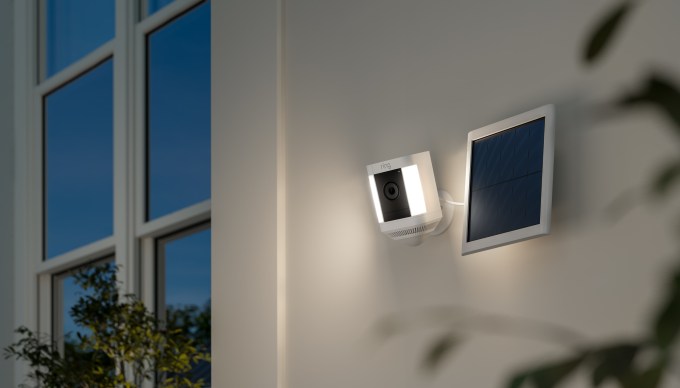
It will be available for pre-order today in battery and plug-in configurations for $229.99. The solar-powered version is $249.99. The wired version isn’t yet available.
Amazon is also updating its Spotlight Cam Plus ($199.99) which now has a new look at is available with multiple power options including wired, plug-in, solar and battery.
Image Credits: Amazon
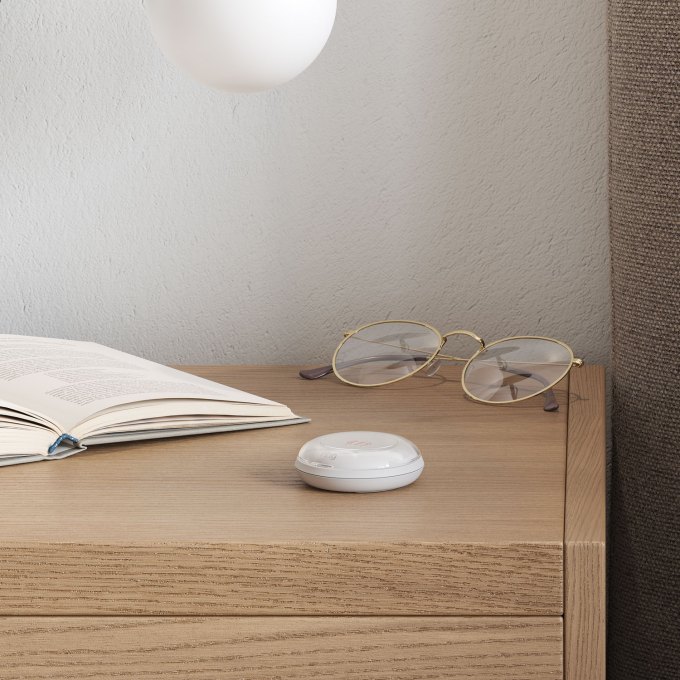
And it’s releasing the second generation of its Ring Alarm Panic Button ($29.99), designed to be either wall-mounted or placed on a flat surface, enabling customers to call for help, including medical or fire assistance.
Image Credits: Amazon
Amazon’s other home security division, Blink, also announced new devices today, including the new Blink Mini Pan Tilt, an accessory for the Blink Mini security camera. This offers additional functionality with a 360-degree view of the room for $29.99. It’s also launching a smart floodlight, the Blink Wired Floodlight Camera, offering Privacy and Activity Zones, for $99.99. It will be available later this year.
Now that the U.S. has finally committed to electrifying cars and trucks, there’s been a lot of handwringing over where they’ll charge.
The Biden administration just approved all 50 states’ plans for where to install DC fast chargers, and while those plans will help fill massive infrastructure gaps, those chargers won’t be nearly enough to handle all the miles that EVs will rack up. Fortunately, they won’t have to — a lot of EV charging is done while cars are parked at home.
But that does raise another problem — millions of households will be installing EV chargers in the coming years. Electricians are likely to be stretched thin, which could make it difficult for homeowners to book their services.
A new startup hopes to ease the burden on both sides by creating a platform to make installing a charger as easy for homeowners as ordering new furniture.
Kopperfield today closed a $5 million seed round, TechCrunch has exclusively learned. The round was co-led by General Catalyst and Lachy Groom with participation from Giant Ventures, MCJ Collective, Shopify founder Tobi Lutke, Coinbase board member Gokul Rajaram, Arcadia Power founder Kiran Bhatraju, First Round Capital partner Cristina Cordova, and other angel investors.
Founders Mark Wong and Jesse Vaughan came up with the idea for Kopperfield following their own struggles to electrify their homes.
The event, organized by investors Sophie Winwood, Ruth Foxe Blader and Clarisse Lam, brought together top minds to discuss creating a more inclusive and equitable venture landscape. The conference was open only to those identifying as women, and panels included topics such as the role of LPs in diversifying tech, finding the next women-founded unicorn, and inspiring more women fund managers.
Winwood, Blader, and Lam were inspired to create the conference after growing tired of the paltry funding and few opportunities granted to women in Europe. In 2021, 1.1% of all VC in Europe was allocated to women-founded companies. Though that number is down from the 2.4% raised in 2020, it is on par with what was raised in 2017, 2018 and 2019 which saw women receive 1.5%, 1.8% and 1.5% of all venture capital, respectively.
Diversity conferences such as these are quite common in the U.S., though not at all in Europe. Women in VC Summit: Europe is stunning in the breadth of its vision: Through sunset soirées, wine chats, and networking hours, women from across the continent convened to permeate, once and for all, the concrete ceiling holding them back.
The event will end today with a happy hour known as “ally drinks,” where men will finally be allowed into the room. It’s a subtle nod to knowing that change is a group effort, and those with power are responsible for how they wield it.