



VFX artists show that Hollywood can use AI to create, not exploit

Hollywood may be embroiled in ongoing labor disputes that involve AI, but the technology infiltrated film and TV long, long ago. At SIGGRAPH in LA, algorithmic and generative tools were on display in countless talks and announcements. We may not know where the likes of GPT-4 and Stable Diffusion fit in yet, but the creative side of production is ready to embrace them — if it can be done in a way that augments rather than replaces artists.

SIGGRAPH isn’t a film and TV production conference, but one about computer graphics and visual effects (for 50 years now!), and the topics naturally have overlapped more and more in recent years.

This year, the elephant in the room was the strike, and few presentations or talks got into it; however, at afterparties and networking events it was more or less the first thing anyone brought up. Even so, SIGGRAPH is very much a conference about bringing together technical and creative minds, and the vibe I got was “it sucks, but in the meantime we can continue to improve our craft.”

The fears around AI in production are, not to say illusory, but certainly a bit misleading. Generative AI like image and text models have improved greatly, leading to worries that they will replace writers and artists. And certainly studio executives have floated harmful — and unrealistic — hopes of partly replacing writers and actors using AI tools. But AI has been present in film and TV for quite a while, performing important and artist-driven tasks.

I saw this on display in numerous panels, technical paper presentations, and interviews. Of course a history of AI in VFX would be interesting, but for the present here are some ways AI in its various forms was being shown at the cutting edge of effects and production work.

Pixar’s artists put ML and simulations to work

One early example came in a pair of Pixar presentations about animation techniques used in their latest film, Elemental. The characters in this movie are more abstract than others, and the prospect of making a person who is made of fire, water, or air is no easy one. Imagine wrangling the fractal complexity of these substances into a body that can act and express itself clearly while still looking “real.”

As animators and effects coordinators explained one after another, procedural generation was core to the process, simulating and parameterizing the flames or waves or vapors that made up dozens of characters. Hand sculpting and animating every little wisp of flame or cloud that wafts off a character was never an option — this would be extremely tedious, labor-intensive, and technical rather than creative work.

But as the presentations made clear, although they relied heavily on sims and sophisticated material shaders to create the desired effects, the artistic team and process were deeply intertwined with the engineering side. (They also collaborated with researchers at ETH Zurich for the purpose.)

One example was the overall look of one of the main characters, Ember, who is made of flame. It wasn’t enough to simulate flames or tweak the colors or adjust the many dials to affect the outcome. Ultimately the flames needed to reflect the look the artist wanted, not just the way flames appear in real life. To that end they employed “volumetric neural style transfer” or NST; style transfer is a machine learning technique most will have experienced by, say, having a selfie changed to the style of Edvard Munch or the like.

In this case the team took the raw voxels of the “pyro simulation,” or generated flames, and passed it through a style transfer network trained on an artist’s expression of what they wanted the character’s flames to look like: more stylized, less simulated. The resulting voxels have the natural, unpredictable look of a simulation but also the unmistakable cast of the artist’s choice.
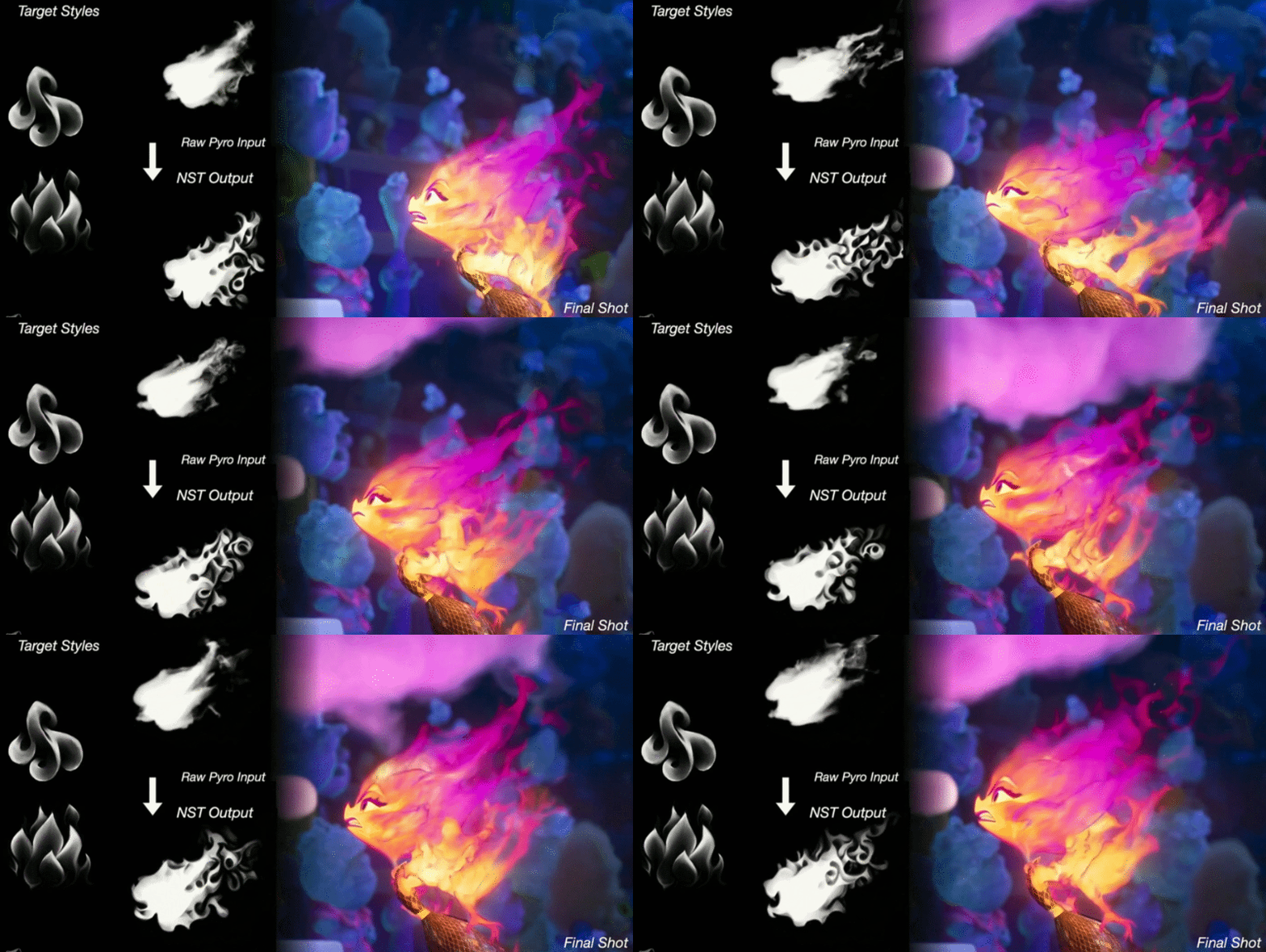
Simplified example of NST in action adding style to Ember’s flames.

Of course the animators are sensitive to the idea that they just generated the film using AI, which is not the case.

“If anyone ever tells you that Pixar used AI to make Elemental, that’s wrong,” said Pixar’s Paul Kanyuk pointedly during the presentation. “We used volumetric NST to shape her silhouette edges.”

(To be clear, NST is an machine learning technique we would identify as falling under the AI umbrella, but the point Kanyuk was making is that it was used as a tool to achieve an artistic outcome — nothing was simply “made with AI.”)

Later, other members of the animation and design teams explained how they used procedural, generative, or style transfer tools to do things like recolor a landscape to fit an artist’s palette or mood board, or fill in city blocks with unique buildings mutated from “hero” hand-drawn ones. The clear theme was that AI and AI-adjacent tools were there to serve the purposes of the artists, speeding up tedious manual processes and providing a better match with the desired look.

AI accelerating dialogue
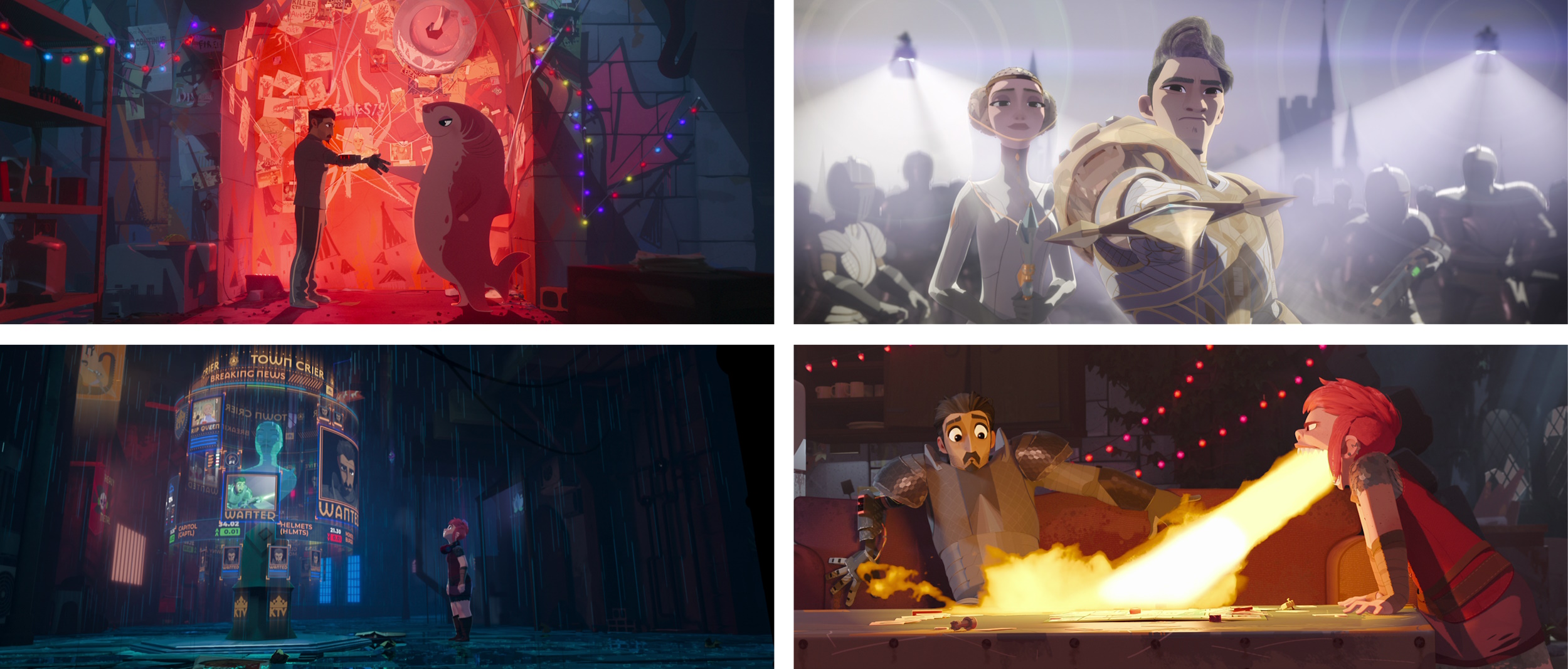
Images from Nimona, which DNEG animated.

I heard a similar note from Martine Bertrand, Senior AI Researcher at DNEG, the VFX and post-production outfit that most recently animated the excellent and visually stunning Nimona. He explained that many existing effects and production pipelines are incredibly labor-intensive, in particular look development and environment design. (DNEG also did a presentation, “Where Proceduralism Meets Performance” that touches on these topics.)

“People don’t realize that there’s an enormous amount of time wasted in the creation process,” Bertrand told me. Working with a director to find the right look for a shot can take weeks per attempt, during which infrequent or bad communication often leads to those weeks of work being scrapped. It’s incredibly frustrating, he continued, and AI is a great way to accelerate this and other processes that are nowhere near final products, but simply exploratory and general.

Artists using AI to multiply their efforts “enables dialogue between creators and directors,” he said. Alien jungle, sure — but like this? Or like this? A mysterious cave, like this? Or like this? For a creator-led, visually complex story like Nimona, getting fast feedback is especially important. Wasting a week rendering a look that the director rejects a week later is a serious production delay.

In fact new levels of collaboration and interactivity are being achieved in early creative work like pre-visualization, as one talk by Sokrispy CEO Sam Wickert explained. His company was tasked with doing previs for the outbreak scene at the very start of HBO’s The Last of Us — a complex “oner” in a car with countless extras, camera movements, and effects.

While the use of AI was limited in that more grounded scene, it’s easy to see how improved voice synthesis, procedural environment generation, and other tools could and did contribute to this increasingly tech-forward process.
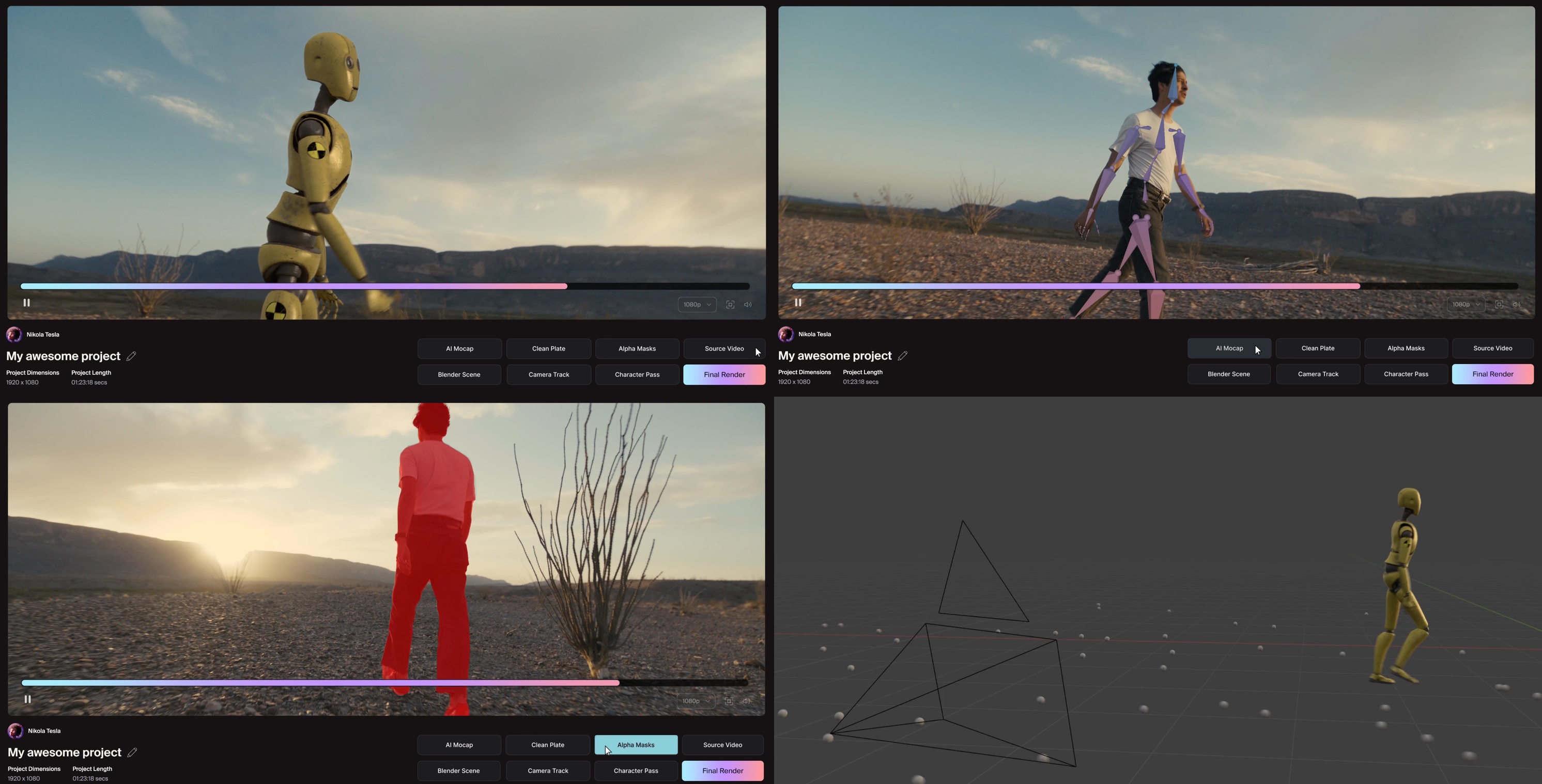
Final shot, mocap data, mask, and 3D environment generated by Wonder Studio.

Wonder Dynamics, which was cited in several keynotes and presentations, offers another example of use of machine learning processes in production — entirely under the artists’ control. Advanced scene and object recognition models parse normal footage and instantly replace human actors with 3D models, a process that once took weeks or months.

But as they told me a few months ago, the tasks they automate are not the creative ones — it’s grueling rote (sometimes roto) labor that involves almost no creative decisions. “This doesn’t disrupt what they’re doing; it automates 80-90% of the objective VFX work and leaves them with the subjective work,” co-founder Nikola Todorovic said then. I caught up with him and his co-founder, actor Tye Sheridan at SIGGRAPH, and they were enjoying being the toast of the town: it was clear that the industry was moving in the direction they had started off in years ago. (Incidentally, come see Sheridan on the AI stage at TechCrunch Disrupt in September.)

That said, the warnings of writers and actors striking are in no way being dismissed by the VFX community. They echo them, in fact, and their concerns are similar — if not quite as existential. For an actor, one’s likeness or performance (or for a writer, one’s imagination and voice) is one’s livelihood, and the threat of it being appropriated and automated entirely is a terrifying one.

For artists elsewhere in the production process, the threat of automation is also real, and also more of a people problem than a technology one. Many people I spoke to agreed that bad decisions by uninformed leaders are the real problem.

“AI looks so smart that you may defer your decision-making process to the machine,” said Bertrand. “And when humans defer their responsibilities to machines, that’s where it gets scary.”

If AI can be harnessed to enhance or streamline the creative process, such as by reducing time spent on repetitive tasks or enabling creators with smaller teams or budgets to match their better-resourced peers, it could be transformative. But if the creative process is seconded to AI, a path some executives seem keen to explore, then despite the technology already pervading Hollywood, the strikes will just be getting started.


from https://ift.tt/81yZG7s
via Technews

Share:

WhatsApp rolls out support for HD video

Last week, WhatsApp announced it was adding support for HD photos, allowing the messaging app users the option to preserve the high-def resolution of the phones they wanted to share with friends and family. At the time, the company said support for HD videos was coming soon. Today, the company confirmed with TechCrunch that HD video support is now rolling out to both iOS and Android users.

Similar to the HD photos feature, the HD videos feature gives customers the choice to share high-def videos across WhatsApp. Previously, high-def videos would have been compressed to 480p, as per the app’s prior resolution limit. Now, users can opt to send their video in HD 00 but only up to 720p.

The process here is the same as for sharing HD photos.

After selecting the video or videos you want to share, you’ll tap the new HD button on the top of the screen. A dialog box will appear where you can confirm if you want to share in Standard Quality or HD Quality and will show the associated file sizes. You then press send to share the video as usual.

Images and videos shared on WhatsApp are protected with the company’s end-to-end encryption.

The recipient will see a small HD badge on the video shared in the app that lets them know you’ve shared in HD. This lets them decide if they have the storage space or bandwidth available to view the video you’ve shared in HD quality at the time.


from https://ift.tt/Tf6Gb8K
via Technews
Share:

The 6 most important things to know about SaaS+ product architecture

Whether you want to build a SaaS+ company from scratch or turn an existing company into a business that can monetize embedded products and services, these are the six key concepts you need to know.

These concepts have technical implications but are as much business logic decisions as architectural ones. A founding team should have a shared perspective on these six issues. Being aligned on these concepts will drive product roadmap, core technical architecture, pricing strategy and product marketing.

You can 10x the revenue of your SaaS company by putting the right building blocks in place from the start. If you build the foundation of your SaaS+ house correctly, you can remodel the interior fairly easily in the coming years.

1. Everything revolves around the transaction

Shopping cart functionality and flexibility at the transaction level are two of the critical technical elements in SaaS+ because a high percentage of revenue typically revolves around the flow of funds on the platform. There are a couple things to think about when building transaction technology:

  • Multimerchant cart: Building a shopping cart can get complicated when you’re taking into account more than one merchant in a single transaction, but architecting the cart to handle this from day one will pay dividends when you look to sell multiple SaaS+ products at the time of checkout. Specifically, this technology allows the user to see a single transaction, while behind the scenes there are actually multiple transactions occurring simultaneously, with each vendor individually. This is especially critical if you hope to sell regulated products such as embedded insurance.
  • Split transaction/payout tech: An alternative to the multimerchant cart is the split transaction and split payout technology. This capability allows a truly single transaction at checkout, but then carries the burden of instantly associating net amounts due with each interested party and then settling with them by dynamically distributing the correct funds to recipients following the transaction. This is often initially viewed as the more elegant solution, but it doesn’t work for regulated products like insurance where the original transaction has to be with the actual insurance company. Realistically, you need to build both a multi-merchant cart and split transaction capability from day one.

For the end user, it all boils down to the checkout experience. Whether a given transaction is leveraging multimerchant cart technology or split transaction tools, the choice should be invisible to the end user while also accommodating a myriad of different SaaS+ products sold at checkout.

Being aligned on these concepts will drive product roadmap, core technical architecture, pricing strategy and product marketing.

Example: At SportsEngine, we built a commerce system where customers use one shopping cart to check out, but each item is actually being bought separately. The customer enters their payment information only once, after which the platform initiates multiple transactions on their card behind the scenes. So, for example, they can register for Minnesota Hockey and USA Hockey in one step, while also buying insurance and their uniform in the same transaction. One cart, one checkout . . . four independent vendors.

Etsy also allows customers to buy from multiple merchants in a single transaction. The marketplace then splits the payment between the different vendors and themselves. DoorDash’s single vendor shopping cart allows you to add multiple dishes from a single restaurant, but to order from two different restaurants, you need to make separate orders.

2. Single instance of a human

Don’t silo your data. You want to create one profile per person and use it everywhere on your platform. This means: one profile, one payment method, one background screen and one rating system for each human. Build your data model so each person’s profile and information is available across the entire platform. This is the power of the platform.


from https://ift.tt/pqm3haO
via Technews
Share:

Tesla investors might get payout from SEC settlement

Tesla shareholders who claimed to face financial losses after CEO Elon Musk tweeted about taking the company private might be on the verge of receiving compensation from a $42.3 million fund established as part of Musk’s federal securities fraud settlement.

The United States Securities and Exchange Commission said 3,350 eligible claimants will share in the payout, recouping almost 52% of their losses, according to a Wednesday night court filing in the Southern District of New York Court.

The compensation to investors comes several months after Musk was found not liable in a class-action securities fraud trial that explored how the CEO’s now infamous “funding secured” tweet caused volatility in the stock, resulting in losses of money. If Musk had lost the trial, he’d have paid out billions of dollars in damages to investors.

The fund comes from a 2018 settlement with the SEC over the tweet. After the SEC filed a complaint alleging Musk lied when he tweeted he had secured funding for a private takeover of the company at $420 per share, Musk agreed to step down as chairman of Tesla and pay a $20 million fine. Tesla agreed to pay a separate $20 million penalty. The total amount grew to $42.3 million with interest payments.

U.S. District Judge Lewis Liman in Manhattan said Thursday he hopes to approve the payouts by September 1 or shortly afterward.

The SEC settlement also included a stipulation that Musk agree to let a Tesla lawyer approve some of his Twitter posts. Musk has sought to scrap that decree, calling it a “muzzle” on his right to free speech. In May, Judge Liman, who oversees the case, denied the motion to end the decree.

Musk is expected to appeal that decision to the U.S. Supreme Court.


from https://ift.tt/J1ZX0rf
via Technews
Share:

OnlyFans’ profitability proves the creator economy boom was real enough

Like many sectors, creator-focused startups had an easy time of attracting funding in 2020 and 2021. But venture capital investment into this category slowed down significantly starting in the second half of 2022: going from 42 rounds worth $336 million in Q2 2022, to only 19 rounds worth $110.2 million in Q3 2022.

At the time, Nate O’Brien of Roadrunner VC said it best: “The creator bubble is popping.”


The Exchange explores startups, markets and money.

Read it every morning on TechCrunch+ or get The Exchange newsletter every Saturday.


As is often the case with hyped sectors, they end up deflating when the market isn’t favorable. And it gets worse if you’re in a category that depends on the fickle advertising market, which is strongly exposed to macroeconomic fluctuations. But more importantly, the rise of the creator economy was largely driven by factors that proved to be quite temporary.

“The growth in the creator space was fueled in two parts: by COVID and [by] the boom in e-commerce (the primary advertiser in the creator economy). People have largely returned to their ordinary lives, and e-commerce has reverted to its usual pace, so the slower growth of the creator space is not surprising,” Coventure partner Brian Harwitt told TechCrunch+ in a recent investor survey.

Sure, it isn’t surprising, but it still means that new startups hoping to solve problems for creators and help them generate revenue are today often struggling to raise money, and probably expand as well.

Venture rounds and younger startups form only part of the picture, though. There are many outliers to be found if you simply examine the set of companies that raised plenty of cash before the ad market started to cool down, and chief among them is OnlyFans. It’s actually one of the best companies in the space right now, period.

OnlyProfit

It’s often difficult to get a good picture of the state of some businesses, especially late-stage startups and large private tech companies, as we usually only have incomplete or delayed data to study. With OnlyFans, we have strong and complete information; it’s simply dated. Thanks to data from its British parent Fenix International, we have OnlyFans’ results for its fiscal year ended November 30, 2022, which is basically all of calendar 2022. Huzzah!


from https://ift.tt/8NDdqKt
via Technews
Share:

Advanced Ionics nets $12.5M Series A to inject green hydrogen into heavy industry

When people talk about hydrogen these days, they almost always mention transportation. I get it: people are used to filling up tanks, not charging cars. But from a practical perspective, transportation is not a great use for hydrogen.

“Hydrogen is really terrible to store and to transport,” said Chad Mason, founder and CEO of Advanced Ionics.

Which is why Advanced Ionics is a hydrogen company that has nothing to do with transportation. Instead, the startup is focused on heavy industry, which represents about a third of global emissions.

“Hydrogen is one of the main feedstocks for a vast majority of industrial processes,” Mason told TechCrunch+. It’s essential for the ammonia used to make fertilizers and for many petrochemical processes used to make everything from plastics to synthetic rubber and lubricants. Even steel and glass production could benefit from a decarbonized source of hydrogen.

Amid the crowd of hydrogen companies hoping to elbow their way into these markets, Advanced Ionics hopes its more efficient approach to using electrolysis will give it an unfair advantage in producing hydrogen.

Today, much of the world’s hydrogen supply comes from what’s called steam-reformed methane. Basically, steam is mixed with methane gas, producing hydrogen and carbon dioxide. Electrolyzers, on the other hand, use electricity to split water into hydrogen and oxygen. If they’re powered by renewable energy, then the process can be carbon-free.

But they’re not perfect.

Most efforts to produce hydrogen work at either relatively low temperatures or high temperatures. Advanced Ionics’ electrolyzers, though, work at temperatures that are not too high or low, basically the same range at which many industrial processes already take place. That means the heat requirements for the startup’s equipment are the same as what’s already available at those sites.


from https://ift.tt/cH1T5gq
via Technews
Share:

Friend.tech hype grows, Tornado Cash founders go for a spin and FBI’s monitoring North Korean hackers

Welcome back to Chain Reaction.

To get a roundup of TechCrunch’s biggest and most important crypto stories delivered to your inbox every Thursday at 12 p.m. PT, subscribe here. Follow me on Twitter @Jacqmelinek for breaking crypto news, memes and more.

If you haven’t heard about friend.tech this week, you’re probably living under a rock. But that’s ok, we dove deep into the hype and looked at what skeptics are worried about for the new application.

There was also a lot of talk around Tornado Cash as the two founders behind the crypto mixer were charged on Wednesday by U.S. federal agencies. Details on that and more below.

This week in web3

  1. Two founders behind crypto mixer Tornado Cash charged by U.S. federal courts
  2. FBI says North Korean hackers preparing to cash out after high-profile crypto hacks
  3. Friend.tech hype is skyrocketing, but will it actually reach the stars?
  4. Solana Pay integrates plug-in with Shopify for USDC payments
  5. Checkout.com cuts ties with Binance, which is mulling legal action in response

The latest pod

For this week’s episode, Jacquelyn interviewed Erik Svenson, co-founder, president and chief financial officer at Blockstream, a bitcoin and blockchain-focused infrastructure firm.

The company was founded in 2014 and has its own sidechain technology, Liquid Network, as well as bitcoin mining operations and hardware wallets for Bitcoin and other assets. It most recently raised $125 million in January and has raised more than $400 million to date.

Erik previously worked on Wall Street as a VP for AIG investments and was a co-founder and consultant of other startups. The last startup he co-founded before Blockstream was Dan’s Plan, a health tech company.

We discussed how the current macroenvironment is impacting Bitcoin-focused businesses and where Erik sees the most opportunities for startups today.

We also talked about:

  • Blockstream’s mining operations
  • Surviving a bear market
  • Transitioning from TradFi to crypto
  • Advice for startups

Subscribe to Chain Reaction on Apple Podcasts, Spotify or your favorite pod platform to keep up with the latest episodes, and please leave us a review if you like what you hear!

Follow the money

  1. Crypto lender Maple Finance raises $5 million to enter Asia amid regulatory clarity
  2. Vessel Capital emerges from stealth with $55 million fund focused on web3 infrastructure and apps
  3. Berlin-based Anytype raises $13.4 million for its open sourced tool
  4. Nodal Power raises $13 million to use landfill to power bitcoin mining centers
  5. Decentralized credit protocol PADO Labs raises $3 million in a seed round

This list was compiled with information from Messari as well as TechCrunch’s own reporting.

What else we’re writing

Want to branch out from the world of web3? Here are some articles on TechCrunch that caught our attention this week.

  1. Nvidia’s Q2 earnings prove it’s the big winner in the generative AI boom
  2. 5 trends in VC funding for pre-seed startups (TC+)
  3. Chronic technical debt could be holding your company back (TC+)
  4. The late-stage venture market is crumbling (TC+)
  5. Introducing the Startup Battlefield 200 companies at TechCrunch Disrupt 2023

from https://ift.tt/bOCvfk9
via Technews
Share:

Popular Post

Search This Blog

Powered by Blogger.

Labels

Labels

Most view post

Facebook Page

Recent Posts

Blog Archive